

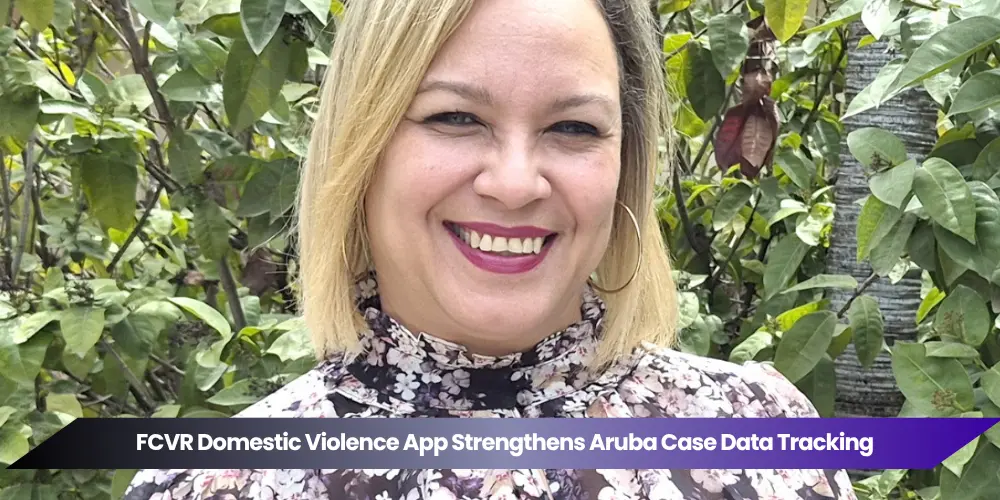
ORANJESTAD, Aruba — The FCVR Domestic Violence App is giving Fundacion Contra Violencia Relacional a new tool to record, analyse and better understand cases of domestic and gender-based violence in Aruba.
FCVR acquired the case-management application with financial support received from Aruba Bank as part of the foundation’s continuing professionalisation.
Director Esther Broeksema said the new system will allow FCVR to organise information more systematically and identify developments that may help guide prevention, education and support services.

New System Improves Case Registration
Through the application, FCVR can register and measure different aspects of the situations handled by the organisation.
The collected information can be processed into monthly and quarterly reports, while annual data can provide a broader picture of patterns developing over time.
This allows the organisation to move beyond individual case files and examine recurring issues across the people seeking assistance.
Better organised information may also help FCVR determine where additional education, prevention programmes or specialised services are needed.
FCVR Concerned About Current Violence Trends
Broeksema said the information being observed by FCVR remains concerning.
According to the director, the organisation is not seeing indications that domestic and gender-based violence cases are declining. Instead, its current observations suggest that the problem may be increasing.
The announcement did not provide comparative annual figures, so the trend remains based on FCVR’s experience with the cases reaching its services.
The new case-management system should eventually make it easier for the foundation to compare periods and produce more consistent reports on developments.
Violence Affects Different Parts of Society
FCVR also emphasised that domestic and gender-based violence is not limited to one age group, social position or personal background.
Cases can involve people from different sections of the community.
Broeksema said FCVR is also observing situations involving young people, reinforcing the organisation’s belief that prevention must begin before unhealthy relationship patterns become established.
That makes education about respect, boundaries, communication and healthy relationships an important part of the foundation’s work.
Prevention Remains a Major Priority
FCVR continues to place significant emphasis on educating the community.
Broeksema said the organisation does not want to focus only on responding after violence occurs. It also wants residents to understand what healthy relationships should look like and recognise warning signs before situations become more serious.
Education can address subjects including mutual respect, personal boundaries, controlling behaviour, intimidation, communication and ways to seek assistance.
The foundation also works with partners outside the traditional social-services sector.
Broeksema said prevention requires cooperation with public institutions and other organisations that regularly interact with residents.
Better Data Can Support Better Decisions
Reliable case information can help organisations understand whether particular problems are appearing more frequently, which groups are seeking assistance and where additional resources may be required.
Monthly and quarterly analysis can also make it easier to notice changes sooner instead of waiting until the end of the year.
Over time, consistent data may support discussions involving prevention programmes, professional training and public policy.
The application does not itself reduce domestic violence. Its value will depend on how accurately information is entered, how trends are interpreted and how the resulting knowledge is translated into practical action.
Aruba Bank Support Helps Digital Modernisation
FCVR received financial support from Aruba Bank at the end of 2025 during the bank’s 100th anniversary activities.
Part of that contribution was directed toward strengthening FCVR’s professional and digital infrastructure, including the case-management system.
The investment is intended to improve the organisation’s ability to serve people experiencing violence while strengthening its capacity to document the wider problem.
Education About Healthy Relationships Continues
Broeksema said FCVR will continue its community education because prevention remains essential.
The organisation wants young people and adults to understand that violence should not be accepted as a normal part of a relationship.
With the FCVR Domestic Violence App, the foundation now has an additional tool for identifying patterns and producing information that can support that preventive work.
The long-term objective is not simply to collect more data, but to use better information to strengthen intervention, education and cooperation aimed at reducing domestic and gender-based violence throughout Aruba.