
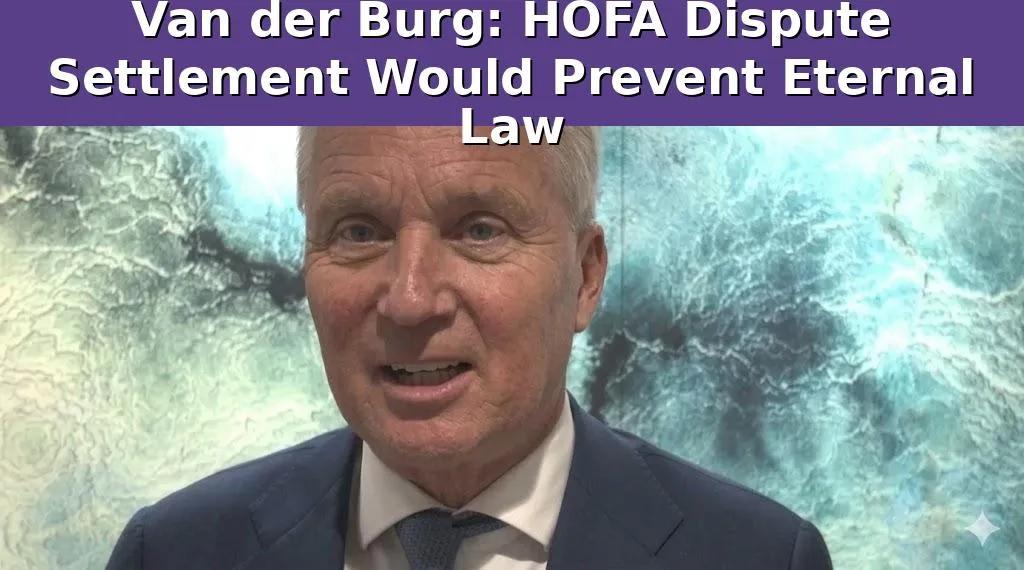
Concern about the future of the HOFA law continues to grow in Aruba, where many fear that the Kingdom law, even though it has a defined duration, in practice will never end. During the Noticiacla LIVE program this week, Noticiacla journalist Tito Laclé put the question directly to Dutch State Secretary Eric van der Burg.
Interpretation of the Netherlands vs Aruba
The main concern is the difference in interpretation between the Netherlands and Aruba on the financial result, meaning the end of the law may never be reached. While the Netherlands may consider that the financial situation is still not sufficiently good at final account, Aruba may have a different opinion. This feeds the fear that the Netherlands will have the final say in determining whether Aruba is ready, maintaining HOFA active indefinitely without a defined end.
Van der Burg Recognizes Concerns
Van der Burg acknowledged the concern and indicated that the solution lies in creating a formal system to resolve conflicts. “To avoid this type of situation, it is important to have a geschillenregeling,” he declared. According to the Secretary of State, this mechanism is already contemplated in the statute, and currently has a proposal presented by the Aruba government to the Raad van State.

“This type of rule will apply to all countries in the Kingdom and will provide an independent mechanism to treat (any) difference of opinion,” Van der Burg explained. “This creates a guarantee that this type of conflict will not arise again,” he continued, emphasizing that the establishment of a conflict resolution system is a key step for the future.
Last Word: Netherlands or Aruba?
When pressed on who has the final word in the event of a disagreement on an agreement, he admitted that this is still not clearly defined. “The system is not yet in effect. We are working on it a lot, since 10-10-10,” he said, recognizing that the process has taken too long. According to Van der Burg, establishing a conflict resolution system is a key step for the future. “This is something that will have my attention in the coming years,” he concluded, emphasizing the need for more clarity and balance in the relationship between countries in the Kingdom.
Uncertainty Without Independent Mechanism
The declaration by Van der Burg does not eliminate all doubts, but confirms that without an independent mechanism, the discussion about HOFA and its eventual conclusion will continue to generate uncertainty in Aruba. The absence of a formal dispute resolution process leaves both sides vulnerable to prolonged disagreements, as neither has a clear path to resolve fundamental differences in interpretation.
The HOFA law has been a point of contention between Aruba and the Netherlands for years, with Aruba arguing that the Kingdom legislation undermines the autonomy promised under Aruba’s Status Aparte. The Dutch government maintains that financial supervision is necessary for economic stability, while Aruba contends that it violates the principle of self-determination and creates permanent dependency.
Path Forward: Formal Dispute Resolution
Van der Burg’s statements indicate awareness of the need for structured processes to handle disagreements within the Kingdom. The geschillenregeling, or dispute settlement mechanism, would provide both parties with an established process for addressing differences of opinion on financial matters and the interpretation of Kingdom laws. This could potentially reduce the political tension surrounding HOFA by creating predictable rules for how disputes are resolved.
The ongoing uncertainty about HOFA’s future reflects broader questions about the relationship between Aruba and the Netherlands within the Kingdom structure. As the financial situation of Aruba continues to evolve with debt reduction and economic growth, the arguments for maintaining HOFA weaken, while political concerns about autonomy and sovereignty remain strong.