

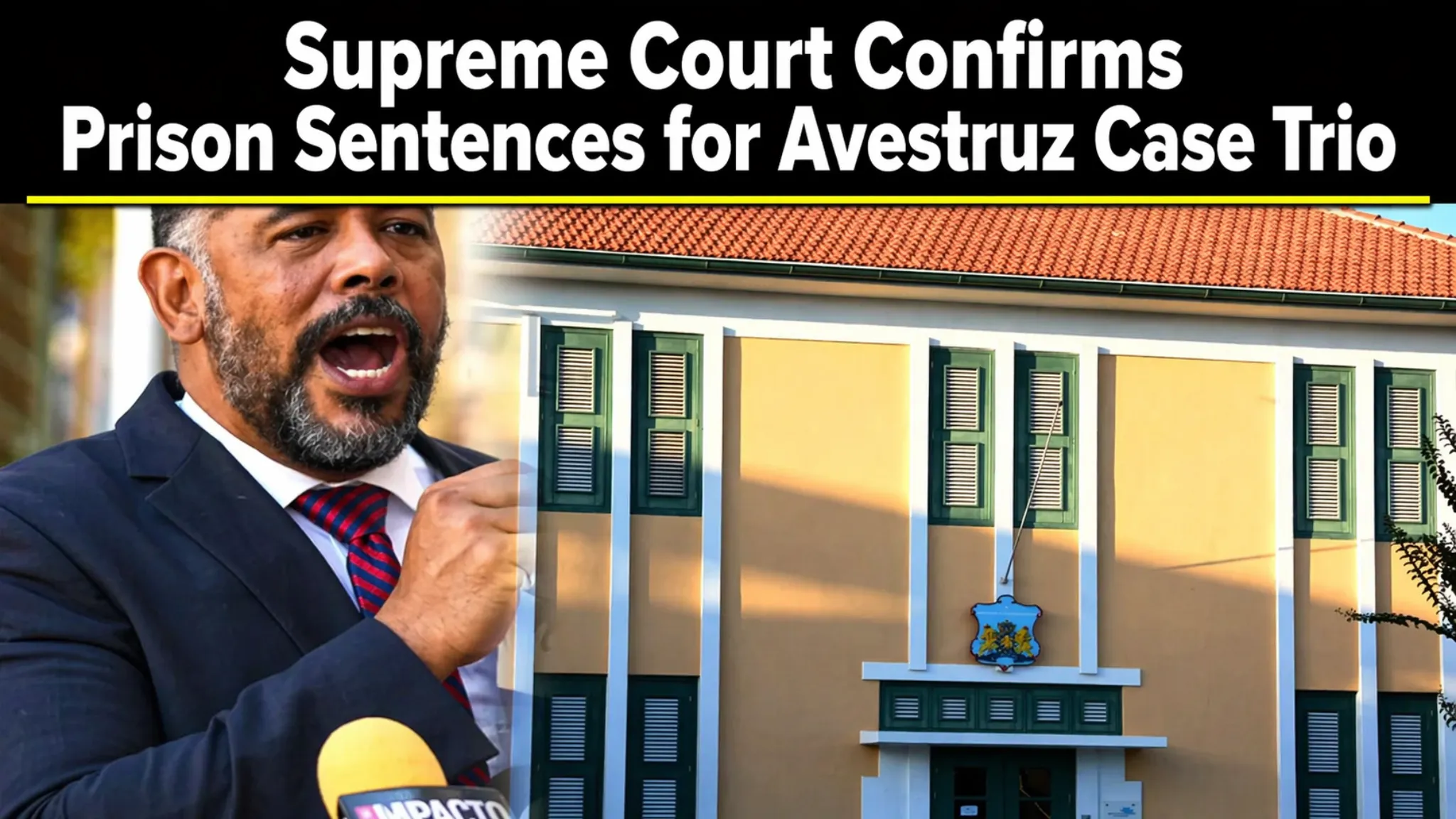
The Supreme Court of the Netherlands has confirmed prison sentences for three defendants in the high-profile Avestruz corruption case, marking a final chapter in one of Aruba’s most significant political corruption trials.
The Netherlands’ highest court (Hoge Raad) rejected appeals from former Minister Benny Sevinger, Maria Leoncita Arends, and Pieter Susebeek on Tuesday, April 14, 2026. The decision upholds sentences originally issued by the Superior Court, ending a years-long legal battle.
Benny Sevinger Sentenced to Four Years
Former Minister Benny Sevinger has been sentenced to four years in prison, with one year conditional. The court also barred him from holding any government position or running for representative office for six years following his release.

The Supreme Court found Sevinger guilty of complicity in defrauding the government, accepting bribes, and malversation of public funds.
Leoncita Arends Receives Two-Year Sentence
Maria Leoncita Arends had her appeal rejected and will serve two years in prison, with one year conditional. The court imposed a three-year probation period as part of her sentence.
Pieter Susebeek Sentenced to 30 Months
Pieter Susebeek’s appeal was also denied. He received a 30-month prison sentence, with 10 months conditional, plus a two-year probation period. Additionally, the court ordered the confiscation of $1.3 million.
Court Details Fraud Scheme
The Supreme Court outlined the fraudulent operation, which involved shell companies linked to co-conspirators with close ties to Sevinger and his political party, AVP.
The scheme involved submitting land lease (erfpacht) applications to the Minister through these companies. The companies existed only on paper and had no real assets. The conspirators’ goal was to sell the land parcels at substantial profits after approval.
Sevinger’s role was to swiftly approve these requests, bypassing standard administrative evaluation procedures. This gave preferential treatment to his associates’ applications.
During the period when decisions on these applications were made, Sevinger accepted gifts from his co-conspirators. This constituted bribery. The court found he also misused funds from a foundation operating his election campaign to cover personal travel expenses—a clear case of malversation.
Political Reaction in Aruba
The verdict generated significant reaction across Aruba on Wednesday. Observers noted that justice has now definitively convicted another AVP minister for corruption.
Opposition figures pointed out that Sevinger’s daughter currently serves in Parliament, continuing what critics call the “Sevinger legacy.” The nature of this legacy has become a subject of public debate.
On Wednesday morning, no AVP parliamentarians were present at work. Many interpreted this absence as panic within the AVP party following the Supreme Court’s decision.
The Avestruz case represents one of the most significant corruption trials in Aruba’s recent history, involving high-ranking government officials and complex financial crimes.