
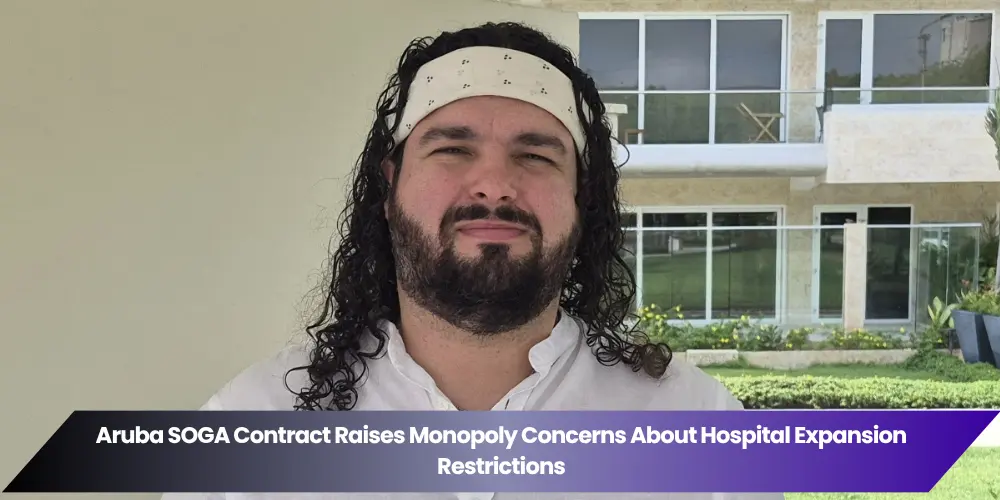
The Aruba SOGA contract has raised concerns from Fundacion SIKI President Jayburtt Dijkhoff, PhD, who claims the 2013 agreement may restrict competition and limit the expansion of healthcare services on the island.
During an interview with Matutino DIARIO, Dijkhoff discussed the agreement between the Government of Aruba and Stichting Onroerend Goed Aruba, commonly known as SOGA.
According to Dijkhoff’s interpretation, the contract states that the hospital cannot expand, introduce additional services or establish another hospital in Aruba without prior approval from SOGA, except in certain agreements involving the United States.

He argued that these provisions may have created a structure resembling a monopoly.
Dijkhoff also questioned whether members of the Parliament of Aruba are fully aware of the terms and possible consequences of the agreement signed on February 15, 2013.
“These conditions appear to have been designed in a way that practically creates a monopoly,” Dijkhoff said, describing his interpretation of the contract.
He stressed that his concerns should prompt Parliament to examine the agreement and determine whether it protects the interests of patients and the wider Aruban community.
Dijkhoff also questioned whether the agreement could be connected to discussions surrounding a possible merger involving Dr. Horacio E. Oduber Hospital and ImSan.
According to his analysis, a merger could potentially allow the hospital organization to acquire additional properties, including facilities in San Nicolas, and expand services currently provided by ImSan.
However, Dijkhoff warned that such a restructuring could potentially conflict with provisions contained in the Aruba SOGA contract.
He claimed that if the health minister or the Government of Aruba approved a reorganization combining ImSan and the hospital into one entity, SOGA could argue that the agreement had been breached.
Dijkhoff acknowledged that the contract may not contain a clearly defined penalty for such a breach. Nevertheless, he said the legal and financial implications should be carefully reviewed before any restructuring moves forward.
He also questioned whether patients, healthcare professionals and other stakeholders were adequately consulted when the agreement was developed.
According to Dijkhoff, Aruba does not have a fully open healthcare market, making transparency and public oversight especially important.
He alleged that significant public funding is being invested in renovations at Dr. Horacio E. Oduber Hospital while competition in the healthcare sector remains limited.
Dijkhoff further claimed that SOGA receives nearly three million Aruban florins each month, amounting to more than 40 million florins annually.
He said these payments are secured through a national decree, while the hospital and ImSan receive lump-sum funding from AZV that may not be directly linked to the number of patients treated.
These statements represent Dijkhoff’s interpretation and criticism of the agreement. The report does not include a response from SOGA, the Government of Aruba, the hospital, ImSan or Parliament.
Dijkhoff called on Parliament to review the Aruba SOGA contract, clarify its restrictions and determine whether the agreement supports fair competition, sustainable healthcare investment and the best interests of Aruba’s patients.