


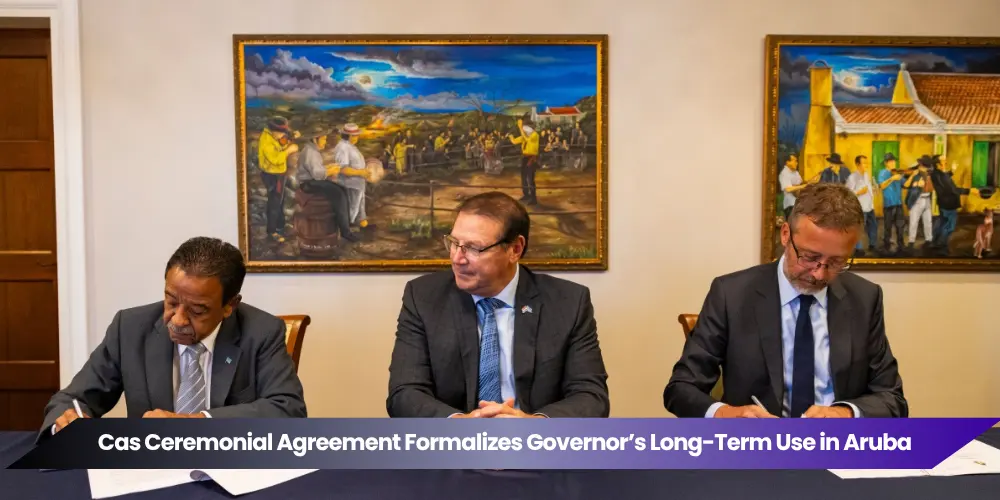
ORANJESTAD, Aruba — A new Cas Ceremonial Agreement has formalized the long-term legal arrangement governing the official reception property used by the Governor of Aruba at Maria Christinastraat 2.
Land Aruba signed an erfpacht agreement on Wednesday, August 19, 2026, involving the Cabinet of the Governor of Aruba.
Governor Alfonso Boekhoudt was present for the signing.

Minister René Herdé, who is responsible for the Ministry of Housing, Infrastructure, Internal Services and Telecommunications, signed on behalf of Land Aruba, while Cabinet Director Laurens Warnink signed on behalf of the Governor’s Cabinet.
Agreement Strengthens Legal Basis for Property Use
The arrangement is intended to allow Cas Ceremonial to be managed and used in a more efficient and sustainable way for the Governor’s official responsibilities.
The building has long been used for audiences, receptions, swearing-in ceremonies and other formal events involving the Governor.
Before the latest agreement, the property operated under a historical arrangement dating from shortly after Aruba obtained Status Aparte.
A government land notice published in July explained that the property had originally been provided free of charge for the Governor’s use through a 1986 notarial agreement. Authorities later decided that this historical arrangement should be converted into a more durable property right through erfpacht.
Land Aruba Previously Owned Property
DIP records show that the plots and building at Maria Christinastraat 2 were owned by Land Aruba before the new agreement.
The residence was constructed in 1985–1986 using funds from the Netherlands on land belonging to Aruba. Under property-law principles, the building subsequently became property of Land Aruba.
The July notice identified four government-owned parcels involved in the intended erfpacht arrangement and described the State of the Netherlands as the sole serious candidate because the property has historically and specifically served the Governor of Aruba.
The latest announcement states that the Governor’s Cabinet will become owner of the Cas Ceremonial building under the new arrangement.
This does not mean the underlying government land was simply sold outright. The land is being made available through an erfpacht structure.
Property Has Important Constitutional Function
Cas Ceremonial plays a distinctive role in Aruba’s constitutional and governmental system.
DIP described the property as having a special constitutional, representative and administrative function connected to the Governor.
It also forms part of Aruba’s wider governmental centre together with the Parliament building and nearby official facilities.
The building is used when the Governor receives dignitaries, conducts formal audiences and carries out ceremonial responsibilities.
Recent ceremonies held there have included the swearing-in of judges and meetings with visiting officials.
Building Dates Back to Aruba’s Status Aparte
Construction of the original official Governor’s residence began in 1985.
When Aruba became a separate country within the Kingdom of the Netherlands on January 1, 1986, the island also received its own Governor.
Aruba’s first two governors, Felipe Tromp and Olindo Koolman, lived in the official residence during their terms.
Later, Governor Fredis Refunjol did not use it as a residence while renovations were pending.
A major reconstruction and renovation was completed in 2015, after which the building was repurposed as Cas Ceremonial di Gobernador rather than primarily serving as a residential property.
Official Receptions Now Central to Its Use
Today, Cas Ceremonial functions mainly as an official reception house.
It hosts audiences, naturalization ceremonies, government-related meetings and receptions involving senior officials and visiting dignitaries.
The property also contains works of art, including pieces loaned by cultural institutions in the Netherlands and works by local artists.
Its long association with Aruba’s governors has also given the property historical and cultural significance beyond its administrative use.
Earlier Public Notice Prepared Legal Transfer
Before the August signing, Aruba’s Department of Infrastructure and Planning published a formal Didam notice concerning Maria Christinastraat 2 in July.
The notice stated that authorities intended to establish the erfpacht right and that the arrangement would formalize the historical relationship surrounding the Governor’s use of the property.
It also noted that the property had been professionally valued and that the transaction required proper legal and accounting treatment of the building’s value and documented maintenance, restoration and investment expenses.
The government then allowed a statutory period for any party claiming to qualify as another serious candidate to challenge the proposed arrangement.
New Arrangement Supports Long-Term Management
The Cas Ceremonial Agreement gives the Governor’s institution a clearer long-term legal basis for managing a property already used for official purposes for decades.
The government says the arrangement will make it possible to use and maintain Cas Ceremonial more efficiently and sustainably in the future.
The signing therefore represents less a change in the building’s everyday ceremonial function and more a formalization of the legal relationship surrounding one of Aruba’s important official government properties.