

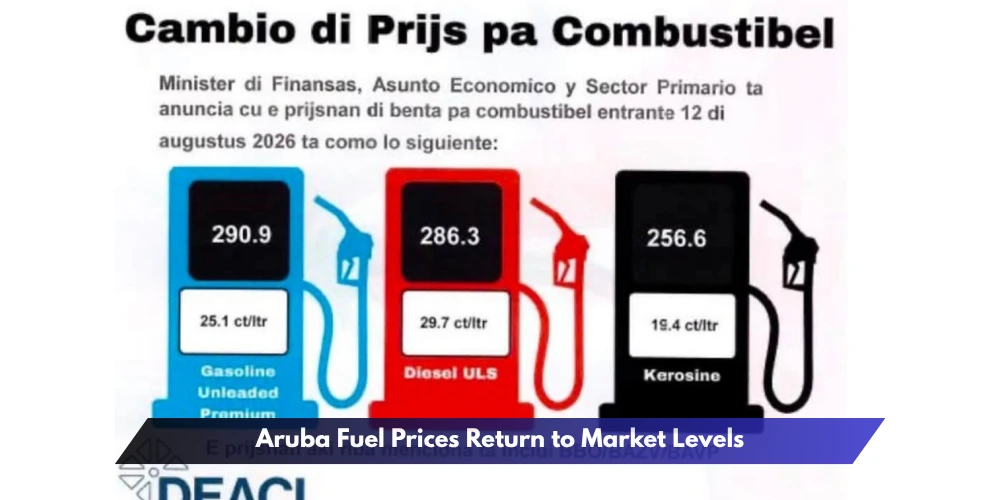
ORANJESTAD, Aruba – Aruba Fuel Prices Return to Market Levels beginning August 12, 2026, after the government partially absorbed international increases in gasoline and diesel costs for four months. The Ministry of Finance, Economic Affairs and Primary Sector announced new pump prices while confirming that an earlier reduction of 10 cents per liter will remain in effect.
Under the new rates, gasoline will cost Afl. 2.909 per liter, representing an increase of 25.1 cents per liter, or 9.5%. Diesel will rise to Afl. 2.863 per liter, an increase of 29.7 cents per liter, or 11.6%.
According to the ministry, both prices continue to include the 10-cent-per-liter reduction that has been in effect since May 1, 2025.

Minister Geoffrey Wever said continued instability and uncertainty in international petroleum markets remain important factors behind local fuel pricing. The government statement points particularly to geopolitical tensions involving the United States and Iran and renewed disruption around the Strait of Hormuz as developments that Aruba cannot directly influence.
The ministry said the international average “postings” used by the Department of Economic Affairs in its fuel-price calculations increased significantly. For gasoline, the reference price reportedly rose from 148 cents to 158 cents per liter, while the diesel reference increased from 162 cents to 185 cents per liter.
Aruba Fuel Prices Return to Market Levels after a temporary four-month intervention by the AVP-FUTURO government. From April 8 through August 11, the government made approximately Afl. 10 million available to partially absorb increases in gasoline and diesel prices and prevent the full impact of international market movements from reaching consumers immediately.
The government said the temporary measure was intended to protect purchasing power during a period of sharp international price increases. Although the special four-month mitigation period has ended, the earlier 10-cent reduction per liter will remain in place.
The government also highlighted a number of broader financial-support measures intended to assist households facing higher living costs. These include Afl. 4.5 million earmarked for a proposed compensation allowance for workers earning between the minimum wage and the calculated subsistence level, with the legal framework still under preparation.
Basic social assistance is also being increased by Afl. 150 per month, from Afl. 450 to Afl. 600. According to the government, the monthly school allowance will increase by Afl. 300, reaching Afl. 1,100 for eligible families with children between the ages of 3 and 24 who are enrolled in full-time education.
The contribution toward school fees is set to rise from Afl. 120 to Afl. 250 per child, while support for purchasing school supplies will increase from Afl. 250 to Afl. 300 per child, with a maximum of Afl. 1,000 per family.
The government also recently increased disability assistance by Afl. 100 per month and said it is working on legal reforms intended to modernize Aruba’s broader social-support system.
Minister Wever said the government’s priority remains protecting purchasing power while maintaining responsible public finances. He emphasized that Aruba cannot control global petroleum prices, but the government can intervene temporarily when financial circumstances allow.
From August 12, the excise duty on gasoline will return to 61.4 cents per liter, while the excise duty on diesel will return to 33.2 cents per liter. The 10-cent-per-liter reduction introduced in May 2025 will continue.
The government said it will keep monitoring developments in the Middle East and their effect on global petroleum prices while balancing consumer protection, economic stability and sustainable public finances.