

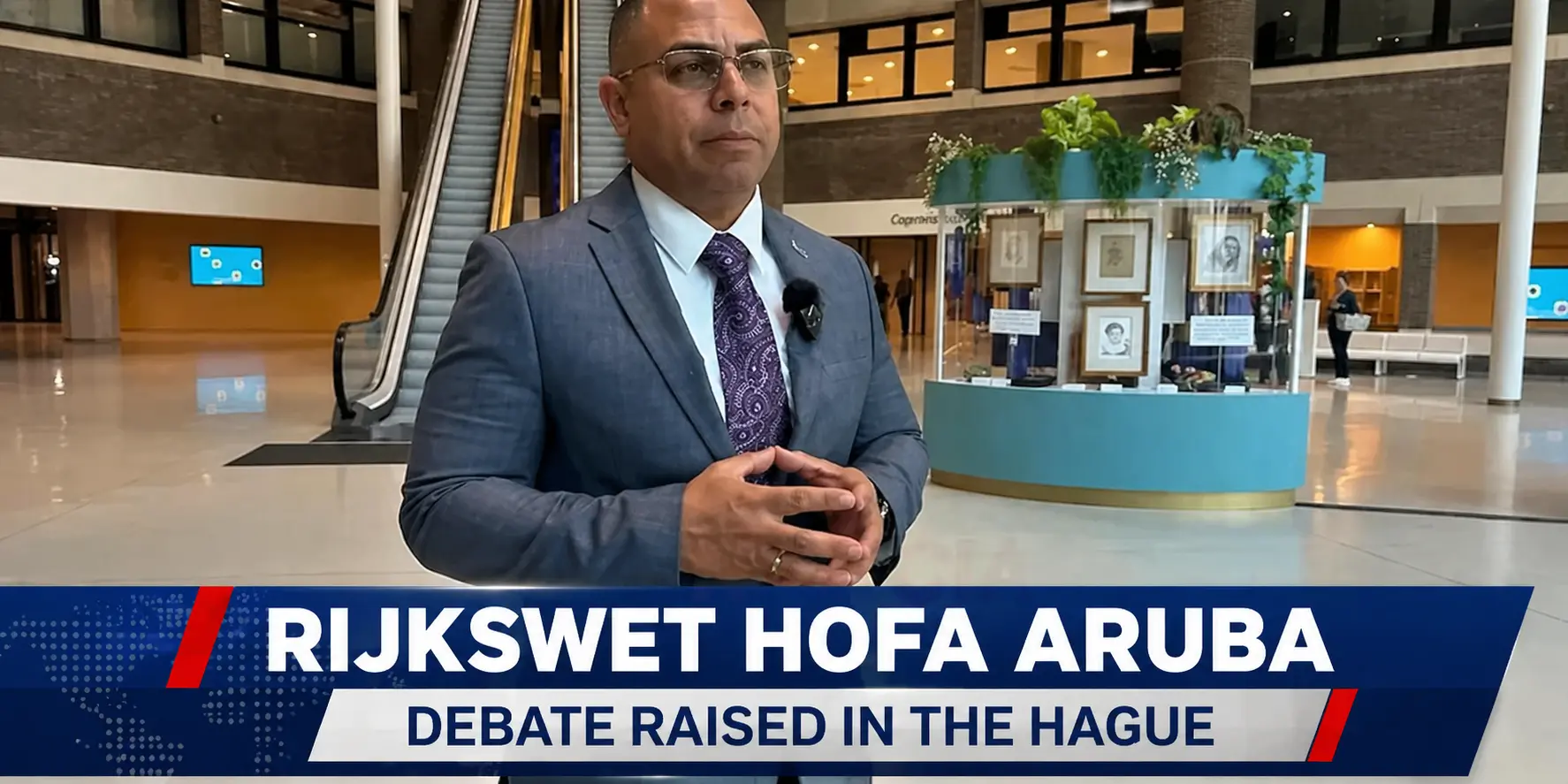
The Rijkswet HOFA Aruba Debate has intensified as parliamentarian Eduard Pieters brought the issue to an international level during his official mission to The Hague.
Representing the PPA faction, Pieters emphasized that the discussion goes beyond politics and directly concerns the constitutional integrity of Aruba within the Dutch Kingdom. According to him, the proposed law could have far-reaching consequences for Aruba’s autonomy and democratic structure.
A central point in the Rijkswet HOFA Aruba Debate is the protection of the budget right of Aruba’s Parliament. Pieters described this as one of the most fundamental tools of democratic governance. Without control over financial decisions, he argued, Parliament risks losing its essential role.

“Without budget right, Parliament loses its essence,” Pieters stated, highlighting the seriousness of the issue.
He warned that the proposed framework under Rijkswet HOFA could allow external influence over Aruba’s financial decisions. This, according to Pieters, creates a risk of weakening the island’s independence in managing its own affairs.
The Rijkswet HOFA Aruba Debate also raises concerns about institutional balance within the Kingdom. Pieters cautioned that accepting such measures could set a precedent for increased intervention in the future.
“If we accept this now, we open the door for more intervention,” he explained, pointing to the potential shift from cooperation to centralization within the Kingdom.
As an alternative, Pieters proposed strengthening internal financial control mechanisms. He suggested creating a budget chamber within Aruba’s Constitution, supported by national legislation. This approach would maintain accountability while preserving Aruba’s autonomy.
The Rijkswet HOFA Aruba Debate also touches on broader issues of equality within the Kingdom. Pieters argued that Aruba has demonstrated financial progress, including improvements in debt management and economic stability.
“A country that complies should not be treated as a country that fails,” he stated, reinforcing the argument against external control.
He concluded by reaffirming Aruba’s position as an equal partner within the Kingdom, emphasizing that autonomy is a constitutional right rather than a privilege.
The Rijkswet HOFA Aruba Debate continues to spark discussion both locally and internationally, as leaders evaluate the balance between cooperation and sovereignty.
This development marks a critical moment in Aruba’s political landscape, with long-term implications for governance and constitutional rights.