

ORANJESTAD, Aruba — Burubundu Development Concerns are growing after Fundacion CONPA raised questions about public consultation, traffic planning and the proposed wastewater system for a major residential development near Pos Chiquito.
The foundation said it examined documents connected to the Burubundu Residences subdivision plan and identified matters that it believes require further investigation before final approval or construction.
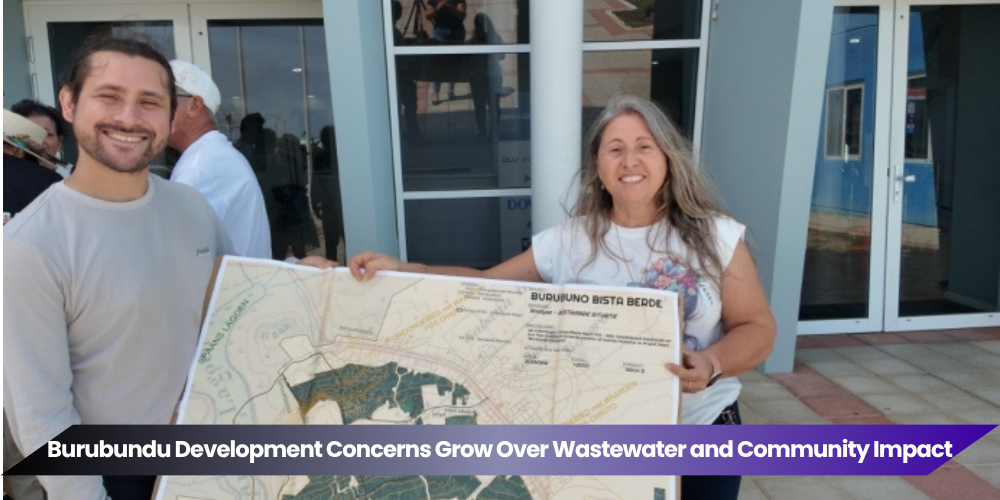
CONPA treasurer Aaron Bislip said the organization supports efforts to address Aruba’s housing shortage but believes large developments must be supported by detailed infrastructure, environmental and community-impact studies.

The concerns presented by CONPA remain the foundation’s assessment and have not all been independently confirmed by the responsible government departments.
Major Residential Community Proposed
Burubundu Residences is planned as a new community in the Pos Chiquito and Burubundu area.
Government descriptions of the project indicate that it could include approximately 850 to 1,000 housing units, including family homes, apartments and modern residential buildings.
Plans presented publicly have also included green areas, recreational spaces, sports facilities, commercial opportunities and a central landscaped area intended to serve the wider community.
The government has described the development as an important response to Aruba’s need for additional housing.
However, CONPA argues that the size of the project makes early consultation and detailed technical planning especially important.
Subdivision Plan Opened for Inspection
Aruba’s Department of Infrastructure and Planning published a notice concerning the proposed Burubundu subdivision under Article 33 of the National Ordinance on Spatial Development.
The official notice stated that the draft plan would be available for inspection beginning May 29, 2026, subject to the applicable public-review process.
Bislip said CONPA reviewed the available documents shortly after their publication and approached the project with an open mind.
Following that review, the foundation concluded that several potential risks required greater public attention.
CONPA also consulted residents, organizations and government-related departments as part of its examination, according to Bislip.
Foundation Questions Community Consultation
One of the main Burubundu Development Concerns involves whether nearby residents, schools and relevant public agencies were adequately informed or involved during the planning process.
Bislip claimed that people and organizations contacted by CONPA said they had not been consulted about the proposed development.
He also alleged that some homes or community properties could be affected by elements of the plan.
These claims require confirmation through official land records, detailed project maps and responses from the government and project planners.
The original announcement did not include a formal response from the developer, the Department of Infrastructure and Planning or other agencies involved in reviewing the subdivision.
Traffic Impact Raises Questions
CONPA also questioned whether the potential traffic effects of the development had been studied with all appropriate authorities.
A residential project containing hundreds of homes could generate significant additional vehicle movements in and around Pos Chiquito.
The foundation said road design, intersections, access routes, pedestrian safety and emergency access should be evaluated before the project advances.
Bislip stated that the Aruba Police Traffic Planning Bureau had reportedly not been informed or involved in the plan.
That assertion was not independently confirmed in the official sources reviewed.
Aruba’s subdivision-review process generally includes technical evaluation and consideration of whether a proposed development is appropriate for its surroundings or could create unacceptable disruption.
Wastewater Solution Not Clearly Defined
The most significant environmental issue raised by CONPA concerns wastewater.
Bislip said the project documentation reviewed by the foundation did not clearly establish whether the development would use a central sewer system, septic tanks or another wastewater-treatment solution.
He argued that this decision should be made before permits are granted because the project’s size could produce a substantial volume of wastewater.
CONPA believes an unresolved wastewater plan could create risks for residents, groundwater, nearby communities and the coastal environment.
The foundation said the geology and natural drainage patterns around Burubundu must be studied carefully before determining which wastewater system would be appropriate.
Coastal Pollution Risk Alleged
Bislip warned that inadequately controlled wastewater could potentially travel through natural drainage channels toward Pos Chiquito, Mangel Halto and nearby marine areas.
He said such a situation could result in unpleasant odours, pollution and possible damage to coral ecosystems.
These potential effects represent CONPA’s warning rather than the conclusion of a published government environmental-impact assessment.
A hydrological, geological and wastewater-engineering study would be required to determine whether such a pathway is likely and what safeguards would be necessary.
Aruba has already recognized wastewater capacity and water pollution as major national challenges. Existing wastewater infrastructure has faced capacity concerns, while modernization projects seek to improve treatment and protect public health and the environment.
CONPA Supports Housing With Safeguards
Bislip emphasized that CONPA is not opposing housing development in principle.
He acknowledged that Aruba has a serious need for additional homes and said the island requires effective long-term solutions.
However, the foundation believes housing projects should not proceed in ways that could create larger infrastructure, traffic or environmental problems.
CONPA is calling for clear answers about sewage treatment, road capacity, public safety, environmental protection and the possible effect on existing residents.
The foundation also wants relevant government departments and community representatives to participate before final decisions are made.
Alternative Development Vision Presented
CONPA has previously presented an alternative vision for Burubundu Residences.
The foundation said housing could still be developed while placing greater emphasis on environmental protection, sustainability and the needs of surrounding communities.
Its recommendations reportedly include preserving natural areas and ensuring that infrastructure is planned before large-scale residential construction begins.
The foundation’s wider work includes research, documentation and efforts to encourage cooperation among residents, government departments and other organizations.
CONPA said this collaborative approach could help identify potential problems early and produce better outcomes for both future residents and existing communities.
Official Response Still Needed
The concerns raised by CONPA would benefit from a detailed response from the Government of Aruba, the project planners and the agencies responsible for roads, wastewater and environmental protection.
Such a response could clarify which departments have reviewed the project, what studies have been completed and which wastewater option is being considered.
It could also explain whether any homes, schools or privately occupied properties would be affected.
Until those details are publicly clarified, CONPA says the Burubundu Development Concerns involving consultation, traffic and wastewater should remain part of the public discussion.
The foundation is urging decision-makers to ensure that Aruba’s need for housing is addressed through development that is safe, transparent, sustainable and supported by appropriate infrastructure.