

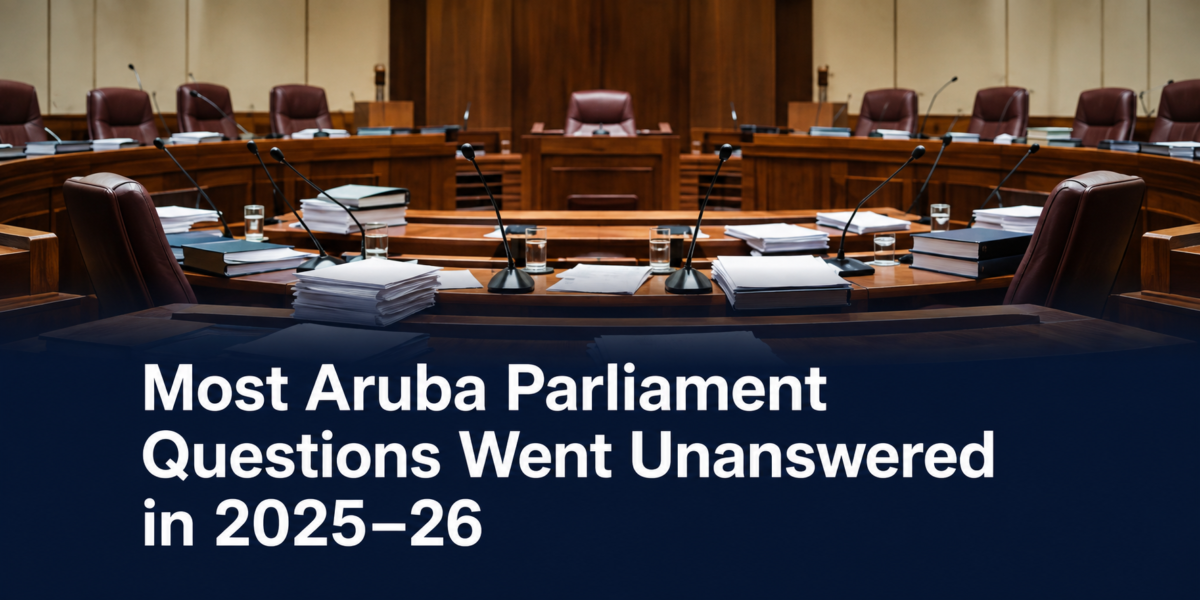
More than half of the written questions submitted during Aruba’s 2025–2026 parliamentary year remained unanswered when the session closed on September 7, according to figures reported from Parliament’s annual summary.
Members submitted 4,595 written questions during the year. Of those, 1,979 received responses and 2,616 were still unanswered, leaving roughly 57 percent without a recorded reply.
Annual summary records meetings and legislation
The parliamentary year began on September 9, 2025. Marlon Sneek served as president and Muzaninn Wever as vice-president. The 21-seat chamber consisted of nine AVP members, eight MEP members, three FUTURO members and one PPA member.

The annual figures list 21 public meetings, 13 public consultations, three closed meetings, 21 Central Committee meetings and two question-hour sessions. Parliament also held five meetings of the Senioren Convent and two solemn sessions.
Government introduced nine bills, while members presented four initiative bills. Eight bills were approved during the year and six were ratified. Members submitted 48 motions: 27 were approved, 19 rejected and two withdrawn. Three amendments were presented, with one adopted.
Response totals varied across government
Rocco Tjon submitted the largest number of written questions at 1,035, followed by Evelyn Wever-Croes with 996 and Edgard Vrolijk with 628. Vrolijk had 516 questions listed as unanswered after receiving 112 responses.
Finance Minister Geoffrey Wever received 1,093 questions and answered 535, leaving 558 unanswered. Justice Minister Arthur Dowers received 789 and answered 201, leaving 588 unanswered. Infrastructure and Telecommunications Minister Rene Herde received 13 and answered all 13, according to the reported summary.
Separate reporting by NoticiaCla highlighted that four members were listed with no written questions during the year: Gino Goeloe, Clifford Heyliger, Stephany Sevinger and Mike de Meza.
Why the figures matter
Written questions are one of the tools legislators use to seek information and scrutinize government decisions. A large unanswered backlog can limit the information available to Parliament and the public, even when the chamber remains active in meetings, motions and legislation.
Sources: Reporting from 24ora and NoticiaCla.