


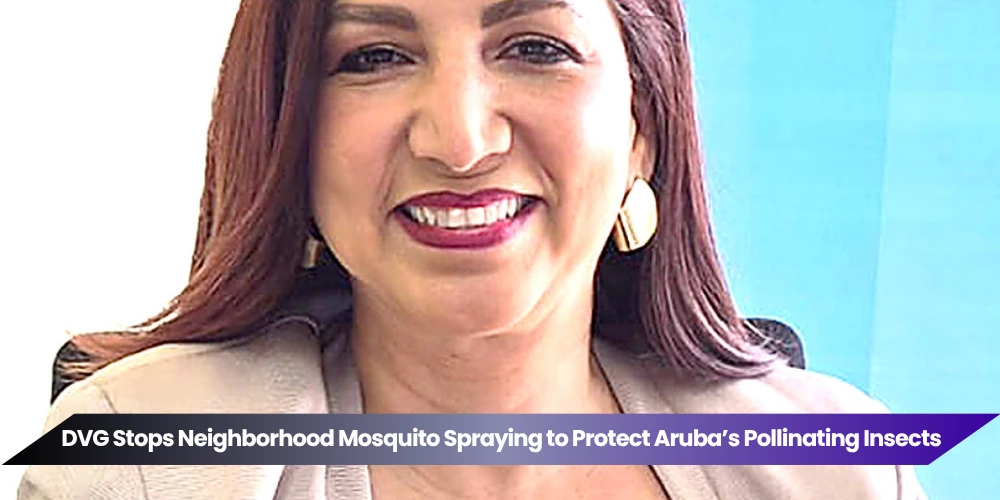
The Aruba mosquito spraying approach has changed as the Department of Public Health prioritizes targeted mosquito control, environmental protection and the removal of breeding sites.
Jurette Croes of the Department of Public Health, known as DVG, said mosquito problems continue to cause significant inconvenience for residents in several areas of Aruba.
DVG and its Mosquito Control Service, GKMB, continue monitoring and visiting locations known for high mosquito activity, including several mangrove areas.

Croes explained that the mosquitoes commonly found in these areas are not necessarily the Aedes aegypti species responsible for transmitting illnesses such as dengue, chikungunya and Zika.
Although other mosquito species may not present the same disease risk, they can still create considerable discomfort for nearby communities.
According to Croes, GKMB makes every effort to use natural mosquito-control products whenever these options are available and practical.
The objective is to reduce mosquito problems while avoiding unnecessary harm to Aruba’s natural environment.
DVG no longer carries out routine neighbourhood fogging in the same manner used in the past.
Croes said the chemical fog does not affect mosquitoes alone. It can also kill butterflies and other insects that play an essential role in pollinating plants.
Official DVG guidance has similarly stated that spraying kills primarily adult flying mosquitoes and does not remove eggs or larvae developing in standing water. DVG has said GKMB will use spraying during an outbreak of mosquito-borne disease rather than as a routine response to every mosquito nuisance.
“Protecting public health must remain balanced with protecting nature,” Croes said.
DVG is therefore asking residents to address mosquito problems at their source by removing accumulated water where mosquitoes can reproduce.
Residents should regularly inspect yards, gardens and areas around their homes for buckets, containers, discarded objects, plant pots and other items capable of holding rainwater.
These containers should be emptied, cleaned, covered or removed to prevent mosquitoes from completing their breeding cycle.
DVG has repeatedly emphasized that community participation is essential because mosquito larvae can continue developing when standing water remains around homes and neighbourhoods.
Residents are also encouraged to keep their surroundings clean and report situations that could present a wider public-health risk.
The revised Aruba mosquito spraying strategy seeks to protect residents from mosquito-borne illnesses while reducing harm to butterflies, pollinators and Aruba’s wider ecosystem.