

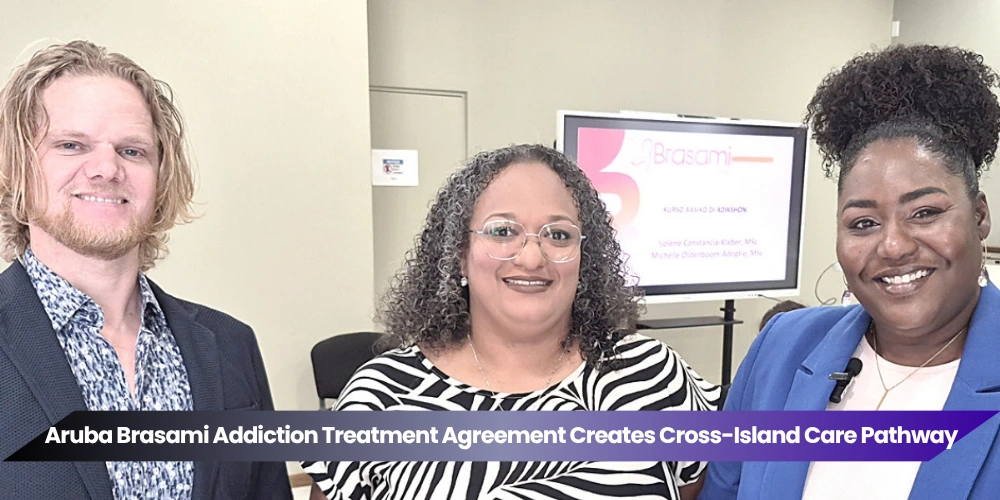
ORANJESTAD, Aruba — The Aruba Brasami Addiction Treatment agreement will allow eligible residents with severe and chronic substance-use disorders to receive compulsory treatment at Verslavingskliniek Brasami in Curaçao.
Representatives of the Curaçao clinic visited Aruba during the first week of August to formalise the cooperation and explain the referral procedures to organisations working within Aruba’s health, social-care and justice systems.
The agreement is intended to create a coordinated process through which selected clients can travel to Curaçao for the first stage of treatment and later return to Aruba for continued rehabilitation and social reintegration.

Programme Intended for Complex Chronic Cases
Ijolène Constancia-Klaber of Brasami said the programme is not designed for people in the earliest stages of a substance-use problem.
It is intended primarily for clients whose addiction has become chronic and complex and has already seriously affected their physical or mental health, family relationships, employment and ability to function independently.
Each case will require assessment before a referral can be made. The announcement does not state which diagnostic criteria, medical evaluations or risk-assessment tools will be used to determine eligibility.
Admission Requires a Legal Basis
Clients cannot enter this particular Brasami pathway solely through an ordinary voluntary request.
Constancia-Klaber said admission must be based on a legal measure, such as curatorship or another judicial title under which a judge orders treatment.
This means the agreement combines health care with judicial oversight. Authorities must coordinate the legal order, medical information, travel arrangements and admission before a client can be transferred to Curaçao.
The announcement does not explain which court will consider applications, who may initiate a case or what appeal and review procedures will apply. Those matters should not be added without official clarification.
Treatment Begins in Curaçao
Brasami will provide the first stage of recovery in Curaçao.
According to the announcement, this stage includes detoxification, structure and therapeutic treatment intended to stabilise the client and establish a foundation for recovery.
An earlier inspection by the Council for Law Enforcement described Brasami’s treatment structure as including detoxification, rehabilitation and resocialisation, supported by care workers, social workers, medical personnel and external professionals.
The exact duration of the Curaçao placement will likely depend on the client’s condition and treatment plan, but no standard treatment period was announced.
Reintegration Will Continue in Aruba
After completing the first phase in Curaçao, clients are expected to return to Aruba for the second stage of their recovery.
That phase will focus on resocialisation and continued care within the client’s home community.
Effective follow-up may involve housing, employment preparation, family support, mental-health treatment, relapse prevention and supervision by social-care or justice organisations.
The agreement’s success will therefore depend not only on treatment at Brasami but also on whether Aruba has sufficient professionals and programmes available to support clients after they return.
Stakeholders Discuss Referral Protocols
Working sessions were held at Aruba’s Department of Public Health on August 3 and 4.
Participants reportedly included representatives of DVG, Respaldo, Stichting Hunto, Veiligheidshuis Aruba, the Public Prosecutor’s Office, Reclassering and Brasami.
The sessions focused on strengthening cooperation and defining the procedures required for compulsory treatment under judicial instruction.
Clear coordination is important because a single case may involve medical professionals, prosecutors, probation officers, social workers, relatives and judicial authorities across two countries.
Smooth Transfer Considered Essential
Constancia-Klaber said the referral process must be properly channelled so clients can travel to Curaçao, receive treatment and return to Aruba without unnecessary disruption.
A coordinated transfer may also help prevent gaps in medication, medical records, legal supervision and aftercare.
The report does not explain who will pay for air travel, accommodation, treatment, medical escorts or emergency care. It also does not identify the organisation responsible for maintaining contact with a client’s family during admission.
These operational details will require clarification as the agreement is implemented.
Brasami Conditions Require Continued Oversight
Brasami performs an important role in Curaçao’s addiction and criminal-justice care system, but public oversight reports have also identified concerns.
The Council for Law Enforcement’s 2024 assessment described conditions in Brasami’s detoxification section and continuing staff shortages as matters of serious concern.
The new Aruba agreement does not state whether those concerns have been fully resolved or which quality, safety and inspection standards will apply to Aruban clients.
Transparent monitoring will be important because the programme involves people receiving compulsory treatment and therefore requires strong protection of their dignity, safety and legal rights.
Agreement Expands Regional Cooperation
The arrangement reflects growing cooperation among health and mental-care organisations within the Dutch Caribbean.
Brasami, Respaldo and other regional institutions already participate in broader efforts to improve mental-health and addiction-care collaboration across the islands.
For Aruba, the agreement provides access to a specialised inpatient pathway that is not currently available locally for every chronic and complex case.
However, the long-term impact will depend on available placements, judicial procedures, treatment quality and the strength of the follow-up care provided after clients return home.
The Aruba Brasami Addiction Treatment agreement establishes a new cross-island route for compulsory recovery care while placing responsibility on both countries to ensure that treatment remains coordinated, safe and focused on lasting reintegration.