


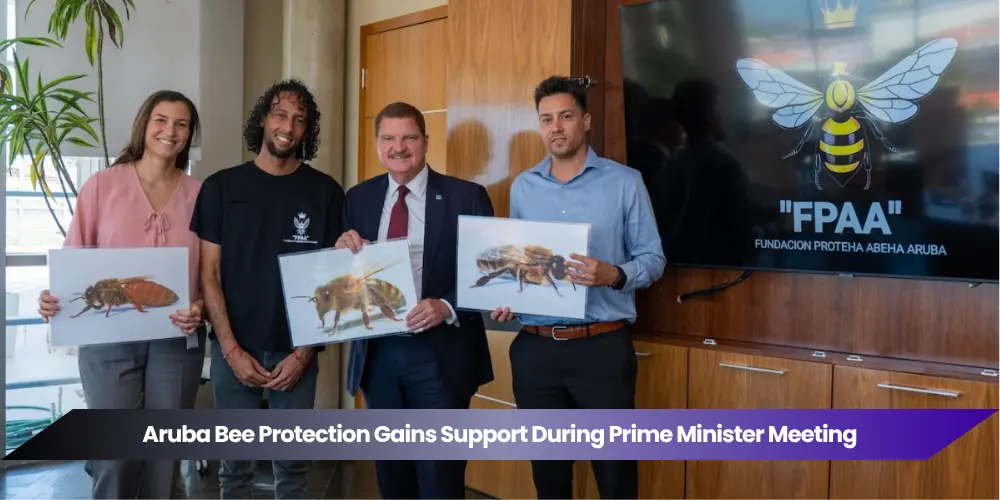
ORANJESTAD, Aruba — Aruba Bee Protection was the focus of a meeting between Prime Minister Mike Eman and representatives of Fundacion Proteha Abeha Aruba.
The discussion addressed the importance of protecting bees, increasing public awareness and helping residents understand the essential role pollinators play in Aruba’s ecosystems and food production.
Foundation president Jhowell Maduro shared information about the organisation’s conservation work and the practical steps residents can take to support bees across the island.

Foundation Highlights Importance of Pollination
Maduro explained that bees contribute to the pollination of fruit trees, vegetables and other flowering plants forming part of Aruba’s natural environment.
Pollination allows plants to reproduce and supports the development of many fruits, vegetables, nuts and seeds.
The Food and Agriculture Organization says approximately 75% of global food-crop types depend to some extent on pollinators. Bees are among the most important pollinators, although butterflies, moths, birds, bats and several other species also contribute.
Protecting pollinators therefore supports both biodiversity and the continued availability of a varied food supply.
Not Every Bee Colony Presents Immediate Danger
One of the foundation’s principal messages was that the presence of bees does not automatically mean they must be destroyed.
Maduro said a colony creating a genuine risk should be assessed by a bee specialist who can determine whether it can be safely rescued and relocated.
Residents should not disturb, strike, spray or attempt to remove a colony without the necessary knowledge and protective equipment.
The safest response is to keep people and animals away from the area and contact an experienced professional, particularly when bees are near a home, school, workplace or frequently used public space.
Residents Encouraged to Limit Pesticide Use
Fundacion Proteha Abeha Aruba encouraged residents to reduce pesticide use, especially around flowers and plants visited by pollinators.
Aruba’s Department of Nature and Environment has previously identified habitat loss, pesticides and climate change among the pressures affecting bees and other pollinating species.
The department recommends reducing harmful chemical use and considering more sustainable alternatives whenever possible.
Pesticides should always be used according to their official instructions. Applying chemicals unnecessarily or directly to flowering plants can expose bees while they are collecting pollen and nectar.
Flowering Plants Can Provide Food
Residents can also contribute by planting trees, shrubs and flowers that provide food for bees.
A variety of plants flowering during different parts of the year can help create a more consistent supply of pollen and nectar.
Aruba’s government has previously identified local plants including watapana and several flowering trees and shrubs as useful resources for pollinators.
Providing suitable vegetation is especially valuable in developed areas where natural habitats may be limited.
The foundation also encouraged residents to make water available during dry periods, while ensuring that containers are maintained responsibly and do not become breeding sites for mosquitoes.
Public Awareness Remains Important
Many people react to bees with fear because they associate every colony with stings or aggressive behaviour.
Education can help residents distinguish between a bee simply visiting flowers and a colony established in a location that may require professional attention.
Public awareness can also reduce unnecessary destruction of colonies while maintaining safety around people who are allergic to bee stings.
The foundation’s message combines conservation with responsible risk management: bees should be protected when possible, but potentially dangerous situations should be handled by trained specialists.
Maduro Shares Experience With Government
Maduro is described as a bee specialist who has represented Aruba twice during international bee-related activities in Bogotá.
During the meeting, he presented information about the foundation’s work and its efforts to promote a better understanding of bees within the community.
The announcement did not provide details about the Bogotá events or identify a new international agreement resulting from his participation.
Prime Minister Praises Conservation Work
Eman expressed appreciation for the foundation’s activities and said initiatives promoting the protection of essential species contribute to a more environmentally conscious Aruba.
The prime minister connected the organisation’s work with the island’s broader interest in sustainable development and protecting nature for future generations.
No new government funding, legislation or official bee-management programme was announced during the meeting.
Bee Protection Requires Shared Responsibility
Protecting pollinators depends on cooperation among residents, farmers, gardeners, businesses, conservation organisations and public authorities.
Individuals can assist by reducing unnecessary pesticide use, planting suitable flowering vegetation and requesting professional help when a colony must be removed.
The meeting placed Aruba Bee Protection within the wider discussion about biodiversity, food security and sustainable development.
Fundacion Proteha Abeha Aruba hopes that greater awareness will help residents appreciate the value of bees while responding safely and responsibly when colonies appear near populated areas.