
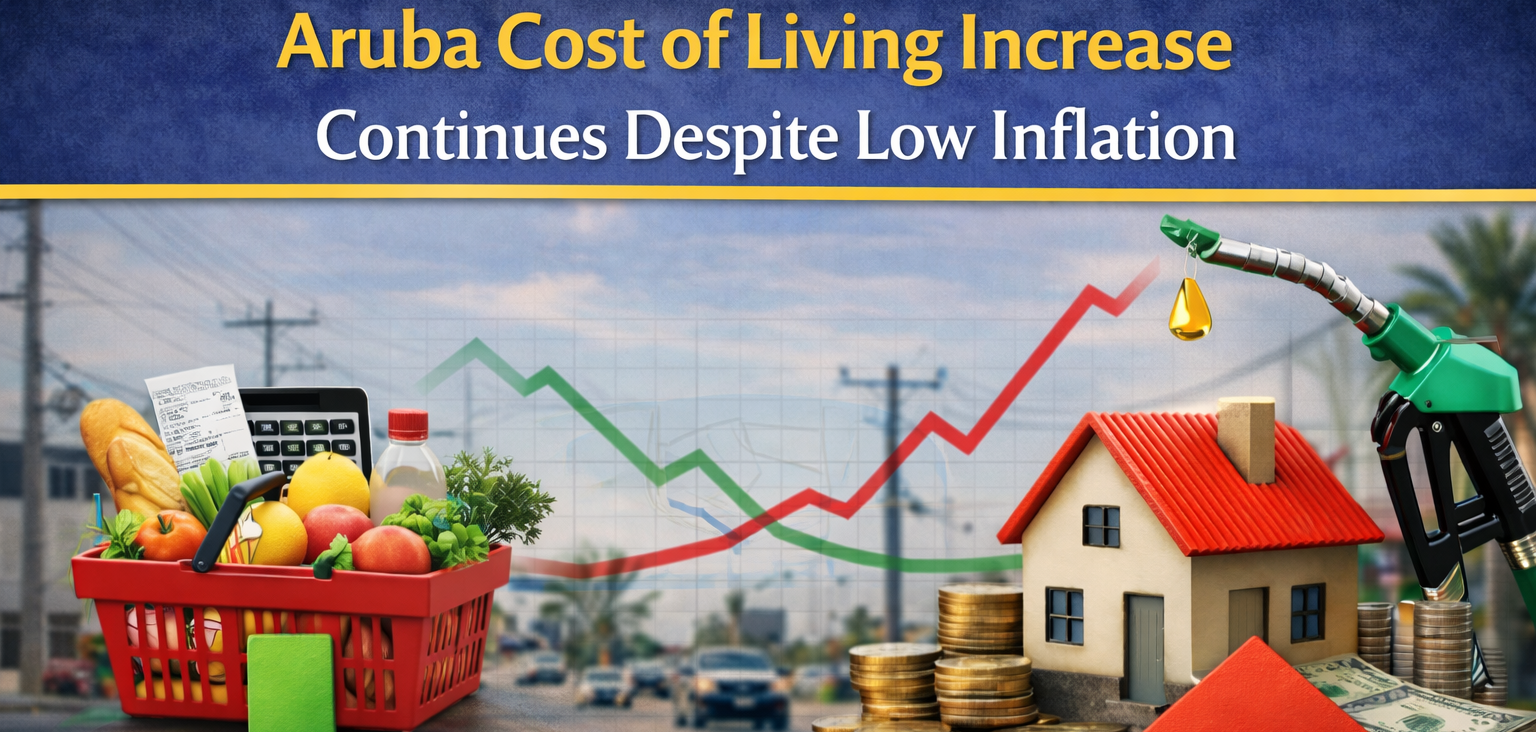
The Aruba cost of living increase continues to affect residents despite official data showing low inflation, according to new figures released by the Central Bureau of Statistics (CBS).
In February 2026, the Consumer Price Index (CPI) recorded a modest rise of 0.6%, while annual inflation stood at 0.7%. Over a 24-month average, inflation remained very low at 0.1%, significantly below previous years. However, the Aruba cost of living increase tells a different story for households.
Out of 12 economic sectors, 10 recorded price increases, with notable rises in recreation (+15.3%), transportation, communication, furniture, and food. Only the housing sector showed a slight decrease.

The impact of the Aruba cost of living increase is most visible in the minimum living cost (bestaansminimum):
- Family (2 adults + 2 children): Afl. 5,551 (+22 florin in one month)
- Single adult: Afl. 2,643 (+10 florin)
Compared to last year, family expenses increased by 57 florin, mainly due to rising food prices. Data also shows that the average adult still faces an income deficit of Afl. 636, meaning many residents cannot cover basic expenses.
Despite low inflation figures, the Aruba cost of living increase remains driven by core inflation, which rose by 1.0%, indicating ongoing price pressure in the local economy. Meanwhile, energy prices dropped by 4.0%, helping to keep overall inflation low.
The Aruba cost of living increase highlights the growing gap between official statistics and everyday reality. While inflation appears stable on paper, rising costs for food, transport, and services continue to put pressure on households.
In simple terms, even with low inflation, the Aruba cost of living increase means that life is becoming more expensive for many residents each month.