

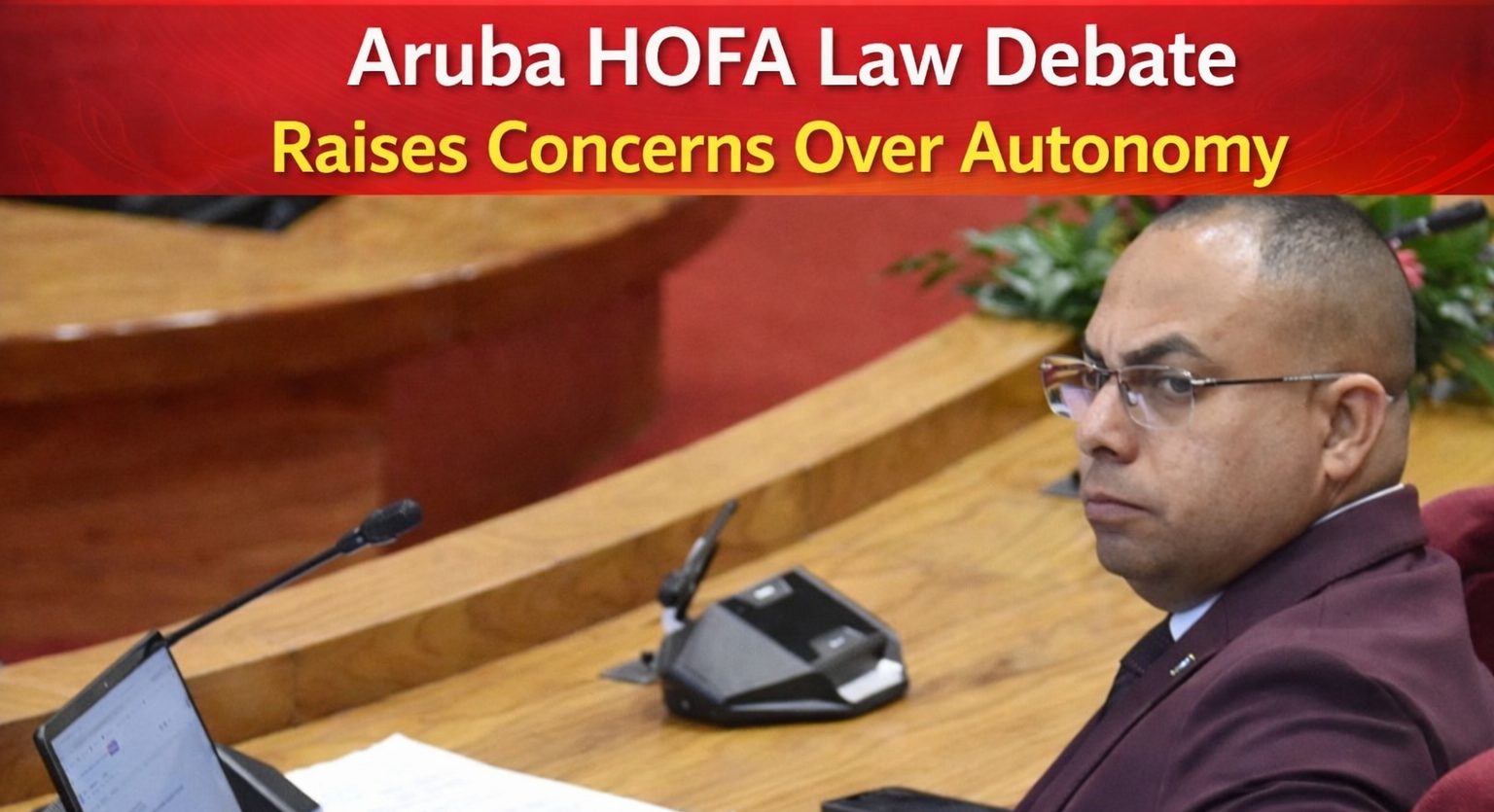
The Aruba HOFA law autonomy debate has intensified after PPA parliamentarian Eduard Pieters raised serious concerns about the handling of the proposed Rijkswet HOFA.
Following the recent national celebrations of 40 years of Status Aparte and 50 years of the National Anthem and Flag, Pieters warned that the current process surrounding the law is not only questionable but also poses a risk to Aruba’s democracy and autonomy.
The Aruba HOFA law autonomy debate gained attention after a public meeting was organized with 13 representatives from unions and professional groups. According to Pieters, the way the meeting was conducted reflected a troubling pattern of limiting public voices within Parliament.

He criticized the short notice given to participants and the decision to allow only five minutes per group to present and ask questions on such an important issue. Pieters described this as a lack of respect for democratic participation.
During the meeting, Pieters also pointed to what he described as a passive attitude from the governing coalition. He noted that many coalition members remained silent and only responded when pressured by opposition members, raising concerns about their role as representatives of the people.
According to Pieters, the unions and organizations present showed stronger leadership in defending public interests than some members of Parliament. He stressed that Parliament’s primary role should be to represent the people, not simply support government decisions.
At the center of the Aruba HOFA law autonomy debate is the Rijkswet HOFA, which the government views as necessary for financial discipline. However, PPA argues that the law threatens Aruba’s autonomy and self-determination.
Pieters emphasized that a consensus law should reflect agreement not only from the government but also from Parliament and the public. He argued that such consensus is currently lacking.
While supporting financial discipline, PPA has proposed alternatives, including strengthening local financial oversight through a national budget authority within Aruba’s constitutional framework. Pieters highlighted that Aruba’s debt has already decreased significantly in recent years, suggesting that external control may not be necessary.
He described the situation as a critical moment for Aruba’s democracy, questioning the role of Parliament if it lacks real influence over financial decisions.
The Aruba HOFA law autonomy debate continues to spark discussion across the island, as calls grow for a unified national approach involving unions, business groups, and the public to protect Aruba’s autonomy while maintaining financial responsibility.