

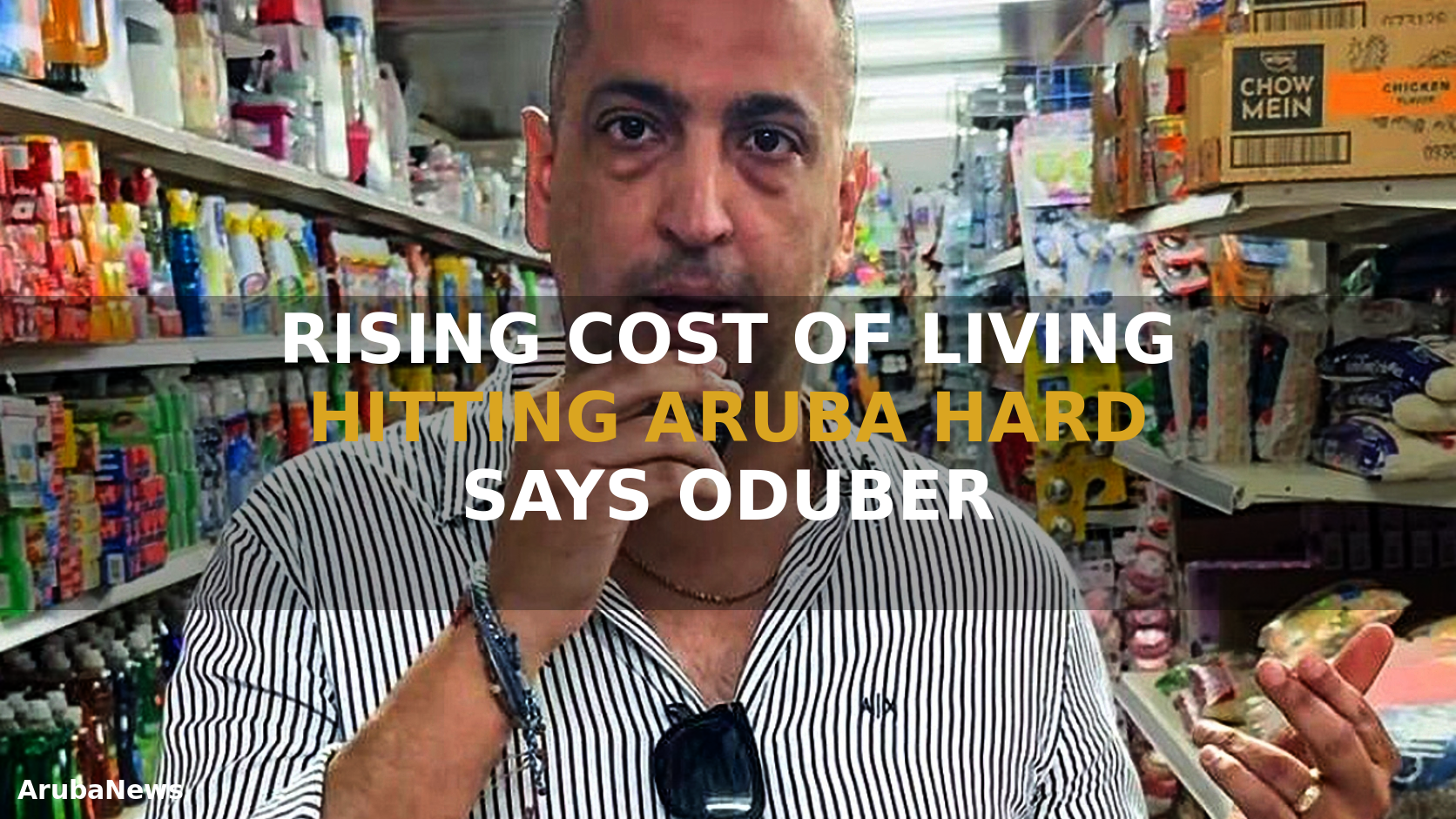
cost of living in Aruba : Parliamentarian Dangui Oduber has sharply criticized the Aruban government over the relentless rise in the cost of living, accusing the AVP-Futuro administration of doing the exact opposite of what it promised during its election campaign. Instead of lowering prices and improving purchasing power, Oduber argues, the government has presided over month-after-month increases that are strangling household budgets across the island.
According to figures from the Central Bureau of Statistics (CBS), the subsistence minimum, the minimum income needed for an individual or household to live with dignity, has risen once again. For a family of two adults and two children aged 0 to 14, the minimum required income reached Afl. 5,602 per month in March 2026, an increase of Afl. 95 compared to March 2025, when the figure stood at Afl. 5,507. The increase was driven primarily by higher costs in essential categories, with food and non-alcoholic beverages rising by Afl. 71 over the twelve-month period, while housing costs increased by Afl. 14 in the same timeframe.
The situation becomes even more critical when comparing the subsistence minimum with actual wages. For a single adult, the subsistence minimum is calculated at Afl. 2,636 per month, while the minimum wage sits at approximately Afl. 1,900. This means the minimum wage falls short of covering basic living expenses by more than Afl. 700 per month, leaving a significant gap that many Arubans simply cannot bridge.

This shortfall, Oduber noted, confirms the warning previously issued by the Central Bank of Aruba: the middle class on the island is steadily disappearing. People are entering supermarkets with fear, the parliamentarian said, as the cost of living has reached a point where 100 Florin no longer holds any meaningful value.
Both the Central Bank and CBS have confirmed that food prices have seen drastic increases, and household wallets are emptier than ever. Despite the government’s promises to bring relief, lower the cost of living, and fill refrigerators again, the reality today is the complete opposite. Prices of water and electricity have not decreased, while rising gas prices and daily increases in food and beverage costs continue to squeeze household budgets relentlessly.
Oduber emphasized that the government has forgotten about approximately 80,000 people in Aruba. For this group, there are no incentives and no improvement in purchasing power, while the middle class disappears further with each passing day. Many Arubans are now forced to work two jobs just to make it to the end of the month, subjecting families to enormous stress and pressure due to the high cost of living.
The parliamentarian also criticized Minister Geoffrey Wever for telling the public there is no inflation and that no prices have risen in Aruba. Oduber described a minister who refuses to acknowledge the reality of price increases as being totally disconnected from the daily struggles of the population.
Oduber concluded by pointing out that in a country where the government has accumulated more than 500 million Florin in surplus, it is unacceptable that so many people are suffering. The prosperity that was promised, he said, has not been shared with the people who need it most.
Update — October 1, 2026: MEP parliamentarian Dangui Oduber has voiced deep concern about the accumulated rise in essential household costs in Aruba, pointing to new Consumer Price Index (CPI) figures published by the Central Bureau of Statistics (CBS) comparing August 2024 with August 2026.
According to Oduber, the comparison between the Wever-Croes cabinet period (August 2024) and the current AVP-Futuro cabinet (August 2026) shows a considerable increase in the monthly spending of the population. The sharpest rises include diesel at +29.7%, gasoline at +12.9%, non-alcoholic beverages at +7.0%, home maintenance and repair at +4.9%, food at +3.9% and rent at +3.0%.
Oduber stressed that these are not just figures on paper but a direct hit to citizens’ wallets, as people must spend more of their monthly salary to cover the same basic needs such as food, housing and transport. He also noted that the subsistence minimum (bestaansminimum) for a family of four reached Afl. 5,663 per month in August 2026, an increase of Afl. 144 compared with August 2025.
The parliamentarian said the economic debate should focus not only on the government’s financial results but on citizens’ real purchasing power, and called on the government to explain which concrete measures it will implement to address the rising cost of living, particularly in food, energy, transport and housing.
Source: 24ora