
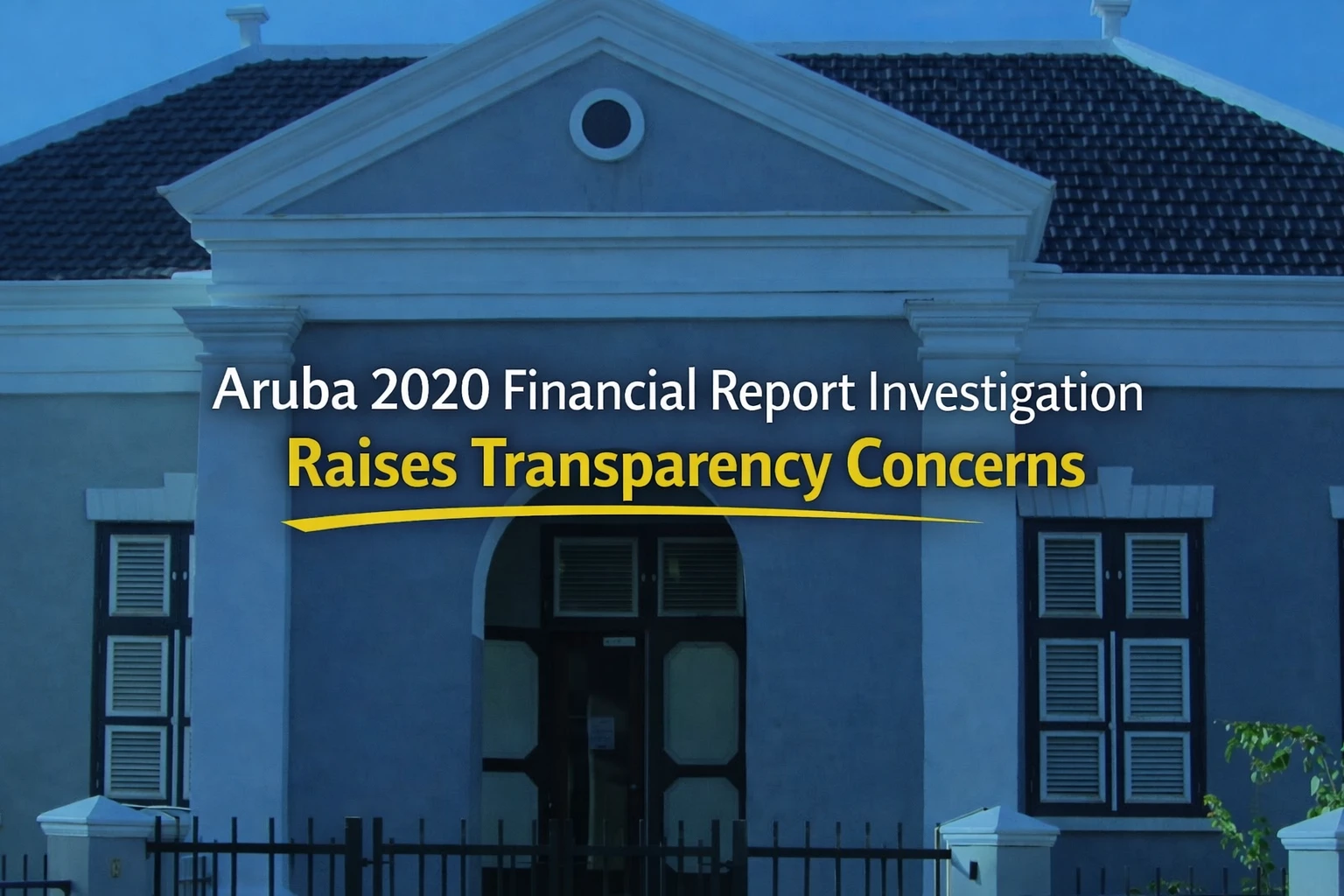
The General Audit Chamber of Aruba (Algemene Rekenkamer) has released its official Report on the Investigation of the 2020 Annual Financial Accounts of the Country of Aruba, highlighting serious concerns about transparency, financial management, and accountability within the government.
The report was published on March 13, 2026, as part of the institution’s constitutional responsibility to oversee public finances and evaluate whether government spending follows legal and financial regulations.
Delayed Financial Accountability Raises Concerns
According to the Audit Chamber, timely and complete financial reporting is essential for maintaining accountability, transparency, and sustainable public finances. However, the report notes that it took more than five years for the government to present full accountability for the exceptional financial year of 2020.

The auditors emphasized that this delay is deeply concerning because annual financial reports are a key tool for Parliament and the public to monitor government spending and ensure proper governance.
COVID-19 Pandemic Created Major Financial Pressure
The year 2020 was heavily impacted by the COVID-19 pandemic, which created an unprecedented financial burden for Aruba.
During that year, the government spent approximately Afl. 341.5 million in emergency financial support programs. These included:
-
Afl. 275.5 million in wage subsidies
-
Afl. 42.8 million through the FASE emergency assistance program
-
Afl. 22.9 million through the MKB support program for small and medium-sized businesses
Additionally, the government contributed Afl. 99.7 million to AZV, Aruba’s national health insurance system.
Because government expenses rose significantly while revenues declined, Aruba recorded an operational deficit of about Afl. 739.6 million in 2020. This represented an increase of Afl. 735.2 million compared with 2019.
To help cover the deficit, Aruba received financial loans from the Netherlands, which came with strict conditions.
Reduced Transparency in the Budget System
The Audit Chamber also expressed concern that structural changes to the national budget law reduced transparency.
Although these changes lowered the number of legal violations within the budget—from 90 violations in 2019 to only 9 in 2020—the report warns that this improvement came at the cost of reduced transparency and less informative financial reporting.
Under the new structure, ministries gained greater flexibility to reallocate funds within their departments without prior approval from Parliament, weakening parliamentary oversight.
Irregular Financial Activities Identified
The investigation also identified illegal or irregular financial activities during the execution of the 2020 budget.
Government spending exceeded Parliament-approved limits by approximately Afl. 12 million, which the Audit Chamber classified as unauthorized.
Additionally, Afl. 42.8 million in FASE emergency payments were made without a proper legal basis at the time. The report also noted irregularities related to government loans because the Minister of Finance did not obtain prior parliamentary approval for loans exceeding five years, as required by law.
Call for Structural Improvements
The Audit Chamber warns that efforts to reduce reporting delays should not come at the expense of transparency, legal compliance, or financial accuracy.
With the government aiming to introduce a fully auditable annual financial report by 2026, the institution urges authorities to take corrective measures quickly to strengthen financial management and restore public trust.
The full report, including conclusions, recommendations, and responses from the Ministry of Finance, is available on the Algemene Rekenkamer Aruba website.