

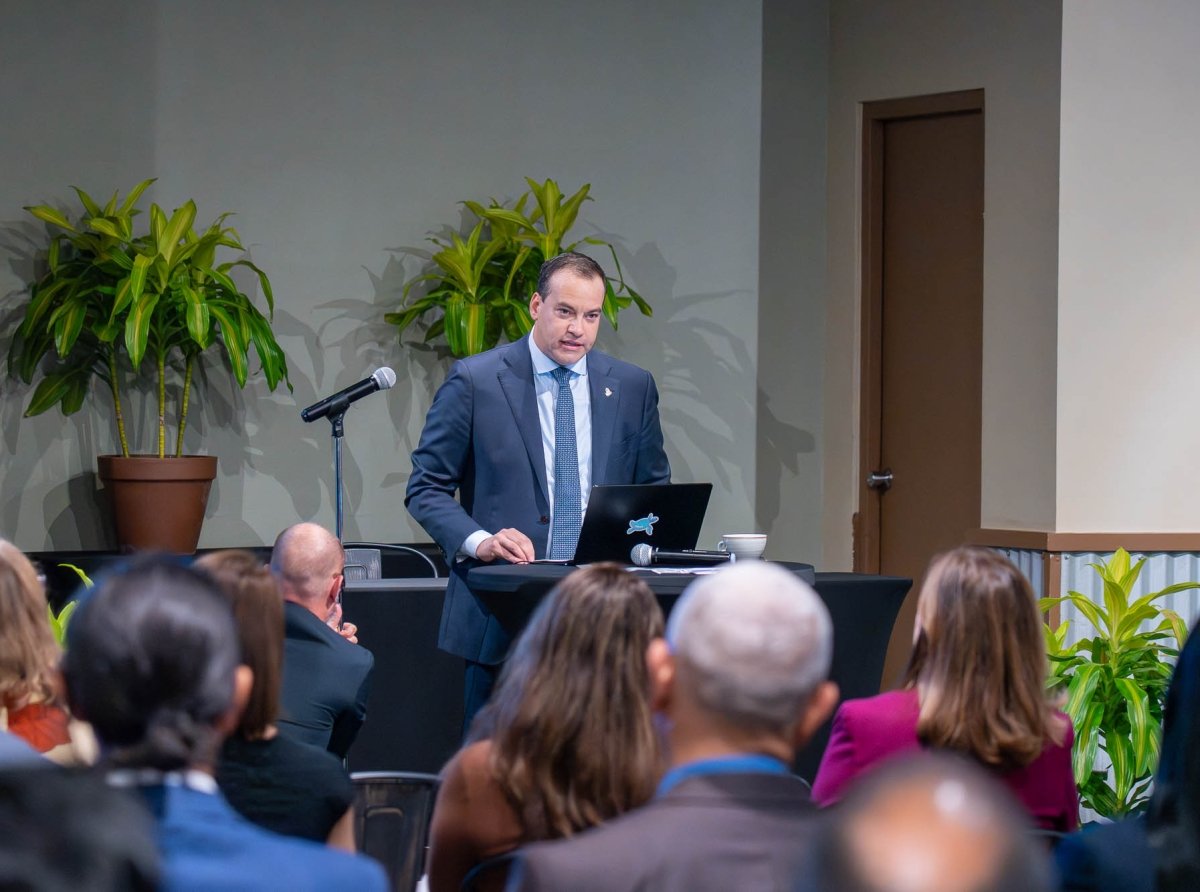
The Government of Aruba, through the Minister of Finance, Economic Affairs, and Primary Sector, Mr. Geoffrey Wever, officially launched the CORVI Report (Climate and Ocean Risk Vulnerability Initiative) — an in-depth study analyzing Aruba’s climate and ocean-related risks and their impacts on the island’s economy, infrastructure, and environment.
The event, held on Tuesday, November 4, 2025, brought together representatives from government, the private sector, NGOs, and academia to discuss the study’s findings and recommendations. The research was conducted in collaboration with the Stimson Center and several international strategic partners.
A Scientific Foundation for Sustainable Economic Development
In his speech, Minister Wever emphasized that the CORVI Report serves as a strategic and scientific foundation for Aruba’s sustainable development, providing a clear overview of the country’s key climate vulnerabilities and primary risk clusters:

- Degradation of marine and coastal ecosystems
- Demographic changes and pressure on infrastructure
- Fragility of a tourism-dependent coastal economy
The Minister stressed that climate change is not a distant threat but an immediate economic and financial risk for Aruba. Rising sea levels, coastal erosion, and extreme heat are already placing pressure on national infrastructure, financial stability, and community well-being.
“Strengthening our climate resilience is an economic imperative,” said Wever. “To achieve this, Aruba must attract and mobilize sustainable climate investments, which depend on a transparent and stable investment environment.”
He added that without a solid financial ecosystem, sustainable investment is impossible. The government’s responsibility, he explained, is to create the conditions that encourage public–private collaboration and de-risk green investments.
Aruba Aligns with the Helsinki Principles
Minister Wever noted that Aruba has recently joined the Coalition of Finance Ministers for Climate Action, a global network guided by the Helsinki Principles, which integrate climate action into fiscal and economic policymaking.
He highlighted two key principles:
- Principle 4: Integrate climate change into macroeconomic policy, fiscal planning, budgets, and public investment management.
- Principle 5: Mobilize private finance to support climate mitigation and adaptation.
“Resilience cannot simply be a budget item — it must be a core element of every national development strategy,” said Wever. “We aim to show that Aruba is a stable, proactive nation ready to attract investment for a sustainable future.”
International Cooperation to Strengthen Local Capacity
Minister Wever also announced that, in partnership with the International Monetary Fund (IMF) and the Caribbean Regional Technical Assistance Centre (CARTAC), Aruba will receive targeted technical assistance in 2026. These missions will aim to strengthen the island’s capacity to integrate climate considerations into public financial management and to develop policies that mobilize private funding for climate resilience.
A Firm Step Toward a Resilient Aruba
The CORVI Report serves as a data-driven evidence base, while the Helsinki Principles offer a framework for action toward a sustainable future.
“The path to resilience is built on collaboration, innovation, and political will,” concluded Wever. “Aruba has the opportunity to become a regional leader in climate-smart governance.”
Photo Credits : https://diario.aw/categories/noticia/general/cambio-climatico-ta-un-riesgo-economico-y-financiero-inmediato-pa-aruba