

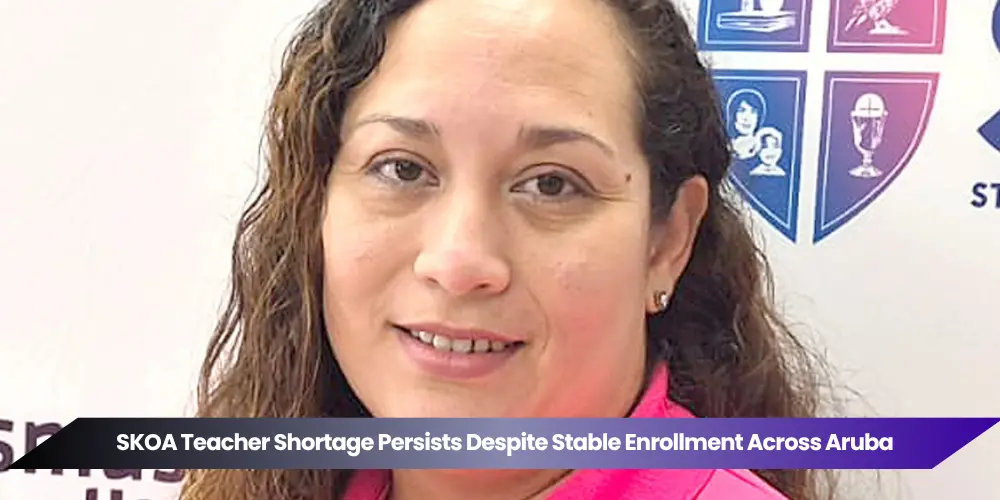
ORANJESTAD, Aruba — The SKOA Teacher Shortage remains a challenge as Aruba begins the 2026–2027 academic year, but the Catholic school board says there is currently no need to close any of its schools.
Jessica Irausquin, interim director of Stichting Katholiek Onderwijs Aruba, told DIARIO that SKOA has filled several previously vacant teaching positions but still has openings that need to be addressed.
Despite those staffing difficulties, student numbers across SKOA schools are currently considered stable.

No School Closures Currently Needed
Irausquin said lower student numbers in some areas do not automatically mean schools need to close.
SKOA currently operates 46 schools across Aruba and serves more than 8,000 students, making it the island’s largest school organisation.
According to Irausquin, current enrollment allows the schools to continue operating without the need for immediate consolidation or closure.
The situation will nevertheless continue to be monitored as Aruba’s demographics change.
Teacher Shortage Limits Additional Classes
One example of the staffing challenge can be seen in kindergarten education.
Irausquin said some kindergarten classes were closed during the previous academic year because of enrollment circumstances.
For the new school year, demand would have justified opening an additional class, but SKOA decided against doing so because a teacher was not available.
The situation illustrates how teacher availability can directly influence class planning even when there are enough students to justify another classroom.
Aruba’s Department of Education has continued publishing teaching vacancies across different school boards during 2026, including positions in primary, vocational and secondary education.
Key Entry Levels Reportedly 99% Full
Irausquin said SKOA’s first-year kindergarten, primary-school and MAVO groups are currently approximately 99% full when measured against the government’s class-size policy.
For the 2026–2027 academic year, the Ministry of Education maintained its policy of generally limiting classes to a maximum of 24 students.
The policy was introduced during the previous school year as part of an effort to reduce teacher workload and provide students with more individual attention.
The ministry also maintains a general minimum of 16 students per class, creating a target range of 16 to 24 students wherever circumstances allow.
Staffing Remains Part of Class-Size Challenge
Although the 24-student limit is intended to improve educational quality, implementation also depends on available classrooms and qualified personnel.
The Ministry of Education has acknowledged that school boards may encounter logistical and organisational challenges when applying the standard and specifically identifies staffing availability as a factor that must be considered.
For SKOA, that means an additional class cannot simply be created whenever enrollment approaches the maximum. A qualified teacher must also be available.
Irausquin said teacher shortages are not unique to Aruba but remain an important local challenge requiring continued recruitment.
Enrollment Situation Changed Since June
Earlier in 2026, SKOA reported that some enrollment spaces remained available for the approaching academic year.
At that time, kindergarten enrollment was approximately 91%, while primary and secondary levels were more than 90% full. SKOA also said there were fewer than 10 vacancies for primary-school teachers and one or two kindergarten vacancies.
The latest figures indicate that enrollment at the principal entry levels increased substantially as the start of the school year approached.
Aruba’s 2026–2027 academic year officially began on August 20.
Lower Birth Numbers Could Affect Future Enrollment
Irausquin said SKOA is also monitoring Aruba’s demographic development.
She noted that fewer children are being born compared with earlier years and said this could eventually affect the number of students entering the school system.
Because children born today will not immediately enter primary education, changes in birth numbers take several years to appear fully in school enrollment.
Irausquin said SKOA expects to reassess the situation in approximately four years and determine whether changes are needed based on enrollment, its educational vision and the needs of students at that time.
No school has been identified for closure as part of that future review.
Current Priority Is Stability and Recruitment
For now, SKOA’s priority is maintaining stability while continuing to address staffing needs.
The organisation says there is no present reason to close schools, while student enrollment at important entry levels remains close to the capacity established by government policy.
The SKOA Teacher Shortage, however, remains a practical obstacle. Even where sufficient students exist to form another class, the lack of an available qualified teacher can prevent expansion.
SKOA will therefore continue monitoring enrollment, demographic trends and personnel availability as it plans for the coming years.