

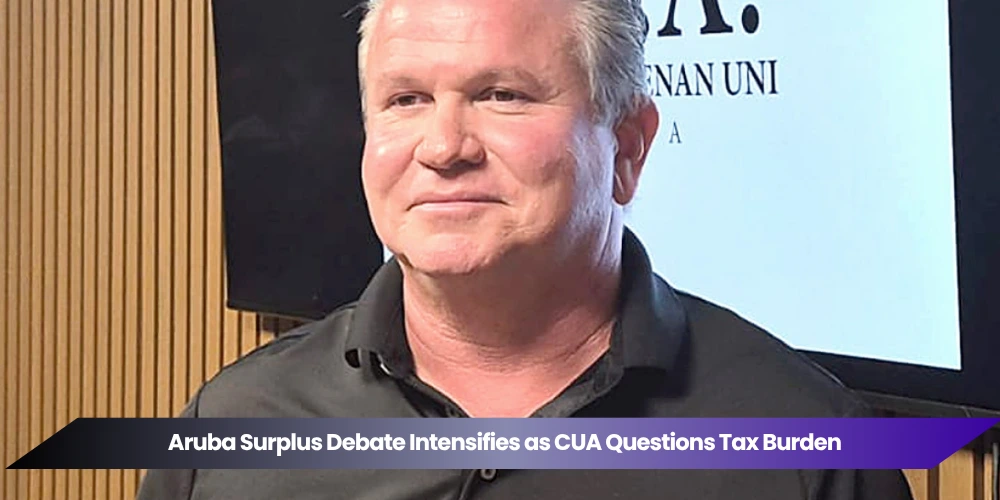
ORANJESTAD, Aruba — The Aruba Surplus Debate has gained a new business-sector perspective after Comerciantenan Uni di Aruba President Frans Ponson questioned how government leaders present positive financial results to the public.
During a CUA press conference this week, Ponson argued that residents should remember that a government surplus is ultimately built from public revenues and should therefore be considered alongside the level of taxation and the services citizens receive in return.
His remarks represent CUA’s economic and political assessment rather than an official accounting conclusion.

Ponson Questions How Surpluses Are Presented
Ponson challenged the idea that a surplus by itself proves that government has managed public finances successfully.
His central argument is that government revenue largely originates from individuals and businesses through taxes and other charges. When tax collections rise, he said, residents are effectively contributing more toward the financial result.
Ponson therefore believes discussions about large surpluses should also examine how much households and businesses are paying and whether public services and infrastructure are improving accordingly.
BBO Example Was Hypothetical
During his explanation, Ponson used the example of government hypothetically increasing BBO to 10%, arguing that businesses would ultimately recover much of that cost through prices paid by consumers.
Aruba does not currently have a 10% combined BBO rate.
The Tax Department states that the combined BBO, BAVP and BAZV rate has been 7% since January 1, 2023. This consists of 2.5% BBO, 1.5% BAVP and 3% BAZV.
Businesses are legally responsible for declaring and paying the applicable turnover-related taxes, although taxation can influence operating costs and ultimately consumer prices.
Fiscal Surplus Has Several Components
A government financing surplus is broader than tax collections alone.
It generally means that revenues exceeded expenditures during the relevant budget period or that a budget projects such a result.
Revenue can include taxes and other government income, while the final balance is also affected by expenditure levels and financial results elsewhere in the collective sector.
For 2026, the College Aruba financieel toezicht said Aruba budgeted a collective-sector financing surplus of approximately 2.6% of gross domestic product, exceeding the minimum 1% financing-balance standard established under Aruba’s financial-supervision framework.
The surplus therefore should not automatically be interpreted either as proof of excellent government performance or solely as evidence that residents were overtaxed. Both revenue and spending developments must be examined.
CUA Connects Surplus Discussion to Public Services
Ponson’s criticism comes as CUA is also raising concerns about government services and infrastructure.
During the same series of public comments, the organisation criticised delays involving construction permits, deteriorating roads and the lengthy closure of the Rooi Afo bridge.
Ponson argued that businesses and residents continue paying taxes while encountering delays when seeking government approvals or waiting for infrastructure improvements.
CUA members have reportedly complained about construction-permit applications remaining unresolved for extended periods, in some cases without clear responses.
For Ponson, those experiences raise the question of whether positive government financial balances are translating quickly enough into improvements that residents and businesses can see.
CAft Has Also Pointed to Low Investment Execution
The concern about public investment has some broader fiscal context.
In its assessment of Aruba’s 2026 budget, CAft said the available budgetary space was being used substantially for structural policy measures and nominal debt reduction, while the level of public investment remained low.
CAft linked the low investment level partly to limitations in Aruba’s implementation capacity.
This does not mean that surplus funds can automatically be redirected to any road, bridge or other project. Aruba’s financial-supervision rules place conditions on budget balances, debt reduction and the use of positive financial results.
Previous government explanations have also stressed that surplus funds are subject to legal rules and cannot simply be spent without considering debt obligations and fiscal requirements.
Taxes Remain Part of Wider Fiscal Discussion
Aruba’s tax system has remained an important subject for businesses and consumers.
The government has been exploring whether the existing BBO system could eventually be replaced by a VAT-style system, with the stated condition that any reform should not increase the overall tax burden on citizens and businesses.
The evaluation has included technical assistance from the International Monetary Fund and consultation with local stakeholders, including CUA.
Any future change would require additional policy decisions and legislation.
Debate Focuses on What Residents Receive in Return
Ponson’s comments ultimately frame the Aruba Surplus Debate around value for taxpayers.
CUA is not disputing that fiscal discipline, debt reduction and positive government balances can strengthen public finances. Instead, Ponson argues that citizens should also evaluate whether taxation is accompanied by timely permits, maintained roads, repaired infrastructure and efficient government services.
His comments add a business-sector critique to Aruba’s ongoing discussion about how financial surpluses should be measured, communicated and ultimately used.
The debate is likely to continue as government presents future budgets and spending priorities while businesses and residents assess whether improvements in Aruba’s public finances are producing visible improvements in everyday services.