

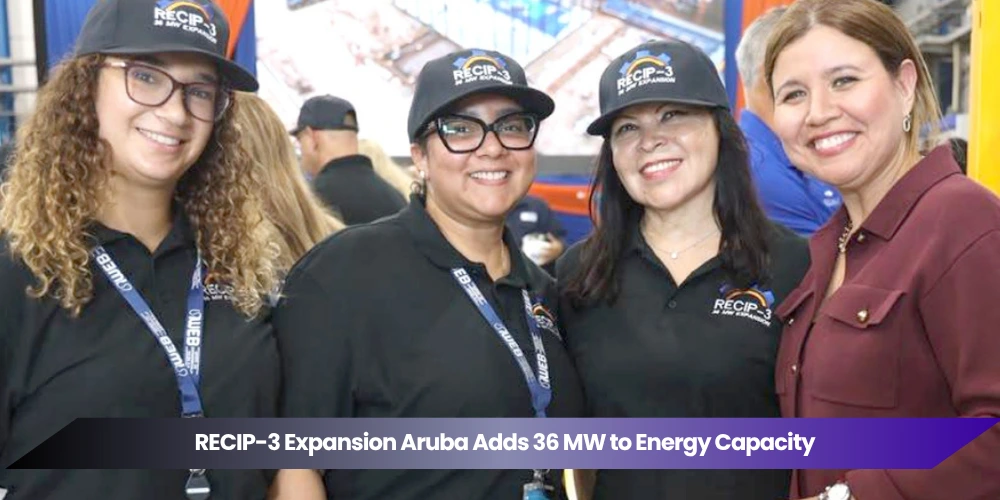
ORANJESTAD, Aruba — The RECIP-3 Expansion Aruba project has been officially completed, adding 36 megawatts of firm electricity-generation capacity to WEB Aruba’s power system.
The expansion, representing an investment of approximately Afl. 115 million, was formally delivered on August 19, 2026. Two new Wärtsilä engines and generators increase WEB’s RECIP generating capacity from approximately 194 MW to 230 MW.
Members of the AVP parliamentary faction attended the official handover, including Parliament President Marlon Sneek and parliamentarians Jennifer Arends-Reyes and Clifford Heyliger.

They described the project as an important investment in Aruba’s critical infrastructure and long-term energy security.
Two Engines Add 36 MW of Firm Capacity
The RECIP-3 expansion consists of two additional Wärtsilä generating units, each capable of producing approximately 18 MW.
WEB and Wärtsilä originally signed the expansion agreement on October 31, 2024, with the project designed to respond to growing electricity demand across the island.
The completed 36 MW addition provides WEB with additional firm capacity that can be called upon when electricity demand rises or when other generating units are temporarily unavailable.
Current reporting places total RECIP generating capacity at approximately 230 MW following completion of the project.
Growing Electricity Demand Drove Expansion
WEB began planning additional capacity after experiencing a significant increase in electricity consumption.
The utility has previously linked the increase to several factors, including higher temperatures, tourism growth, economic activity, construction and residential development.
In 2024, WEB introduced a temporary 20 MW mobile power plant as a short-term measure while permanent capacity was being developed.
Completion of RECIP-3 is expected to allow WEB to replace that temporary facility with permanent generating capacity.
AVP Calls Reliable Electricity a Basic Necessity
Heyliger, who chairs Parliament’s energy committee, said reliable electricity should be regarded as a basic requirement rather than a luxury.
He said dependable energy is necessary for households, schools, hospitals, tourism businesses, commercial activity and public services.
According to the AVP faction, the additional 36 MW improves Aruba’s ability to meet current demand while providing greater capacity for future growth.
The statement represents the faction’s assessment of the investment. The completion announcement did not provide a numerical estimate of how much the project will reduce outages or how electricity tariffs will be affected.
Firm Capacity Can Support More Renewable Energy
The new engines also form part of WEB’s strategy for integrating greater amounts of renewable electricity.
Solar and wind generation vary depending on sunlight, wind conditions and time of day. Electricity systems therefore require sufficient controllable generation or storage to keep supply and demand balanced.
Wärtsilä has previously explained that its reciprocating engines can start and stop relatively quickly, allowing them to complement variable renewable-energy production while supporting grid stability.
WEB has also been exploring additional battery storage and renewable-energy projects as part of its longer-term energy plans.
Expansion Is Not Replacement for Energy Transition
AVP parliamentarian Jennifer Arends-Reyes said the RECIP-3 project should not be viewed as an alternative to Aruba’s transition toward cleaner energy.
Instead, she described firm generating capacity as a foundation that can allow the island to integrate more solar, wind and battery storage without compromising system reliability.
She called for continued investment in clean energy, storage systems and grid modernisation while maintaining attention to affordability for consumers.
The exact future renewable-energy projects, investment amounts and implementation dates were not part of the parliamentary faction’s latest announcement.
Wärtsilä Has Long Relationship With WEB
Wärtsilä has supplied several generations of reciprocating power plants to WEB during more than two decades of cooperation.
In 2024, the companies completed the formal takeover of RECIP Phase IV, a 102 MW dual-fuel power plant consisting of six Wärtsilä engines.
At that time, Wärtsilä reported that WEB’s Wärtsilä-based generating fleet totalled 194 MW.
The new RECIP-3 units bring another 36 MW into the permanent generating portfolio.
Project Represents Afl. 115 Million Investment
The completed expansion represents an investment of approximately Afl. 115 million, according to reporting from the official handover.
The project included the new engines and generators along with the foundations, radiators and supporting infrastructure required to integrate the units into the existing RECIP-3 plant.
Construction and installation were completed through cooperation involving WEB Aruba, Wärtsilä Finland Oy, contractors, engineers and WEB personnel.
Parliamentary Faction Calls for Continued Oversight
Sneek, Arends-Reyes and Heyliger said completion of the expansion demonstrates what can be achieved through planning, continuity and cooperation.
At the same time, the AVP faction said Parliament must continue monitoring major energy investments to ensure efficiency, transparency and measurable benefits for Aruba.
The RECIP-3 Expansion Aruba project now moves from construction into regular operation, giving WEB 36 MW of additional permanent capacity as the island works to balance increasing electricity demand with its longer-term transition toward renewable energy.