

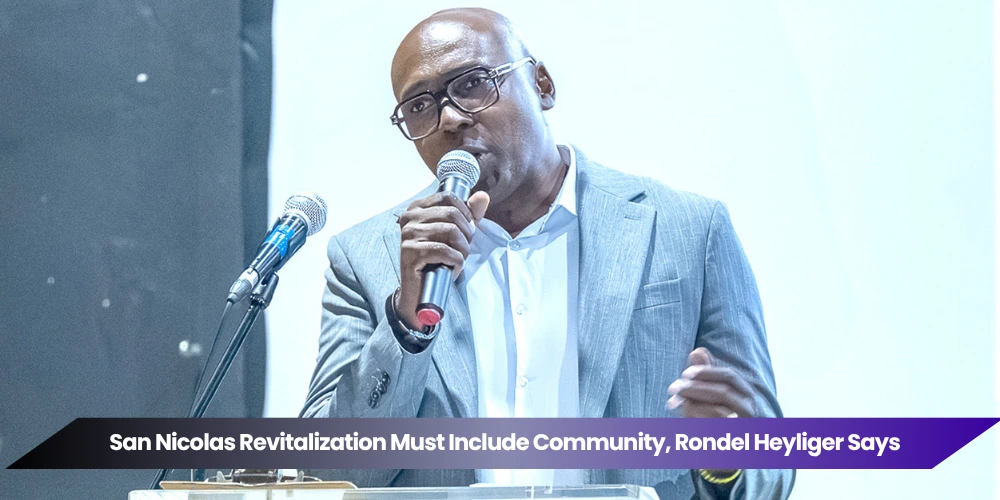
ORANJESTAD, Aruba — San Nicolas Revitalization must be built together with residents rather than simply delivered to the community, according to San Nicolas District Advisor Rondel Heyliger.
Heyliger said years of plans, studies, investments and projects have not yet produced the lasting economic and social transformation that many residents believe the district is capable of achieving.
His comments follow the presentation of five years of research by economist Suzette Dumfries during the Forum on the Future of San Nicolas.

The research examines why previous revitalization efforts have struggled to produce lasting results and what could be done differently going forward. The forum itself was designed to combine evidence, community participation and a practical implementation structure for San Nicolas.
San Nicolas Does Not Lack Ideas
Heyliger said one of the most important lessons is that San Nicolas does not necessarily suffer from a shortage of plans or ideas.
Over the years, development has been approached through infrastructure, tourism, economic programmes, social initiatives, culture and industrial activity surrounding the refinery.
The problem, he argued, is that these areas have too often been treated separately.
A renovated building, improved sidewalk, festival, tourism project or new business can contribute to development, but none can transform an entire district on its own.
According to Heyliger, sustainable revitalization requires employment, infrastructure, education, skills development, property investment, culture, security, commerce and private capital to reinforce one another.
Lago Demonstrated Power of an Integrated Economy
Heyliger used the history of the Lago refinery to illustrate what an interconnected local economy can look like.
Lago did more than directly employ refinery workers. Around those jobs developed training, career opportunities, housing, healthcare, education, sports, recreation and a wider network of shops and service providers.
The refinery therefore supported economic activity throughout San Nicolas.
That system also contained inequality, segregation and economic dependence, Heyliger acknowledged. He said the goal should not be to recreate the Lago era but to understand how strongly connected economic activities can support an entire district.
Lago ceased operations in March 1985. IMF historical analysis estimates that the closure resulted in around 1,300 direct job losses and another 6,000 to 7,000 indirect losses, creating a major shock for Aruba’s economy.
Research Places Community Voice at Center
Heyliger said one of the most valuable elements of Dumfries’ research is its focus on residents rather than relying exclusively on reports and statistics.
The five-year project included extensive engagement with people connected to San Nicolas, including residents, entrepreneurs, property owners, churches, police representatives, cultural organisations, young people and older adults.
Repeated themes included recognition, belonging, safety, equal economic opportunity, authenticity, participation and trust.
The wider Forum on the Future of San Nicolas similarly emphasises that development should include residents alongside government, investors, financial institutions, businesses and civil organisations.
For Heyliger, the central principle is straightforward: San Nicolas should not be developed without meaningful participation from San Nicolas itself.
Community Participation Comes With Responsibility
Heyliger said participation cannot be understood only as a demand directed toward government.
Residents, entrepreneurs, young people and property owners must also prepare themselves to participate when economic opportunities emerge.
If more visitors begin exploring San Nicolas, he asked, will local entrepreneurs be prepared to provide restaurants, cafés, galleries, shops, tours and cultural experiences?
If vacant buildings regain economic value, will local property owners activate them?
And if new industrial activity develops around the former refinery site, will young residents have the qualifications required for the resulting jobs?
Heyliger said these questions should be addressed before major investment arrives rather than afterward.
Government Cannot Revitalize San Nicolas Alone
Government has an important responsibility, Heyliger said, particularly in infrastructure, public spaces, safety, coordination and creating appropriate conditions for investment.
However, he argued that government cannot renovate every vacant building, operate every cultural attraction or create every new business.
A lasting development model requires different actors to assume different responsibilities.
Investors provide capital. Property owners can return vacant buildings to productive use. Entrepreneurs establish new services and companies. Educational institutions can help prepare workers, while government provides policy, infrastructure and coordination.
Community participation, meanwhile, can help establish priorities and protect the district’s interests.
Small Businesses Must Connect With Larger Investments
Heyliger said future investment connected to the former refinery area should have meaningful links with San Nicolas’ wider economy.
New developments could create demand for suppliers, contractors, transportation, maintenance, catering and professional services.
Local small and medium-sized businesses should therefore be prepared to compete for those opportunities.
The Government of Aruba and the Netherlands announced in November 2025 that the former refinery would be dismantled and the site repurposed for sustainable and inclusive development, creating another major transition for San Nicolas.
Heyliger warned against repeating a model in which major economic activity occurs behind refinery gates while the surrounding community remains disconnected from the benefits.
Skills Development Must Begin Early
Young people will also need preparation if San Nicolas is to benefit from future investment.
Training decisions made today could determine whether residents qualify for future positions in construction, technology, energy, tourism, transportation, maintenance and professional services.
Heyliger said revitalization should therefore connect investment with education and workforce development.
Instead of waiting until companies arrive and then discovering that qualified local workers are unavailable, the district should anticipate the skills those investments are likely to require.
Local Ownership Remains Important
Property ownership is another important part of the discussion.
San Nicolas contains buildings and parcels that could become increasingly valuable as investment and tourism activity expand.
Heyliger said local property owners should consider how those assets can contribute to economic renewal rather than leaving them vacant until outside investors recognise their potential.
That does not mean rejecting external investment. Instead, he argues for ensuring that residents and local businesses remain meaningful participants in the district’s changing economy.
Revitalization Must Become an Integrated Process
Dumfries’ forum presents San Nicolas as more than an isolated urban-renewal project.
The initiative considers employment, investment, property, housing, security, culture, social cohesion and economic development as interconnected issues affecting both San Nicolas and Aruba as a whole.
Heyliger said this integrated approach offers an opportunity to move away from a cycle of individual projects that produce visible improvements without establishing a lasting economic structure.
The objective should be an environment where each investment strengthens additional activity.
A tourism attraction could support restaurants. Improved public spaces could increase foot traffic. Training programmes could prepare residents for employment. New businesses could activate vacant properties, while larger industrial investments could create demand for local suppliers.
Future Must Include San Nicolas Residents
For Heyliger, the central question surrounding San Nicolas Revitalization is not only how much government or investors will spend.
Residents must also ask what they are prepared to build, learn, invest in and operate.
Government can create conditions for development, but entrepreneurs, young people, professionals, artists, property owners and community organisations must be prepared to take advantage of those conditions.
Heyliger said revitalization should no longer be viewed as something happening to San Nicolas.
It must become something developed with San Nicolas, ensuring that residents have a genuine economic and social stake in the district’s future.
Heyliger said he plans to elaborate further on Dumfries’ research findings in a second part.