
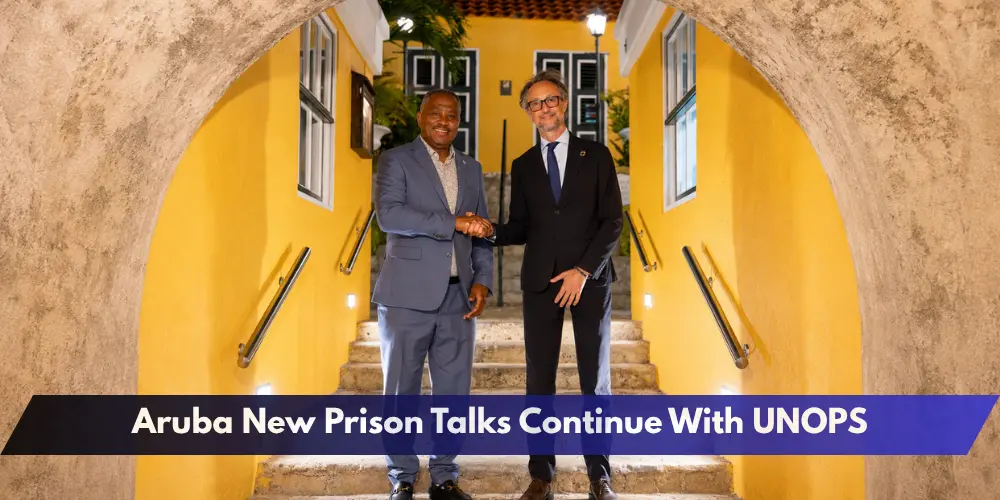
ORANJESTAD, Aruba — Aruba New Prison plans remain under discussion as Justice Minister Arthur Dowers continues exploring cooperation with the United Nations Office for Project Services, or UNOPS, on development of a modern correctional facility.
Dowers recently met Giuseppe Mancinelli, UNOPS Deputy Regional Director for Latin America and the Caribbean, while attending the Justitieel Vierlandenoverleg in Curaçao.
The meeting continued discussions that have been taking place between Aruba and UNOPS about possible technical and project-management assistance for a new prison.

According to Dowers, conditions at the existing Korrektie Instituut Aruba, or KIA, have reached a point where developing a modern correctional institution is no longer simply an option but a necessity.
Aruba New Prison Cooperation Still Being Explored
The latest meeting did not result in a final agreement for construction.
Instead, Aruba and UNOPS are continuing to examine how the international organization could contribute to the project.
UNOPS has experience providing technical assistance, project management and supervision for major public infrastructure developments.
That experience is particularly relevant because the organization is already involved in development of the new Point Blanche correctional facility in Sint Maarten.
Dowers has previously met UNOPS representatives while studying how Aruba could modernize its own detention infrastructure.
Sint Maarten Project Provides Example
The Point Blanche project has become an important regional reference for Aruba.
UNOPS is supporting work connected to the new correctional facility, including technical assistance, project management and supervision.
The development is designed to create more modern detention infrastructure while addressing security, resilience and appropriate conditions for detainees.
Dowers has previously visited Sint Maarten and followed progress on the project as Aruba considers how a similar international partnership could support its own plans.
The minister has emphasized that Aruba does not necessarily need to copy the Sint Maarten model exactly, but the experience can provide useful lessons for planning, procurement and implementation.
KIA Conditions Drive Need for New Facility
The Aruba New Prison discussion is closely connected to longstanding concerns about conditions at KIA.
The correctional facility has faced infrastructure deterioration and capacity problems for years.
Dowers has repeatedly said that both employees and detainees need safer and more appropriate conditions.
Government has continued carrying out repairs and maintenance at KIA in the short term, but those measures do not eliminate the broader question of whether Aruba requires an entirely new facility.
The minister’s position is that long-term planning must now move toward a modern correctional institution capable of meeting current and future needs.
UNOPS Could Provide Technical Support
One of the main questions still being examined is what role UNOPS could play.
Its potential involvement could include technical advice, project planning, management and supervision.
For large public infrastructure projects, these services can help governments organize development phases, procurement and implementation while following established international standards.
No final construction budget, location, timeline or formal UNOPS mandate was announced in the latest update.
The discussions therefore remain at the cooperation and planning stage.
Talks Continue After Curaçao Meeting
Dowers’ meeting with Mancinelli in Curaçao represents another step in a process that began earlier in 2026.
The government has held several discussions with UNOPS representatives while examining options for replacing or substantially modernizing Aruba’s correctional infrastructure.
For Dowers, the deteriorating conditions at KIA make it increasingly important to develop a long-term solution rather than relying only on temporary repairs.
The Aruba New Prison project has not yet reached the construction stage, but continued discussions with UNOPS indicate that the government is actively exploring the expertise and international cooperation needed to move the proposal forward.