

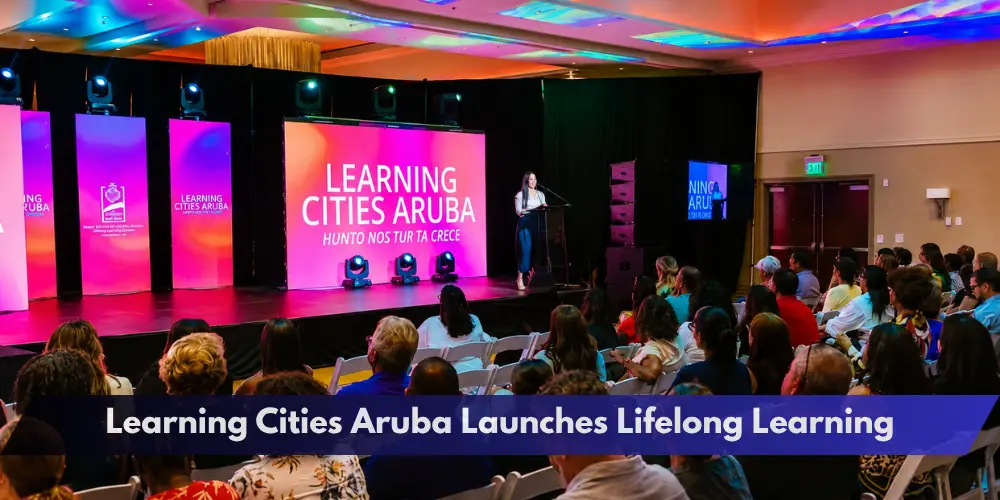
ORANJESTAD, Aruba — Learning Cities Aruba has officially launched its first phase, introducing a national approach aimed at making lifelong learning more accessible through schools, neighborhoods, workplaces and community activities across the island.
Education Minister Gerlien Croes announced the initiative as Aruba responds to rapid changes in technology, employment, education and society.
The program will focus on continuous and inclusive learning through courses, workshops and practical activities designed for people at different stages of life.

Key themes include digitalization, artificial intelligence, multilingualism, inclusion, innovation and sustainable development.
Learning Cities Aruba Builds National Network
Learning Cities Aruba is designed to connect educational institutions, families, communities, workplaces and public organizations rather than limiting learning to traditional classrooms.
The initiative is informed by principles developed through UNESCO’s Global Network of Learning Cities.
However, Learning Cities Aruba’s official platform states that this does not currently represent formal UNESCO designation, membership or endorsement.
UNESCO’s learning-city framework encourages communities to make educational opportunities available throughout people’s lives, including through formal education, workplace learning, families, neighborhoods and modern technology.
Aruba is adapting those principles to an island-wide national approach.
Universities and Education Partners Join
A network of local educational organizations will help develop and deliver the initiative.
The University of Aruba and Instituto Pedagogico Arubano, or IPA, are among the partners expected to contribute through research, adult education and continuing professional development for teachers and educational leaders.
Tienda di Educacion will also play a role in bringing educational resources and support more directly into neighborhoods.
Other participating organizations include educational institutions and professional groups working in vocational education, language development and community learning.
Local and international experts are also expected to contribute knowledge in specialized areas.
AI and Digital Skills Among Priorities
Technology will be an important component of Learning Cities Aruba.
The initiative recognizes that artificial intelligence and digitalization are changing how people study, work and interact.
Rather than treating those developments only as challenges, organizers want residents and education professionals to develop the knowledge required to use technology responsibly and effectively.
The project’s framework includes digital and AI literacy while emphasizing that technology should expand access to learning rather than create additional exclusion.
Other priorities include multilingual education, human rights, inclusion and sustainable development.
First Activities Already Planned
The Learning Cities Aruba agenda for 2026 and 2027 includes several professional and community activities.
Leadership training for educational team leaders is scheduled to begin in September.
Additional activities include workshops on social-emotional learning, support for students with language-development disorders and discussions aimed at connecting vocational education more closely with Aruba’s labor-market needs.
Future sessions are also planned on multilingual education, ethical use of technology, good governance and children’s educational rights.
The range of activities reflects the initiative’s goal of treating learning as something that continues throughout life rather than ending after formal schooling.
Learning Beyond the Classroom
One of the main ideas behind the program is that education takes place in many different settings.
Homes, workplaces, neighborhoods, community centers and public institutions can all become places where people develop new knowledge and abilities.
That approach can include workers learning new professional skills, parents participating in educational programs, teachers receiving additional training and residents developing digital or financial knowledge.
For Aruba, the wider goal is to create an environment where opportunities for learning are easier to find and better connected.
Community Invited to Participate
The Ministry of Education is inviting policymakers, educational leaders, community organizations and international partners to contribute to the platform.
Organizations that already provide educational or training activities can also become part of the broader national learning portfolio.
The first year will focus on identifying existing resources, connecting partners, launching activities and collecting information about what works.
Results can then be evaluated to determine how the initiative should develop further.
Through Learning Cities Aruba, the government hopes to strengthen education, innovation and resilience while building a culture in which learning remains available throughout a person’s life.
The long-term ambition is for Aruba to develop an island-wide learning model that can eventually serve as an example for other communities in the Caribbean.