
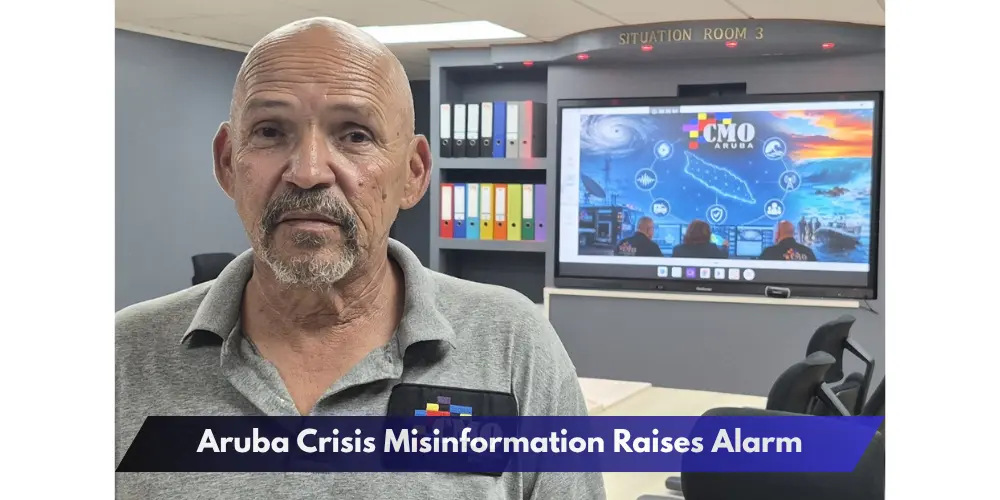
ORANJESTAD, Aruba — Aruba Crisis Misinformation spreading through social media has become one of the biggest concerns for the Crisis Management Office, according to CMO Director Rino Hermans, who is urging residents to rely on official sources during earthquakes, tsunamis, hurricanes and other emergencies.
Hermans said social-media platforms increasingly circulate information from people who may be interested in disaster management but do not necessarily have professional expertise or complete knowledge of the subject.
According to the CMO director, inaccurate information can create unnecessary fear and panic within the community.

Aruba Crisis Misinformation Concerns CMO
Hermans said the growing number of mobile applications offering earthquake, hurricane and other emergency notifications has also created confusion about what those tools can actually provide.
He explained that earthquakes differ significantly from hurricanes because they cannot be predicted in the same manner.
According to Hermans, earthquake applications generally provide information after seismic activity has been detected, including details such as the magnitude of the event.
He noted that if an earthquake were to occur very close to or beneath Aruba, residents would need to focus immediately on protecting themselves and their families rather than depending on a mobile application for advance notice.
For that reason, he encouraged people to understand the limitations of emergency applications and to avoid treating every social-media alert as verified information.
Residents Urged to Follow Official Sources
Hermans identified the Crisis Management Office and Aruba’s meteorological authorities as key official sources for information involving natural threats.
He encouraged journalists and residents to approach the appropriate authorities directly when they need clarification instead of circulating unverified reports.
The goal, he said, is to ensure the public receives accurate information while reducing unnecessary panic.
The Government of Aruba has previously emphasized that CMO plays a central role in emergency-response planning, crisis communication and public preparedness.
Years of Disaster Preparedness Training
Hermans said CMO has worked on earthquake and tsunami preparedness with UNESCO since 2013.
According to him, the organization has received international recognition for its preparedness activities and training work in the Caribbean.
CMO has also organized recurring exercises and public-education initiatives designed to help residents understand evacuation procedures and appropriate responses during disasters.
Hermans highlighted training involving schools and people with special needs as another important part of the organization’s preparedness work.
He said these exercises demonstrate why the public should have confidence in trained emergency-management professionals when receiving information about potential threats.
CMO Warns Against Panic
The CMO director stressed that residents should be cautious about information circulating online, particularly during periods when earthquakes, hurricanes or tsunami concerns are attracting widespread attention.
Aruba Crisis Misinformation can become especially harmful when unofficial claims are repeatedly shared before authorities have had an opportunity to confirm what has actually occurred.
Hermans therefore urged the community to check information through official channels before reposting emergency-related claims.
He said CMO will continue providing the media and the public with verified information when potential threats arise.
The responsibility also falls on residents, he added, to distinguish between official emergency information and unsupported claims circulating through social networks.
Hermans summarized CMO’s approach by emphasizing that its purpose is not to create fear.
Its responsibility, he said, is to provide warnings that help Aruba’s community prepare appropriately for emergencies.