

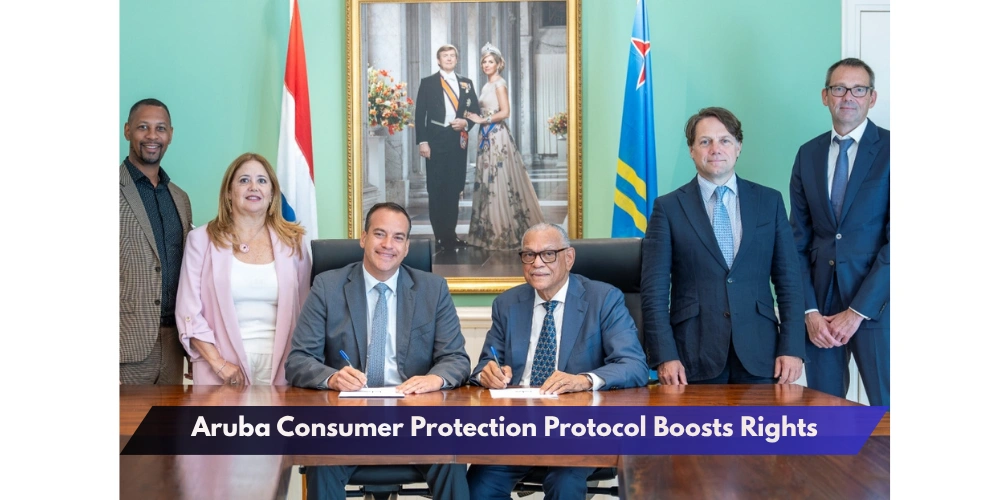
ORANJESTAD, Aruba — The Aruba Consumer Protection Protocol has been signed between the Government of Aruba and the Aruba Fair Trade Authority, creating a clearer structure for handling consumer complaints, market supervision and information sharing.
Finance, Economic Affairs and Primary Sector Minister Geoffrey Wever signed the cooperation agreement on August 24, 2026, on behalf of the Country of Aruba.
AFTA was represented by F.R. Sint Jago.

The protocol is intended to strengthen implementation of Aruba’s consumer-protection framework and clarify how AFTA and the Department of Economic Affairs, Commerce and Industry, or DEACI, work together.
Aruba Consumer Protection Protocol Defines Roles
Under the Aruba Consumer Protection Protocol, AFTA and DEACI have separate but connected responsibilities.
AFTA is responsible for supervising compliance with consumer-protection rules when an alleged violation affects the collective interests of consumers.
DEACI, meanwhile, handles individual consumer complaints, registers reports and can provide information, legal guidance and mediation where appropriate.
The arrangement creates a pathway from an individual complaint to wider regulatory action if information indicates that the same problem may affect multiple consumers.
AFTA officially confirms that it has supervised collective consumer-protection matters since March 15, 2026.
Information Sharing Becomes More Structured
The new agreement establishes procedures for exchanging relevant information between AFTA and DEACI.
It also covers coordination of supervision, alignment of internal processes and protection of confidential information.
The goal is to make it easier for the two organizations to identify recurring problems in the marketplace while ensuring each agency can fulfill its own legal responsibilities.
For consumers, the structure is intended to make it clearer where to go when a problem occurs.
For businesses, it provides greater clarity about which authority supervises compliance with consumer rules.
ConsuLoket Plays Central Role
An important part of the agreement is ConsuLoket, Aruba’s digital consumer information and complaint portal.
AFTA is responsible for financing, content, management and maintenance of the portal.
DEACI is responsible for the system used to register and process individual consumer reports submitted through ConsuLoket.
The systems will be aligned so relevant information can be available to both organizations where needed for their respective responsibilities.
AFTA says ConsuLoket provides consumers with information about their rights and obligations and gives them a central place to submit questions or reports.
Individual complaints remain handled through DEACI, while AFTA can use information from those reports to determine whether a broader investigation is warranted.
Wever Links Protection to Economic Confidence
Wever said consumer protection should be considered an integral part of Aruba’s economic policy.
According to the minister, a strong economy requires more than economic growth. Consumers must understand their rights, businesses need clear rules and public institutions must function effectively.
He also connected consumer protection with purchasing power.
While purchasing power is often discussed in terms of prices and income, Wever said consumers also need protection against unfair commercial practices and access to reliable information when making purchasing decisions.
A marketplace in which consumers feel protected can also create more confidence for businesses that comply with the rules.
AFTA Can Act on Collective Violations
AFTA’s consumer-protection responsibilities go beyond providing information.
The authority can investigate possible collective violations and, where legally justified, take enforcement measures against businesses that fail to comply.
Its official framework allows actions such as administrative fines, orders subject to penalties and public warnings in appropriate cases.
Individual disputes, however, remain separate from AFTA’s collective supervisory role.
This distinction is one of the areas the new cooperation protocol is intended to make clearer.
Cooperation Will Be Reviewed Regularly
The Aruba Consumer Protection Protocol also establishes ongoing oversight of the cooperation itself.
The directors of AFTA and DEACI are expected to meet at least four times each year to discuss implementation, progress and possible obstacles.
Officials at the operational level can maintain more frequent contact when required.
The agreement and its implementation will also be evaluated at least once per year to determine whether changes are needed.
For the government, the objective is to turn consumer-protection legislation into a functioning system involving clear responsibilities, effective supervision and accessible services.
The protocol represents another step in Aruba’s effort to create a more transparent marketplace where consumers have greater protection and businesses have clearer rules to follow.