

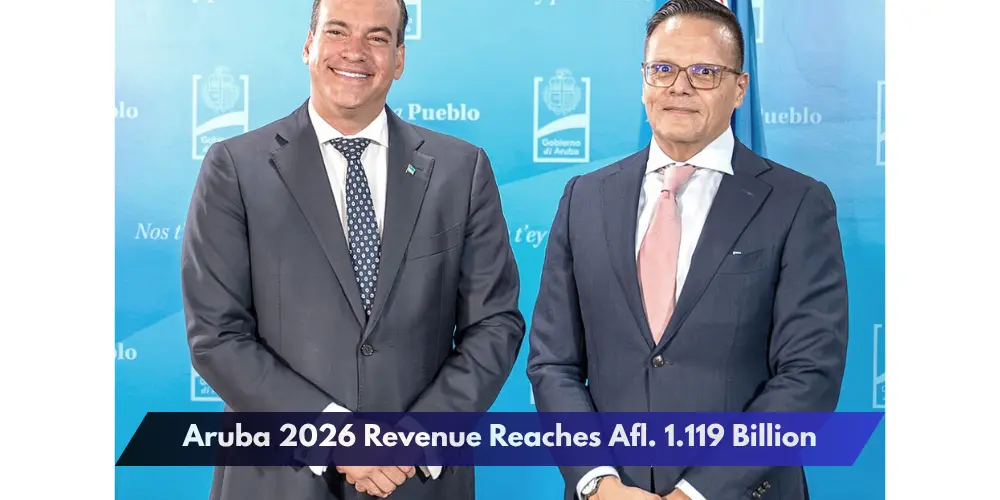
ORANJESTAD, Aruba — Aruba 2026 Revenue reached Afl. 1.119 billion through June 30, representing 56.6% of the government’s total projected income for the year, according to preliminary figures presented by Finance, Economic Affairs and Primary Sector Minister Geoffrey Wever.
The figures form part of Aruba’s quarterly budget execution reporting and show government income running ahead of projections while spending remained below the level budgeted for the first half of the year.
The difference between revenue and expenditure produced a preliminary positive result of nearly Afl. 260 million.

Wever said the results demonstrate the importance of maintaining financial discipline, controlling expenditure and supporting continued economic activity.
Aruba 2026 Revenue Rises From Last Year
Aruba 2026 Revenue increased by approximately Afl. 86 million compared with the first six months of 2025.
Direct and indirect tax revenue allocated to the Country of Aruba reached approximately Afl. 918 million, representing an increase of 7% compared with the same period last year.
BBO/BAVP collections reached Afl. 232 million, up approximately 8%.
Tourist levy revenue also recorded strong growth, reaching Afl. 63.1 million, an increase of 18% compared with the first half of 2025.
Another significant contributor was profit tax.
Government collected Afl. 252.4 million in profit tax during the first six months of 2026, described as the highest first-half level recorded between 2019 and 2026.
According to the figures presented, approximately 90% of this revenue came from regular and structural collections related to company results from 2025.
Wever said the figures point to continued positive development in Aruba’s business activity and broader economy.
Government Spending Remains Below Budget
Government spending also remained below the annual budget trajectory during the first six months of the year.
The preliminary overview presented by the minister placed total expenditure at approximately Afl. 860 million, equivalent to 46.3% of the annual spending budget.
Some of the higher spending compared with 2025 was connected to measures intended to directly support residents.
These included an additional Afl. 150 per month in reparatietoeslag for pensioners, which took effect on January 1, 2026.
Government also temporarily reduced excise duties on gasoline and diesel in response to higher international oil prices.
The measure was intended to limit pressure on household purchasing power and reduce rising operating costs for businesses.
Public Wage Bill Below LAft Limit
The budget execution figures also provide an update on government personnel expenses.
During the first six months of 2026, the public wage bill represented approximately 4.19% of GDP.
Based on the current trend, government projects personnel expenses will reach approximately 8.2% of GDP for the full year.
That would remain below the maximum 10% standard established under LAft.
Wever said controlling personnel and other government expenses remains important despite stronger-than-expected revenue.
Aruba Debt Stands at Afl. 5.022 Billion
At the end of June, Aruba’s public debt stood at approximately Afl. 5.022 billion, equal to 62.2% of GDP.
That compares with a debt-to-GDP ratio of 65.9% during the second quarter of 2025.
Aruba paid approximately Afl. 345 million toward debt during the first six months of 2026, with additional repayments scheduled for the remainder of the year.
Wever stressed that the improved financial results should not be viewed as permission to increase government spending without restraint.
He said Aruba still carries significant public debt and remains vulnerable to international economic developments.
Financial Discipline Remains Priority
The government says stronger Aruba 2026 Revenue should instead be used to improve the country’s financial position, reduce debt, protect purchasing power and create room for future investment.
Wever said the objective is not simply to present positive figures but to establish a stronger financial foundation capable of supporting government obligations and Aruba’s future development.
The Department of Finance compiles the quarterly budget execution report using information from the central government and collective-sector entities including AZV, SVb, ATA, Serlimar, SEPB and the University of Aruba.
The report is submitted to the College Aruba financieel toezicht as part of Aruba’s financial supervision requirements.
Wever said the first-half results are encouraging but stressed that continued discipline will be necessary to keep debt falling, maintain spending controls and strengthen Aruba’s economy and purchasing power.