

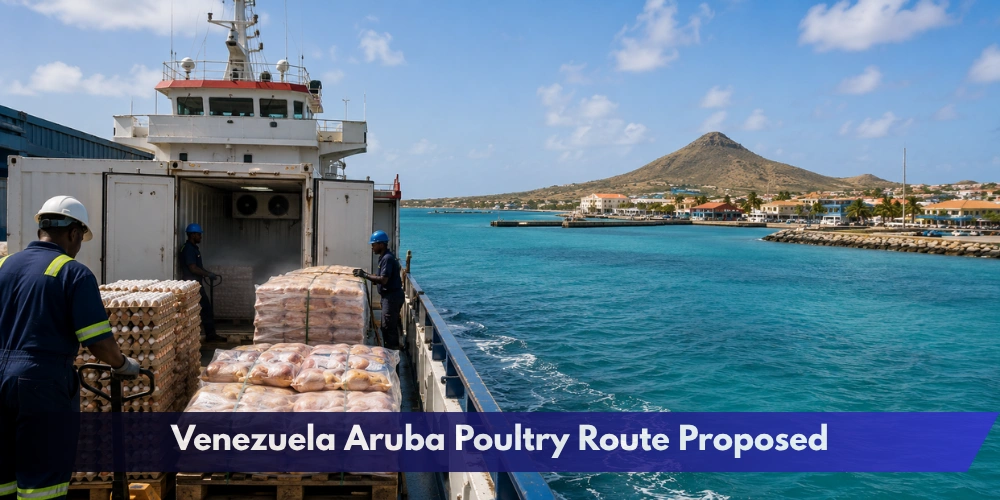
ORANJESTAD, Aruba — A Venezuela Aruba Poultry Route has been proposed as Venezuela’s poultry industry looks to establish a regular maritime connection with Aruba, Curaçao and Bonaire for exports of chicken and eggs.
Francisco Tagliapietra, president of Venezuela’s National Poultry Federation, known as Fenavi, has called for a frequent ferry-style maritime service linking Venezuelan producers with the ABC islands.
The proposal comes as Venezuela’s poultry industry expands production and looks for nearby international markets capable of absorbing additional supply.

Fenavi views Aruba and the neighboring Dutch Caribbean islands as attractive markets because of their proximity to Venezuela and their dependence on imported food products.
Venezuela Aruba Poultry Route Targets ABC Islands
Under the proposed Venezuela Aruba Poultry Route, producers could regularly transport chicken and eggs directly from Venezuela to Aruba, Bonaire and Curaçao.
Tagliapietra has also proposed creating a National Poultry Export Council to help coordinate the industry’s move into international markets.
Venezuela’s poultry sector produced more than 824,825 tons of chicken during 2025, according to figures cited by Fenavi.
The industry also reportedly has unused production capacity that could allow output to increase further if additional export markets become available.
Fenavi has been examining opportunities in the ABC islands for some time.
In 2025, Tagliapietra estimated that Aruba, Curaçao and Bonaire together could initially absorb approximately two million kilograms of Venezuelan chicken each month.
The islands’ tourism industries and their short distance from the Venezuelan coast were identified as important commercial advantages.
Refrigerated Shipping Will Be Essential
Establishing the route would require more than simply increasing poultry production.
Chicken is highly perishable, meaning any regular maritime connection would need reliable refrigerated cargo capacity and a schedule frequent enough to maintain product quality.
Packaging is another issue that Venezuelan producers would need to address.
Products destined for international markets would need proper classification, dates and packaging that meet export and destination-market requirements.
Fenavi has acknowledged that products currently distributed domestically in bags and baskets would need to be prepared differently before large-scale exports could become practical.
Aruba Import Rules Would Still Apply
The proposed Venezuela Aruba Poultry Route would also depend on meeting Aruba’s sanitary, veterinary, customs and food-import requirements.
A maritime route by itself would not automatically authorize Venezuelan poultry products to enter the Aruban market.
Local authorities would still need to approve applicable health and import conditions before commercial shipments could proceed.
Egg imports are particularly regulated in Aruba. Government information indicates that importing chicken eggs normally requires an exemption and supporting import documentation.
That means negotiations between producers and commercial partners would need to be accompanied by the necessary regulatory approvals.
Venezuela Seeks Reliable Export Connection
Fenavi’s proposal is ultimately aimed at creating a predictable logistics system rather than organizing occasional shipments.
A frequent connection would allow poultry producers to plan production around exports while giving importers in Aruba and the other ABC islands access to another nearby potential supplier.
The initiative could also shorten transportation distances compared with food imported from more distant markets.
Interest in the proposal comes as transportation links between Aruba and Venezuela are gradually changing.
Aruba reopened its air border with Venezuela for eligible commercial flights beginning August 1, 2026, subject to approvals and requirements from both countries.
Maritime Route Remains a Proposal
For now, the Venezuela Aruba Poultry Route remains a proposal from Venezuela’s poultry sector.
No final agreement establishing a regular ferry or cargo service for chicken and egg exports to Aruba, Bonaire and Curaçao has been announced.
Before shipments could begin at scale, producers would need to resolve refrigeration and packaging requirements while authorities and businesses address sanitary, customs and import procedures.
If those challenges are resolved, Fenavi believes the proximity of the ABC islands could make them logical first markets as Venezuela’s poultry industry looks to expand its exports beyond the domestic market.