

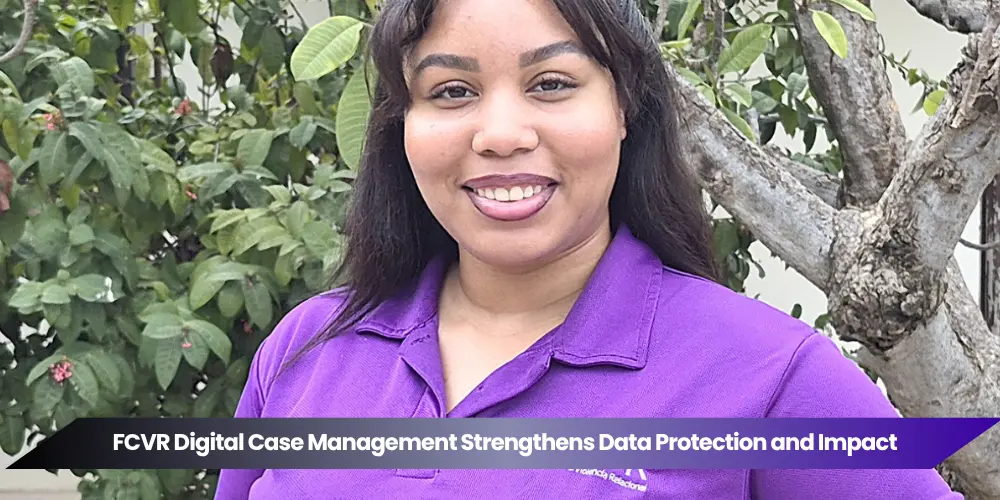
ORANJESTAD, Aruba — FCVR Digital Case Management is changing how Fundacion Contra Violencia Relacional records client information, prepares reports and measures the impact of its work across Aruba.
Before introducing the new application, FCVR processed a significant amount of information manually, according to social worker Shanaya Cicilia.
She said the previous method presented challenges involving the organisation and secure storage of confidential information connected to people receiving support for relational and gender-based violence.

Client Records Move Into Structured Digital System
The new application allows FCVR to digitally register and organise essential information connected to individual cases.
This includes important documents such as safety plans developed for clients and their families.
FCVR describes a safety plan as an individualised practical tool designed to help someone prepare for situations in which their safety may be at risk.
The system can also record action plans used during the guidance process.
According to Cicilia, these plans help clients identify concrete steps toward strengthening their personal circumstances, developing greater independence and eventually leaving a cycle of violence.
Digitalisation Supports Case Management
Case management forms one of FCVR’s central services.
The foundation provides personalised support that can include safety planning, legal referrals, psychological services and assistance accessing social resources.
Keeping these records in a more structured system can help staff organise information associated with each client and follow the different stages of assistance.
The foundation says all of its services are confidential, making responsible handling of sensitive information particularly important.
The latest announcement does not disclose the application’s technical security specifications.
Monthly Reporting Becomes More Structured
The application is also intended to improve FCVR’s monthly reporting.
Cicilia said the foundation can use the system to record how many people receive guidance and support during a particular period.
It can additionally track:
- Clients referred to outside organisations for additional assistance;
- Referrals FCVR receives from other organisations;
- Services provided to individual clients;
- Information and educational initiatives;
- Empowerment programmes;
- The reach of different FCVR projects.
The information gives the organisation a more structured picture of the services provided each month.
Foundation Wants to Measure Community Impact
Beyond administrative efficiency, FCVR says one of the application’s main advantages is its ability to help measure the organisation’s impact.
A foundation may conduct workshops, individual counselling, referrals, shelter services and awareness campaigns, but evaluating their overall reach requires reliable records.
The new system allows FCVR to organise this information in a way that can be reflected more clearly in reports.
Cicilia said this will help the organisation assess not only how much work is being carried out but also the effect its programmes are having on clients and the wider community.
FCVR Has Expanded Its Professional Services
FCVR has worked in Aruba since 1995 and describes itself as the island’s national centre of expertise and treatment focused on relational and gender-based violence.
Its services currently include residential shelter, case management, aftercare, advocacy, awareness activities and professional expertise.
The foundation says its approach has evolved over the years through additional programmes, a dedicated crisis shelter and greater professionalisation of its services.
Its official organisational history also identifies the introduction of a custom CRM system as part of that continuing development.
Accurate Data Can Support Future Planning
More consistent information can help social-service organisations identify changes in demand.
For example, FCVR may be able to determine whether more clients are requiring particular types of referrals, whether specific programmes are reaching their intended audiences or whether demand for services is increasing.
Those findings can support internal planning, funding applications and cooperation with government departments and other community organisations.
UNHCR reported that it has worked with FCVR to strengthen internal procedures and cooperation with government and civil-society partners in Aruba as part of wider efforts addressing violence against women and girls.
Privacy Remains Essential
Digitalisation can make records easier to organise and analyse, but information concerning survivors of relational violence is particularly sensitive.
Client records may include personal circumstances, safety plans, referrals and other confidential information.
The announcement does not specify who can access the application or describe its technical security measures. Those details should therefore not be assumed.
FCVR publicly states that its services are confidential and maintains dedicated case-management and crisis-support services for survivors and their families.
System Supports FCVR’s Long-Term Development
Cicilia described the new application as an important instrument for processing information in a more structured way and showing the real impact of FCVR’s work.
The FCVR Digital Case Management system therefore serves two purposes: helping staff organise individual cases and giving the organisation better information about its overall services.
As FCVR continues supporting people affected by relational and gender-based violence, the digital system is expected to help the foundation document its work more consistently while maintaining its focus on safety, confidentiality and long-term empowerment.