

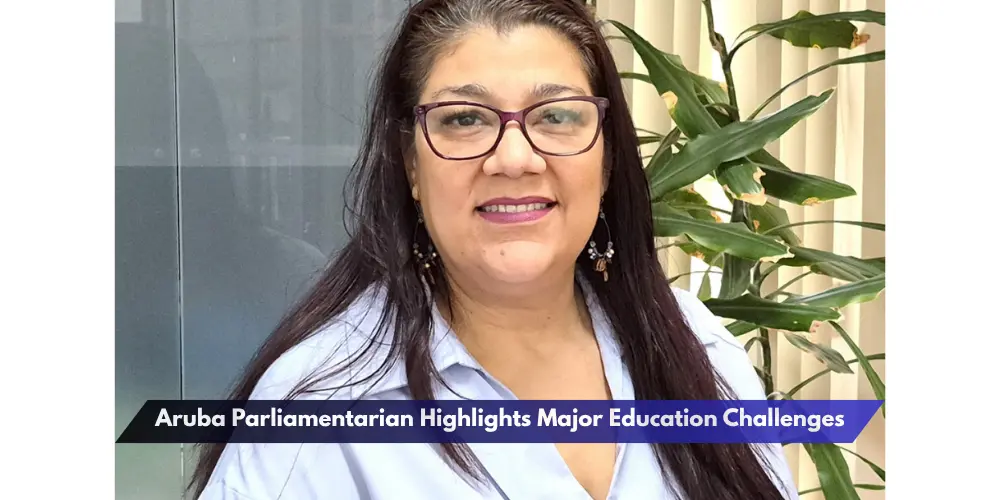
ORANJESTAD, Aruba – Aruba Education Challenges remain a major concern as Vice President of Parliament Muzaninn Wever acknowledges that the island’s school system continues to face serious problems involving infrastructure, maintenance and long-delayed investment.
In an interview, Wever began by wishing all students who are starting the new school year success and expressing hope that they will have a positive and productive academic year.
At the same time, he acknowledged that the education sector is dealing with many challenges that cannot be solved immediately.

According to Wever, one of the main problems is the lack of sufficient investment over many years in school renovations, infrastructure and educational materials. He said that when school buildings are neglected for a long period, the problems become more difficult and expensive to correct.
Wever stressed that deteriorated buildings cannot simply be repaired overnight. In his view, the current government inherited a large number of unresolved issues that require careful attention and coordination.
He also recognized that many people are tired of hearing that they need to be patient.
According to the parliamentarian, parents, teachers and school communities have already waited for years and understandably want visible solutions rather than further delays.
Wever said he understands that frustration and added that Education Minister Gerlien Croes is actively working on solutions.
The Aruba Education Challenges discussion also includes the relationship between government and individual school boards.
Wever explained that not every school building falls directly under government control. In those cases, school boards have an important role in identifying problems, preparing budgets and formally submitting requests so that necessary improvements can be considered and addressed.
He said the minister cannot simply intervene in every school independently without respecting the responsibilities of the school boards.
According to Wever, maintaining cooperation and proper coordination is essential.
He argued that if the government were to take complete control over every decision involving schools, it would effectively remove the role of school boards altogether, something he does not believe would be the right solution.
Instead, he said school boards should continue carrying out their responsibilities while working together with the ministry to improve school conditions.
The parliamentarian emphasized the importance of maintaining what he described as synergy between the different parties involved.
This means that the Ministry of Education, school boards and other responsible institutions need to communicate clearly and work within their respective roles.
Wever’s comments underline that Aruba’s education challenges are not limited to one single issue.
Aging buildings, delayed maintenance, school materials, administrative responsibilities and funding all form part of a broader situation that has developed over many years.
The parliamentarian said solving these problems will require structured planning rather than isolated short-term measures.
He also suggested that clear budgets and proper communication from school boards are necessary so the ministry can evaluate and support required improvements.
As the new school year begins, the discussion places renewed attention on the condition of Aruba’s schools and the need for long-term investment in education.
Aruba Education Challenges remain significant, but Wever said the focus should be on cooperation and practical solutions rather than assigning responsibility to only one institution.
He concluded by emphasizing that school boards have an important role to play in improving their own institutions and that government and education authorities must continue working together to create better conditions for students and teachers across Aruba.