


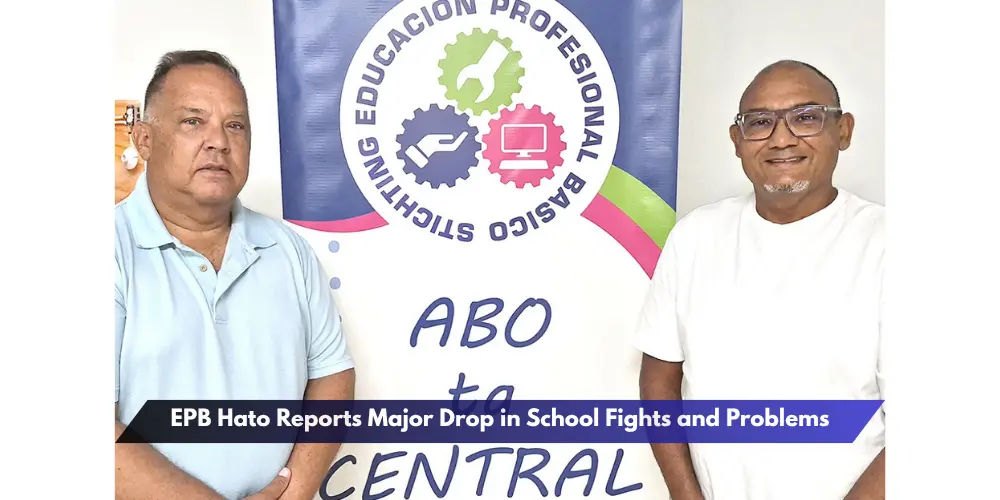
ORANJESTAD, Aruba – EPB Hato School Safety improved significantly during the 2025–2026 academic year, with Director Erwin Lopez reporting that the school experienced almost no fights either inside or directly outside the campus compared with previous years.
EPB Oranjestad, located in Hato, had previously attracted attention because of repeated social and behavioral problems involving students. Incidents reported in earlier periods included fights between young people, confrontations involving security personnel and situations in which parents became involved in disputes outside the school.
According to Lopez, social challenges have not completely disappeared, but the situation has become much more manageable and is no longer developing out of control as frequently as before.

One important part of the improvement has been the availability of additional student support. EPB Hato currently has two social workers and a psychologist who assist students facing personal, emotional or social difficulties.
Lopez said these professionals are doing valuable work and helping the school address problems before they escalate.
He also acknowledged that financial difficulties within some families can contribute to challenges faced by students.
To help address those situations, the school has a foundation supported by teachers. According to Lopez, teachers make monthly contributions from their salaries to help students who are experiencing financial hardship.
The EPB Hato School Safety improvement was particularly visible during the 2025–2026 school year. Lopez said the school now sees very few fights and that the area directly in front of the campus has also become much calmer than during the previous year.
He described the development as evidence that the school is moving in a positive direction.
Financial pressure remains another important issue for students and parents. Families may struggle with school fees, uniforms, laptops and other expenses connected to education.
EPB Oranjestad is now fully digitalized, which means students need their own laptop computer to participate in lessons. The school no longer relies on traditional textbooks because educational materials are provided digitally.
Lopez explained that a basic laptop currently costs approximately Afl. 575 to Afl. 600 and is generally expected to serve a student for about four years.
Students are therefore required to arrive at school with their own device. Lopez emphasized that classrooms do not contain computers that can simply be assigned to students who arrive without one.
Families unable to afford a laptop can apply for assistance through the school’s Social Fund, but Lopez noted that this support requires an application process and cannot necessarily be provided immediately on the first day of school.
Internet access at home is also important because students need Wi-Fi to make full use of the digital learning system.
The school also offers payment arrangements for certain school fees. New first-year students are required to pay the applicable school fee, while existing students can receive a payment arrangement allowing them up to 12 months to complete payment.
Families facing serious financial difficulty can also request assistance from the teachers’ Social Fund.
According to Lopez, many students have applied for support and several have received help. In some cases, the fund has even contributed toward the purchase of laptops.
EPB Oranjestad also receives occasional support from local businesses, with donations helping cover outstanding differences in school-related expenses for students who need additional assistance.
The combination of professional social support, financial assistance and closer attention to student welfare appears to be contributing to the improvement in EPB Hato School Safety.
Lopez said the school still recognizes the challenges facing students and families, but the sharp reduction in fights and disturbances during the last academic year gives him confidence that EPB Hato is moving in the right direction.