

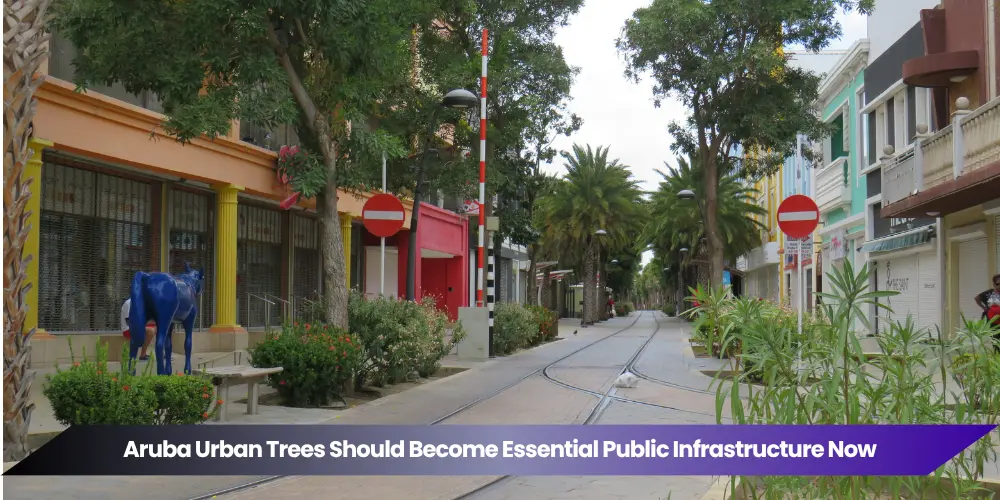
ORANJESTAD, Aruba — Aruba Urban Trees should be treated as essential public infrastructure rather than optional decoration, according to a major international scientific publication examining the importance of urban forests.
The essay, published in the scientific journal PLOS Climate, argues that trees and other woody vegetation in urban areas should receive the same long-term planning, funding and protection given to roads, drainage systems, bridges, electricity networks and water infrastructure.
Although the publication did not specifically study Aruba, its recommendations are relevant to the island as communities face rising temperatures, continued development and increasing pressure on available green spaces.

Trees Provide Essential Community Services
Urban trees perform important services every day without requiring residents to actively operate them.
They provide shade, reduce heat, filter pollutants, limit noise and help rainwater enter the soil instead of immediately flowing across roads and other hard surfaces.
Trees also slow stormwater runoff, provide habitats for wildlife, protect people from ultraviolet radiation and create areas for recreation and community activities.
Urban forests can also capture carbon and reduce the amount of energy buildings require for cooling.
These benefits mean trees should be considered working infrastructure that supports public health, environmental protection and community resilience.
Mature Trees Cannot Be Quickly Replaced
The publication warns that planting young trees does not immediately replace the benefits lost when a large, mature tree is removed or dies.
Newly planted trees may take decades to provide comparable shade, cooling, habitat and other environmental services.
Some young trees may also fail to survive because of heat, drought, limited soil, inadequate maintenance, pests or unsuitable planting locations.
Researchers therefore recommend protecting healthy mature trees while continuing to plant diverse species that are suitable for future climate conditions.
For Aruba, this would mean carefully evaluating established trees before removing them for roads, buildings, parking spaces or other developments.
Urban Heat Creates Growing Challenges
Trees can help reduce temperatures in streets, neighbourhoods, parks and other heavily developed areas.
Buildings, roads, pavements and concrete surfaces absorb and retain heat, making built-up areas warmer than locations with greater vegetation.
Shade from trees can improve comfort for pedestrians, public-transport users, outdoor workers, children and older adults.
This is especially important in Aruba, where residents and visitors spend considerable time outdoors and where shaded pedestrian spaces can support healthier and more comfortable communities.
Urban trees cannot solve climate change alone, but they can form an important part of wider climate-adaptation planning.
Rainwater Management Offers Another Benefit
Trees and healthy soil can also support rainwater management.
Roots create spaces within the soil where water can enter, while leaves and branches temporarily intercept rainfall.
This can help slow the movement of water during heavy rain and reduce the amount flowing directly across roads and developed land.
However, these benefits depend on trees having enough healthy soil and sufficient space for their roots.
Planting a tree in a small opening surrounded entirely by concrete may prevent it from developing properly.
Urban planning should therefore protect soil, root zones and nearby vegetation rather than focusing only on the visible trunk and branches.
Long-Term Budgets Are Necessary
The publication says many cities recognise the benefits of trees but fail to provide stable funding for maintenance, monitoring and protection.
Budgets often support initial tree planting without covering the years of watering, pruning, inspection and care required afterward.
The authors recommend including urban forests in municipal budgets and long-term infrastructure plans.
This would help authorities move beyond occasional planting campaigns and create organised systems for managing trees throughout their complete life cycles.
For Aruba Urban Trees, such an approach could include maintaining an island-wide tree inventory, recording tree conditions and identifying areas where additional shade is most urgently needed.
Correct Species and Locations Matter
Not every type of tree is appropriate for every urban location.
Some species may require more water than is realistically available, while others may develop roots that interfere with pavements, pipes or nearby structures.
Certain trees can also produce allergens, become vulnerable to specific pests or fail under extreme heat and drought.
The researchers therefore recommend evidence-based planning that considers local climate, soil conditions, available space, biodiversity and community needs.
In Aruba, planners would need to prioritise species capable of tolerating heat, wind, limited rainfall and coastal conditions.
A diverse selection would also reduce the risk of losing large numbers of trees to the same disease or environmental stress.
Green Areas Should Be Distributed Fairly
Access to shade and green spaces is not always equal.
Some neighbourhoods have parks, mature trees and shaded streets, while others contain large areas of concrete with little protection from the sun.
The publication recommends tracking tree cover at the neighbourhood level and prioritising communities where residents experience greater heat exposure and limited access to green areas.
Public participation should also form part of the planning process so residents can help identify where trees, shade and public spaces are most needed.
A fair Aruba Urban Trees strategy would ensure that greening projects benefit residential neighbourhoods, schools, bus stops and frequently used public areas throughout the island.
Stronger Legal Protection Recommended
The scientists recommend clear legal frameworks protecting trees located on both public and private land.
These measures could establish when permission is required to remove mature trees, introduce penalties for illegal destruction and require developments to preserve or replace important vegetation.
Financial incentives could also encourage property owners to protect trees and maintain permanent green areas.
However, legal protection must be combined with practical maintenance, monitoring and public education.
Rules alone will not protect trees when authorities lack information about their location, health and environmental value.
Four Priorities Identified
The PLOS Climate publication identifies four main priorities for cities and governments.
The first is to invest in urban forests as essential living infrastructure.
The second is to ensure communities have fair access to trees and green spaces.
The third is to include urban forests within climate, biodiversity and development policies.
The fourth is to strengthen resilience through scientific monitoring, adaptive management and community participation.
Together, these priorities would give trees a formal place within decisions involving roads, housing, tourism infrastructure and public-space development.
Nearly 70 Percent Could Live in Cities
The publication notes that nearly 70 percent of the global population is expected to live in urban areas by 2050.
This growth will increase demand for housing, transportation and other infrastructure while placing additional pressure on existing trees and undeveloped land.
Without effective policies, cities could continue losing mature trees at the same time that residents increasingly require shade, cooling and protection from extreme weather.
The authors argue that every year without effective protection increases the risk of losing natural infrastructure that cannot be restored quickly.
Aruba Can Apply the Recommendations Locally
Aruba can use the international recommendations to review how trees are considered within construction, road upgrades, neighbourhood development and public-space maintenance.
A long-term strategy could include:
- Mapping existing trees and canopy cover;
- Protecting healthy mature trees;
- Selecting climate-resilient native and adapted species;
- Creating sufficient soil and root space;
- Prioritising schools, neighbourhoods and pedestrian areas;
- Providing budgets for watering, pruning and monitoring;
- Requiring tree-impact assessments for major developments;
- Consulting communities about local greening priorities.
The main question is no longer whether trees provide value.
The issue is whether governments, developers and communities are prepared to recognise that value and invest in protecting it.
Treating Aruba Urban Trees as essential infrastructure could help create cooler streets, healthier neighbourhoods, improved rainwater management and more resilient public spaces for future generations.