

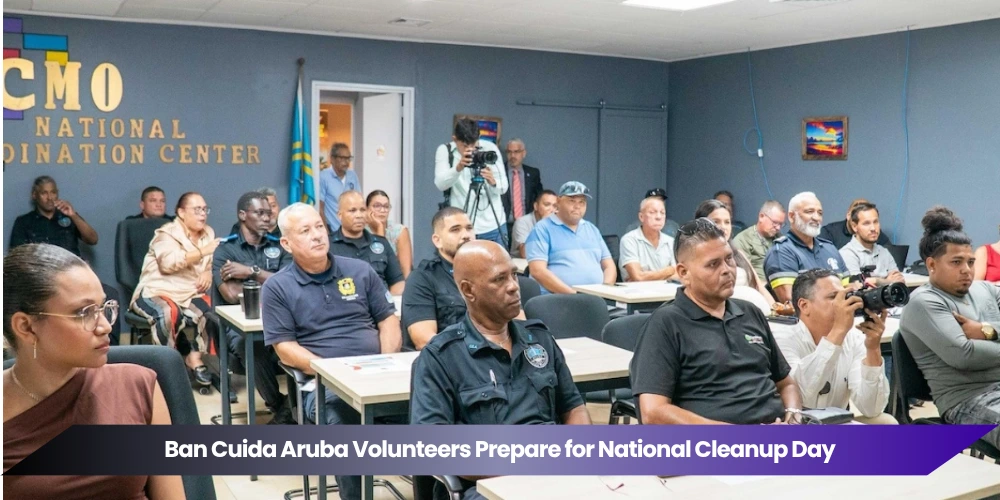
ORANJESTAD, Aruba — Ban Cuida Aruba Volunteers received instructions and assignments ahead of the nationwide cleanup campaign designed to promote community responsibility and long-term care for the island.
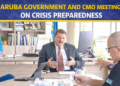
The Crisis Management Office brought together representatives from government departments, public organisations and participating community groups on Thursday afternoon.
Prime Minister Mike Eman and CMO Director Rino Hermans addressed those attending the preparation meeting.

They explained that the campaign was not intended simply to clean Aruba for one day. Its broader purpose was to encourage a national culture of responsibility, cooperation and pride in the island.
The Government of Aruba officially launched the initiative as an island-wide campaign involving residents, businesses, schools, clubs, foundations and neighbourhood organisations.
Volunteers Thanked for Their Service
Eman thanked the volunteers for contributing their time, leadership and experience to the national effort.
He said keeping Aruba clean is a responsibility shared by government institutions, private organisations and individual residents.
According to the prime minister, cleaner neighbourhoods and public spaces can also help prevent problems affecting community health and well-being.
The campaign represents only the beginning of a wider effort to make environmental care part of Aruba’s daily culture.
Eman said current and future generations would benefit from a cleaner country with fewer health risks, environmental problems and waste-related emergencies.
Accumulated Waste Affects Communities
Hermans said the government had intensified cleanup activities in several neighbourhoods during the preceding months.
Teams from the Department of Public Works, Serlimar and Bureau City Inspector have been working to remove accumulated waste and address illegally polluted locations.
A permanent location for residents to deliver certain types of unwanted material has also been made available throughout the week.
However, Hermans said the volume of waste accumulated over several years was too extensive for existing government teams to remove alone.
Waste left along roadsides and in public areas can negatively affect neighbourhood appearance, residents’ quality of life and Aruba’s public image.
Discarded objects can also collect rainwater and create breeding areas for mosquitoes, increasing possible public-health risks.
Campaign Promotes Social Responsibility
Hermans explained that the government could theoretically employ a large company to conduct an extensive cleanup.
However, Ban Cuida Aruba has a deeper purpose than completing the physical work.
The campaign seeks to strengthen solidarity, neighbourly cooperation and personal responsibility for shared spaces.
Residents are being encouraged to clean their neighbourhoods, parks, sports fields and other frequently used public areas.
A person with a pickup truck, for example, could assist a neighbour who does not have transportation by carrying collected waste to an approved location.
Organisers hope the activity will leave Aruba cleaner while also encouraging residents to continue serving their communities.
The official campaign message encourages people to begin where they are by cleaning streets, yards, schools, sports clubs and other shared spaces.
Volunteers Assigned to Collection Points
Waste collection containers were made available at designated locations across Aruba during the national campaign.
At least two trained volunteers were expected to assist at each location.
The Ban Cuida Aruba Volunteers were responsible for directing arriving residents and explaining where different categories of waste should be placed.
Organisers selected volunteers with experience in leadership, organisation, public guidance and managing busy locations.
During the CMO meeting, they received schedules and instructions intended to keep traffic and waste delivery orderly.
The campaign’s official platform published collection locations and encouraged participants to separate waste before arriving.
Safety Remains a Priority
Participants were encouraged to wear suitable clothing, closed footwear and protective gloves while handling waste.
The government also advised volunteers and residents to protect themselves from the sun, drink water regularly and request assistance when lifting heavy materials.
People were instructed to wash their hands properly after cleaning and seek first aid when injuries occurred.
Official health and safety guidance warned participants not to touch their faces, eat or drink while wearing dirty gloves.
Government Hopes Campaign Becomes Regular
The government would like the National Day to Care for Aruba to develop into a recurring community programme.
Hermans referred to practices in other countries where private employers give workers time to participate in community service.
A similar approach in Aruba could allow public institutions and private companies to support monthly or regularly scheduled improvement projects.
Possible future activities could include neighbourhood cleanups, school maintenance, park restoration and assistance for vulnerable residents.
The objective is to create a lasting partnership among government departments, businesses, organisations and volunteers.
Entire Community Invited to Participate
The initiative was organised under the slogan “For me. For you. For all of us.”
Residents could participate individually, with their families or through schools, companies, churches, foundations and sports clubs.
People were encouraged to begin close to home by cleaning their own properties, surrounding streets and nearby public spaces.
Community groups could also volunteer at locations identified as requiring additional assistance.
The official campaign stressed that a cleaner and more liveable Aruba depends on the contribution of every citizen.
Through the preparation and leadership of the Ban Cuida Aruba Volunteers, organisers hoped the national cleanup would operate safely and efficiently.
The wider goal remains to inspire permanent changes in behaviour and strengthen the belief that Aruba belongs to everyone and must be cared for collectively.