

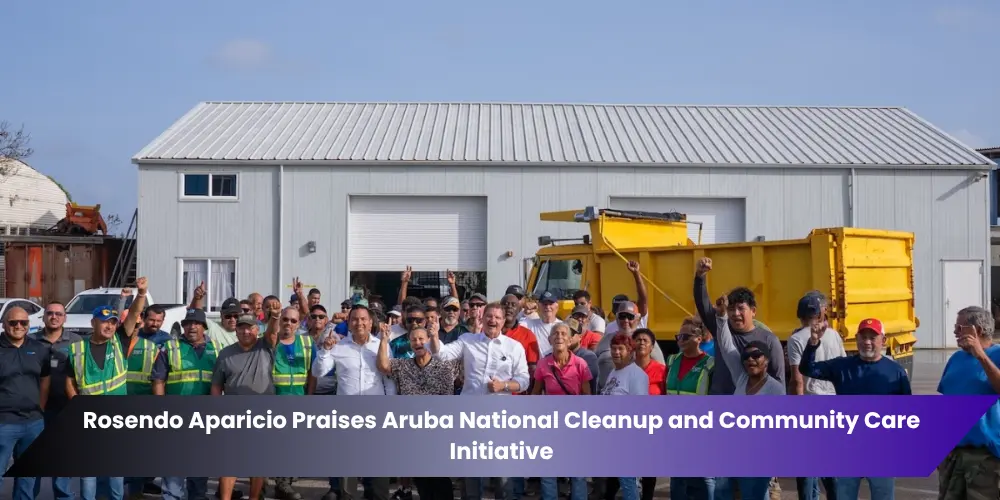
ORANJESTAD, Aruba — Longtime public worker Rosendo Aparicio has expressed support for the Aruba National Cleanup initiative as the island prepares for a national day dedicated to cleaner and better-maintained public spaces.
Aparicio has spent 32 years working to maintain Aruba’s schools, neighbourhoods and other public areas.
His career reflects the daily contribution made by public employees whose work is essential to the cleanliness, safety and appearance of the island.

More Than Three Decades of Service
Earlier in his career, Aparicio was part of a maintenance team assigned to different neighbourhoods.
He and his colleagues cut grass, removed waste and helped keep public spaces in good condition.
His responsibilities later changed, and he now focuses primarily on the maintenance of school properties.
His work helps ensure that school grounds remain clean, safe and suitable for students, teachers and other employees.
School maintenance often takes place outside public attention, but it can directly affect children’s safety and well-being.
A clean and properly maintained school also creates a more welcoming environment in which students can learn and develop.
During his 32 years of service, Aparicio has seen working conditions, public needs and maintenance responsibilities change considerably.
However, his commitment to his duties and the wider community has remained strong.
His story also represents the dedication of many other government employees who perform essential work throughout Aruba every day.
Shared Responsibility for Aruba
Prime Minister Mike Eman has connected the work of employees such as Aparicio with the government’s goal of creating a cleaner, more organized and better-maintained Aruba.
According to Eman, government departments have an important responsibility for public maintenance, but residents and businesses must also contribute.
Employees of the Department of Public Works, known as DOW, already handle the maintenance of schools, neighbourhoods, roadsides and other public infrastructure.
They must also deal with the effects of illegal dumping in different parts of the island.
The prime minister wants to strengthen cooperation among the government, private businesses, community organizations and residents.
The objective is to increase awareness that caring for Aruba should not be viewed exclusively as the responsibility of government workers.
Aparicio and his colleagues perform their part each day, but officials believe lasting improvement will require participation from the entire community.
National Cleanup Planned for July 25
The government will organize the National Ban Cuida Aruba Day on Saturday, July 25, 2026.
The Aruba Cleanup activity invites residents across the island to participate directly in cleaning and caring for their surroundings.
Organizers have emphasized that the campaign is intended to represent more than a single day of collecting waste.
The name Ban Cuida Aruba reflects a broader goal of promoting responsibility, pride and appreciation for the island.
Cleaning an area is important, but maintaining it and preventing further littering are equally necessary.
Twenty-six waste collection points are expected to be established in different parts of Aruba during the campaign.
Teams will be assigned to assist at these locations, while other groups will focus on areas affected by large amounts of waste or illegal dumping.
Government departments, public entities, state-owned companies, contractors and community organizations are expected to provide volunteers, equipment or logistical support.
Participation by government employees will be voluntary.
The prime minister has also encouraged residents and private-sector organizations to join the national effort.
Campaign Expected to Continue
The government hopes the campaign will become the starting point for additional community projects rather than ending after July 25.
Future activities could include repairing schools, improving neighbourhoods and sports facilities, planting trees and restoring public spaces.
Continued public cooperation could also allow DOW employees to focus more heavily on preventive maintenance and infrastructure improvements instead of repeatedly cleaning the same illegally polluted locations.
For workers such as Aparicio, a more responsible community would make their daily work more effective and sustainable.
His 32 years of service demonstrate that caring for Aruba requires consistency, patience and long-term commitment.
The national campaign gives residents an opportunity to recognize the efforts of public maintenance workers while accepting part of the responsibility for protecting the island.
Through cooperation among the government, residents and private sector, organizers believe Aruba can become cleaner, more attractive and better maintained for current residents and future generations.