

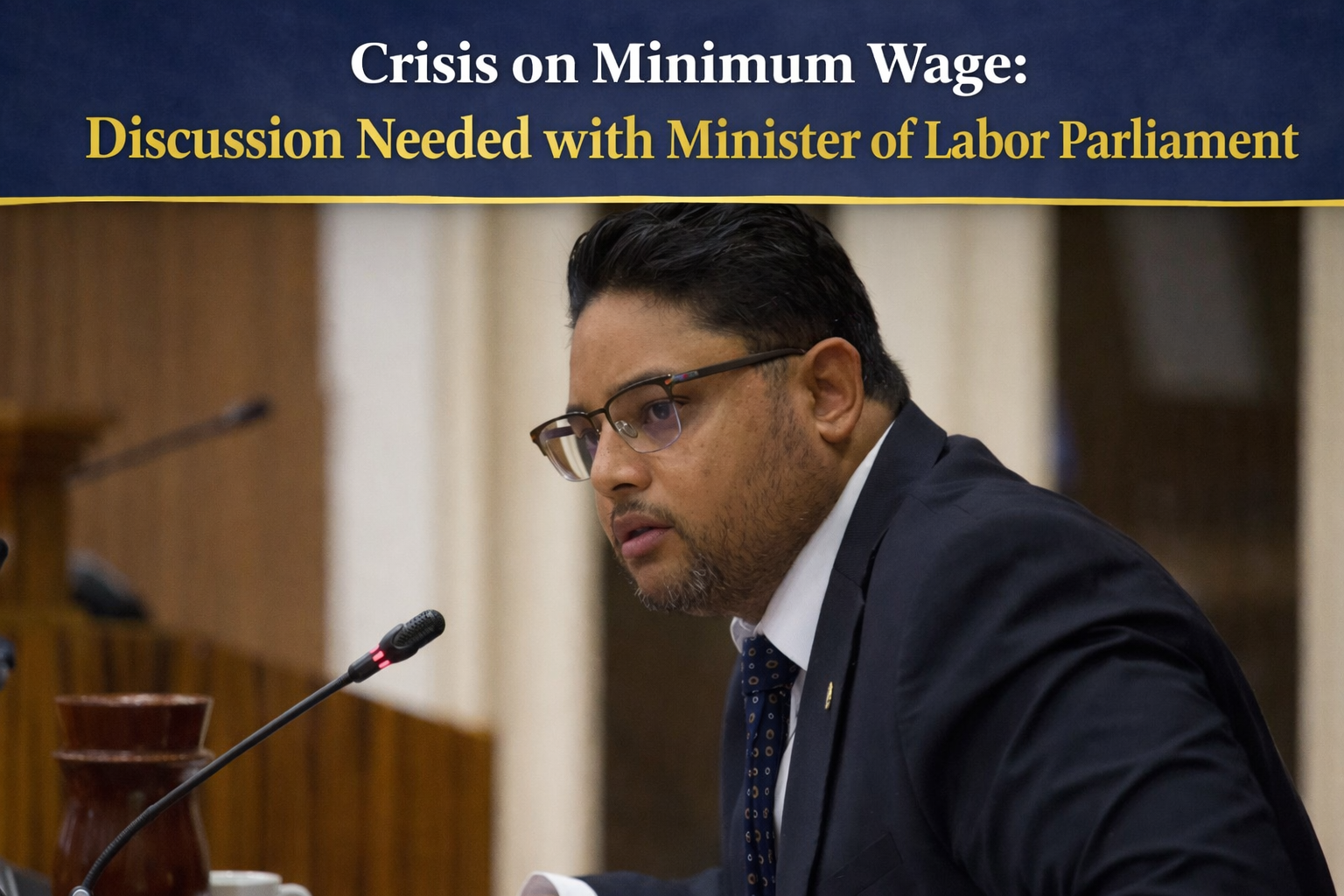
Parliamentarian John Hart from the AVP faction raised concerns in Parliament about the Crisis on Minimum Wage and its impact on the purchasing power of Aruba’s citizens. He emphasized the need for a discussion with the Minister of Labor regarding the minimum wage and existence minimum in light of recent recommendations from the Social Economic Council (SER).
“Improving Purchasing Power” has been a central focus for the Aruba Government. As the AVP-Futuro Cabinet nears its one-year anniversary, John Hart has shown that clear progress has been made, especially with concrete steps taken to improve economic conditions for many citizens.
On March 28, 2025, Hart voted in favor of a budget amendment to improve purchasing power for the community. As part of this, 21,000 pensioners will receive an additional Afl. 250 per month, starting May 1, 2025. Additionally, a reduction of 10 cents per liter on gasoline and diesel was implemented, benefiting all users of transportation on the island.

Despite these improvements, Hart stressed that the commitment to improve purchasing power has not been limited to just one fiscal year. With the approval of the 2026 budget, all pensioners will receive another monthly increase, while teachers will see their salaries raised, and the position of public service professionals will be improved. According to Hart, this is proof that the government is not just talking but acting and achieving concrete results.
Hart also pointed out that while some voices in the opposition criticize the current measures, it was the MEP and PPA factions that voted against the 2026 budget, which included concrete plans to strengthen purchasing power and sustain the public sector.
However, Hart acknowledged that serious challenges remain, especially for workers earning the minimum wage. “Living on a minimum wage of around Afl. 2,000 is a significant challenge for many families on our island,” he said. The rising costs of housing, food, and transportation are putting direct pressure on the purchasing power of this group.
According to a recent SER advisory, published in January 2026, titled ‘Adjusting the Minimum Wage in Three Phases’, there is a gap of approximately 25% between the current minimum wage and the level required for basic subsistence. Official CBS data indicates that a family of four needs about Afl. 5,512 per month to cover basic expenses, while a single adult needs at least Afl. 2,625 per month.
“It’s good that there’s a surplus in the budget, but the reality is that many citizens live with a deficit every month in their pockets. Improving the purchasing power for the most vulnerable in our community is a historic challenge that Cabinet Wever-Croes II left behind, and Cabinet AVP-Futuro has taken seriously to address,” Hart emphasized.
In line with this responsibility, the AVP-Futuro Cabinet took an important step: On December 5, 2025, the Minister of Labor, together with the Prime Minister, officially requested the SER’s advice regarding a proposal to gradually raise the legal minimum wage to the existence minimum over a three-year period.
Hart indicated that the SER‘s advice is positive regarding the gradual increase, but he also emphasized that economic effects, such as increased labor costs and potential effects on other wages and prices, need to be carefully considered. SER also recommended considering fiscal and financial incentives to help employers absorb additional costs.
“My role as a parliamentarian is to oversee the government and evaluate the advice presented. The SER advice presents serious questions that deserve a thorough and transparent discussion in the Aruba Parliament, with direct participation from the Minister of Labor,” Hart stated.
Hart will formally request the Labor Committee President to call a meeting to discuss the minimum wage and purchasing power issues, with the aim of evaluating the SER’s advice and determining the next responsible steps to protect the well-being of Aruba’s workers and their families.