

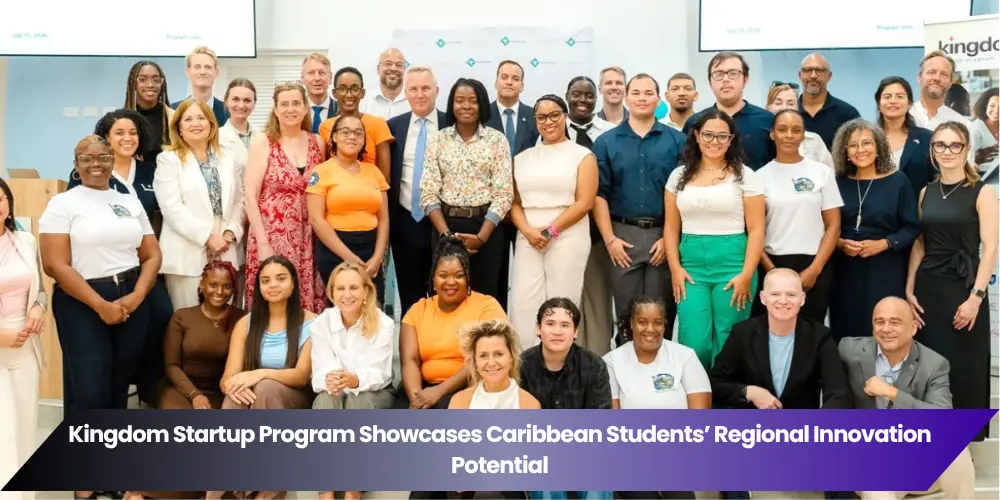
ORANJESTAD, Aruba — Five student teams from Aruba, Curaçao and St. Maarten presented innovative ideas addressing regional challenges during a recent Kingdom Startup Program event at the University of Aruba.
The university welcomed Dutch State Secretary for Kingdom Relations and Effective Government Eric van der Burg for a presentation and roundtable discussions involving the participating students.
The visit also included Barbera Wolfensberger, Gerbert Kunst, Finance, Economic Affairs and Primary Sector Minister Geoffrey Wever, and Education, Youth, Innovation and Sports Minister Gerlien Croes.

Five Teams Present Caribbean Solutions
During the discussions, the five teams shared ideas focused on challenges affecting communities throughout the Dutch Caribbean.
Their areas of interest included:
- Sustainability;
- Renewable energy;
- Waste management;
- Youth development;
- Other social and economic challenges affecting the islands.
The presentations demonstrated how students can apply entrepreneurship to issues extending beyond traditional commercial products.
Their proposals were intended to combine creativity with practical solutions capable of producing a positive regional impact. The announcement did not provide the names of the teams or complete details about their individual projects.
Six-Week Programme Encourages Practical Learning
The Kingdom Startup Program is a six-week summer entrepreneurship initiative bringing together students from the University of Aruba, University of Curaçao and University of St. Martin.
Participants work in small teams to identify problems, develop ideas and test possible solutions.
They also receive guidance from entrepreneurs, mentors and industry specialists before presenting their work during a final showcase in Aruba.
The programme follows a practical learning approach. Students do not only study entrepreneurship in a classroom but also practise collaboration, problem-solving, research and presentation skills.
Participants were not required to enter the programme with an established business idea. Students could apply individually or in teams and develop their concepts during the six-week experience.
Regional Cooperation Expands Opportunities
Bringing students from three Caribbean countries together allows participants to compare challenges affecting their islands.
Aruba, Curaçao and St. Maarten share several concerns, including limited space, dependence on imported resources, waste-processing difficulties and the need for more sustainable economic activity.
However, each island also has its own institutions, industries and community experiences.
Regional teamwork gives students an opportunity to combine those perspectives and develop solutions that may be adaptable to more than one island.
The programme can also help participants build professional relationships with students, mentors and institutions across the Kingdom.
Van der Burg Visits University of Aruba
The presentation formed part of Van der Burg’s July working visit to Aruba, Bonaire and Curaçao.
The Dutch government said strengthening cooperation within the Kingdom, supporting local economic growth and protecting nature were among the central subjects of the regional visit.
At the University of Aruba, Van der Burg received information about how the Kingdom Startup Program helps students from Aruba, Curaçao and St. Maarten develop entrepreneurial skills.
The student presentations provided officials with examples of how young Caribbean residents are approaching sustainability, innovation and community development.
Entrepreneurship Can Support Economic Diversification
Programmes encouraging student entrepreneurship can contribute to economic diversification by helping young people transform ideas into services, projects or future businesses.
This is particularly relevant to Caribbean economies seeking new opportunities outside their most established industries.
Entrepreneurial education can help students learn how to:
- Identify a community or market problem;
- Evaluate whether a proposed solution is practical;
- Develop a sustainable operating model;
- Work with people from different professional backgrounds;
- Present an idea clearly to partners and potential supporters.
Not every student project will become a company. However, the skills developed through the programme may remain useful in employment, research, public service and future entrepreneurial activities.
Universities Support Emerging Innovators
The University of Aruba said it was proud to support an initiative that empowers young entrepreneurs and strengthens regional cooperation.
The collaboration with the universities of Curaçao and St. Martin creates a shared platform where students can learn from one another while developing projects connected to real Caribbean needs.
The University of St. Martin described the initiative as an opportunity for students to gain practical experience, connect with regional peers and explore entrepreneurship beyond the classroom.
Projects Remain in Development
The five student presentations showed potential, but the announcement did not confirm investment agreements, commercial launches or government funding for the proposed projects.
The concepts should therefore be viewed as developing entrepreneurial solutions presented through an educational programme.
Further research, testing, partnerships and financial planning may be required before individual ideas can be implemented on a larger scale.
The Kingdom Startup Program nevertheless demonstrates how students from across the Dutch Caribbean can work together on challenges involving sustainability, energy, waste and youth development.
By combining education, mentoring and regional collaboration, the programme is helping prepare a new generation of Caribbean entrepreneurs and problem-solvers.