

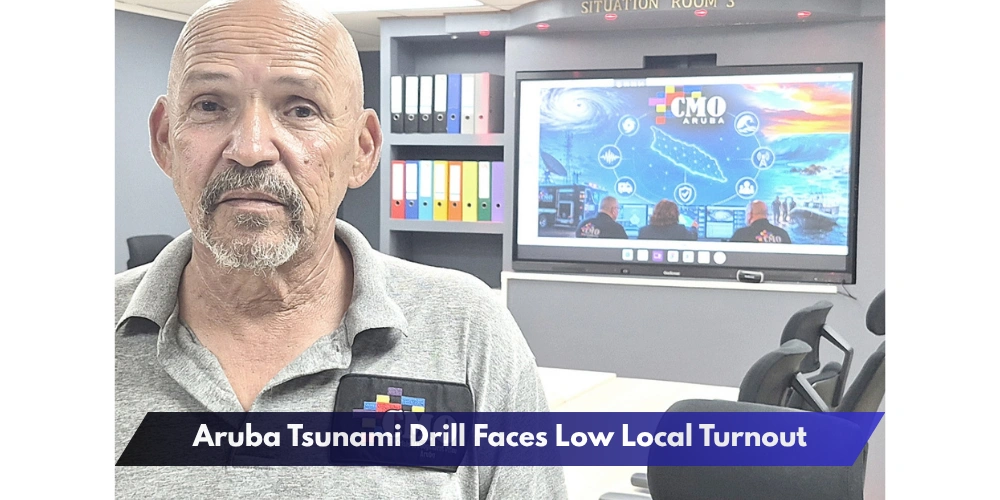
ORANJESTAD, Aruba — The annual Aruba Tsunami Drill needs stronger participation from local residents and institutions if the island is to accurately measure its readiness for a real emergency, according to Crisis Management Office Director Rino Hermans.
Hermans recently emphasized the importance of Aruba’s national evacuation exercise, which is organized each year in March as part of the island’s preparations for a possible tsunami threat.
Despite efforts by CMO to announce the exercise well in advance and explain how residents can participate, Hermans said many people remain unaware of the drill or simply choose not to take part.

Aruba Tsunami Drill Needs More Participation
Hermans said participation concerns are not limited to individual residents.
In previous years, CMO has also identified government departments and other public institutions that did not evacuate during the exercise.
According to Hermans, CMO previously prepared a report for the government after observing that some agencies failed to participate.
He said this issue requires continued attention because an evacuation exercise can only provide an accurate picture of Aruba’s emergency preparedness when different parts of society actively participate.
Families, schools, businesses, government departments and community organizations all have roles during a large-scale evacuation.
Around 32,000 People Joined Latest Exercise
CMO organizes the national evacuation exercise once a year to test and evaluate the effectiveness of Aruba’s evacuation procedures in the event of a potential tsunami.
Hermans said approximately 32,000 people, including tourists, participated during the latest exercise in March.
Aruba’s hotel sector has been actively participating in the drills for approximately seven years, according to Hermans.
Hotels have an important role because large numbers of visitors may be staying in coastal areas if a tsunami warning is issued.
Earlier Caribbean tsunami exercises involving Aruba have also included hotels, schools and government departments as authorities work to improve national preparedness.
Local Participation Remains a Concern
Despite participation from the tourism sector, Hermans said involvement from Aruba’s own community remains limited.
He pointed to questions and comments circulating on social media as evidence that additional public education is still needed.
For CMO, preparedness involves more than issuing warnings after a threat develops.
The agency also wants residents to understand evacuation procedures, know where they should go and recognize their own responsibilities during emergencies.
The Aruba Tsunami Drill gives residents an opportunity to practice those actions before they are ever required during a real event.
Annual Drill Takes Place in March
Hermans said the national evacuation exercise is held every year on the third Thursday of March.
Participation is open to families, schools, workplaces, organizations and government agencies.
By participating, residents can become familiar with evacuation routes and practice how they would respond if authorities issued an actual tsunami warning.
Government preparedness guidance similarly encourages residents to develop emergency plans, know where to obtain official information and discuss emergency procedures with their families before a disaster occurs.
Preparedness Requires Community Action
Hermans stressed that preparing Aruba for a major emergency cannot remain solely the responsibility of CMO or the government.
Even a well-developed national evacuation plan depends on how residents and institutions respond when it is activated.
Participation in the Aruba Tsunami Drill therefore gives authorities an opportunity to identify weaknesses while allowing residents to become more familiar with the actions they may need to take.
CMO’s objective is to increase awareness, improve participation and ensure that more people understand their role during a tsunami or other major emergency.
For Hermans, stronger involvement from Aruba’s own community is an essential part of creating an island that is better prepared to respond when a real emergency occurs.