

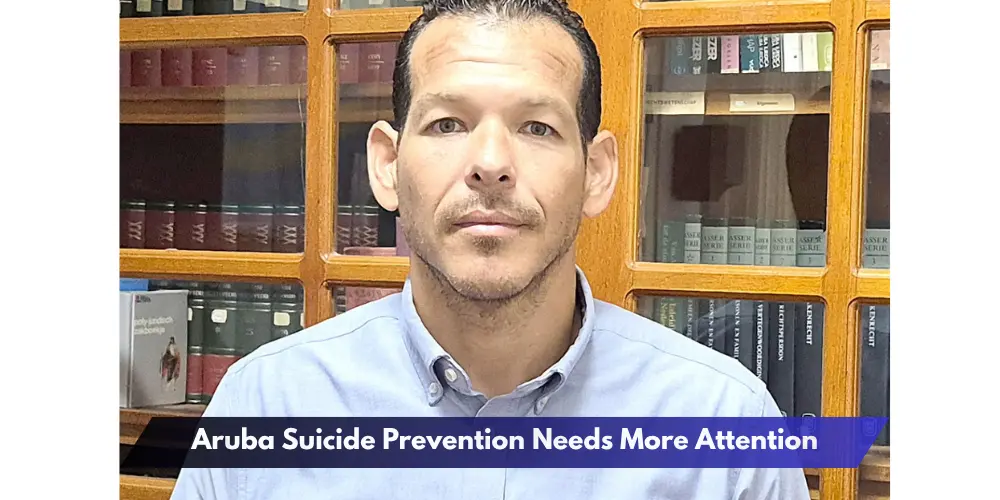
ORANJESTAD, Aruba — Aruba Suicide Prevention requires greater attention and stronger investment in mental-health and social services, according to MEP parliamentarian Rocco Tjon, who says he is increasingly concerned about reports of suicide on the island.
Tjon said not every case becomes public through the media and stressed that he does not blame news organizations for this.
Instead, he argued that suicide prevention itself deserves greater attention from government, health professionals and organizations working with people facing mental-health and social challenges.

His observations about an increase in cases have not been independently confirmed by current official 2026 suicide statistics and should be understood as his assessment of the situation.
Aruba Suicide Prevention Linked to Social Support
Tjon said stronger Aruba Suicide Prevention efforts require sufficient financial resources for both mental-health care and the wider social sector.
He argued that people experiencing serious mental-health difficulties can also be affected by financial problems, family circumstances, social pressures and other challenges.
Because these issues can overlap, Tjon believes suicide prevention cannot be treated exclusively as a healthcare matter.
He pointed to organizations including Stichting Hunto, Fundacion Contra Violencia Relacional and Fundacion Respeta Mi as examples of foundations whose work can form part of the wider support structure available to residents.
Tjon said the previous government had taken steps aimed at increasing financial support for organizations working in these areas.
He also claimed that some intended funding was later reduced or discontinued by the current government.
Those statements reflect Tjon’s political position and have not been independently established through budget documents in the information currently available.
Tjon Calls for Investment Before Problems Escalate
According to Tjon, failing to invest sufficiently in social services can eventually create additional pressure on Aruba’s healthcare system.
His argument is that problems involving finances, relationships, violence, addiction or other social circumstances can affect mental well-being and may become more serious if people cannot access support early.
For that reason, Tjon said Aruba should take a broader approach that connects social affairs, mental-health care and prevention.
He referred to the former government’s decision to combine Justice and Social Affairs under one minister as an example of an effort to strengthen coordination between sectors dealing with interconnected social problems.
Mental Health Remains a Public-Health Concern
Independent public-health information indicates that mental health and suicide prevention remain important issues for Aruba.
Results from Aruba’s 2023 STEPS survey, presented with support from the Pan American Health Organization, found that nearly 5% of participants reported having attempted suicide.
The survey included mental health among a broader range of health and lifestyle indicators studied across the Aruban population.
Aruba has also been working with PAHO and Dutch health institutions to improve the accuracy of death certification and cause-of-death reporting, which can help authorities better monitor mortality trends and develop evidence-based policies.
MEP Has Submitted Questions to Minister
Tjon said the MEP parliamentary faction has already submitted several questions about mental health and related services to Health and Social Affairs Minister Mervin Wyatt-Ras.
According to Tjon, not all of those questions have received responses, particularly on issues he considers important to understanding government policy and available resources.
His latest comments follow other recent calls for more funding and personnel within Aruba’s mental-health sector.
Tjon has also argued that the island’s existing mental-health roadmap through 2030 will require adequate staffing and financing if its objectives are to be fully implemented.
Prevention Requires Wider Cooperation
For Tjon, Aruba Suicide Prevention should involve more than responding after someone reaches a crisis.
He is calling for greater investment in prevention, early support and organizations that work with residents facing mental-health, financial, family and social difficulties.
While official current data is needed before determining whether Aruba is experiencing an actual increase in suicide deaths, the concerns raised underline the importance of accessible mental-health services and reliable information about the scale of the problem.
Tjon maintains that strengthening the social sector alongside healthcare could help identify problems earlier and provide residents with support before difficult circumstances develop into more serious crises.