

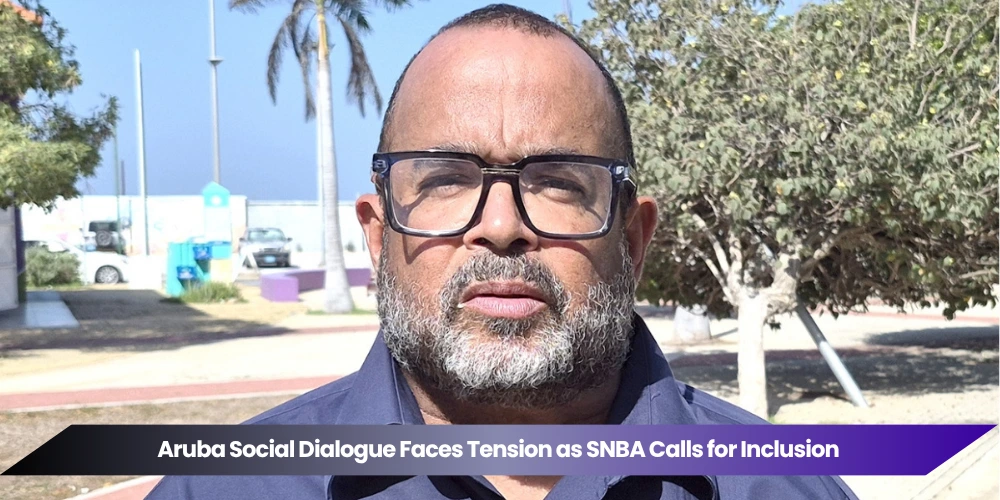
The Aruba Social Dialogue is facing internal tension after San Nicolas Business Association President Errol de Freitas raised concerns about efforts by some participants to exclude other organizations from the process.
De Freitas said he supports continuing the Social Dialogue but believes recent developments have created an uncomfortable atmosphere for some of the participating groups.
He explained that social dialogue is not new in Aruba and has traditionally brought together representatives of employers, employees and government to discuss issues affecting the country.

According to de Freitas, SNBA participated in a recent round of discussions but later heard concerns that certain organizations should no longer be included if the process was to continue successfully.
He specifically referred to comments involving pensioners’ organization OPPA.
According to de Freitas, OPPA President Ivo Valdez strongly defended his organization’s participation, arguing that pensioners represent a substantial part of Aruba’s economy and should therefore have a voice in discussions about national policy.
Chamber of Commerce Also Defended
De Freitas also addressed the participation of the Aruba Chamber of Commerce.
He acknowledged that the Chamber is not a traditional interest group, but argued that it represents a broad cross-section of Aruba’s commercial and industrial sectors.
He highlighted Chamber representative Martijn Balkenstein, whom he described as direct, transparent and clear in discussions.
De Freitas questioned why individuals and organizations with long-standing experience should be excluded from a process intended to represent different sectors of society.
Concern About New Groups Gaining Too Much Influence
The SNBA president said he was uncomfortable with the idea that a newer organization could gain disproportionate influence while groups with decades of experience are pushed aside.
He described the situation as part of a broader pattern in which small alliances or “cliques” can dominate discussions and marginalize other participants.
De Freitas warned other organizations to remain alert and consider the long-term consequences of excluding groups from the dialogue.
According to him, the final impact of national policy decisions is felt by the public, regardless of which organizations dominate the negotiating table.
De Freitas Praises Prime Minister’s Intervention
De Freitas said Prime Minister Mike Eman eventually paused the Social Dialogue when disagreements over participation became too serious.
He praised that decision, saying government should not continue a dialogue that is no longer functioning as a genuine consultation process.
According to de Freitas, if government simply wants to make decisions without broad consultation, it could do so and take those proposals directly to Parliament.
For him, the purpose of the dialogue is precisely to ensure that different sectors are heard.
Call for Participants to Reconsider
De Freitas concluded by expressing disappointment with some of his colleagues and urging all participating groups to reconsider their positions.
He said smaller internal conflicts risk damaging the broader purpose of the process.
The SNBA president stressed that the Aruba Social Dialogue should remain inclusive, respectful and focused on finding solutions that serve the wider community rather than allowing disagreements between organizations to weaken cooperation.