
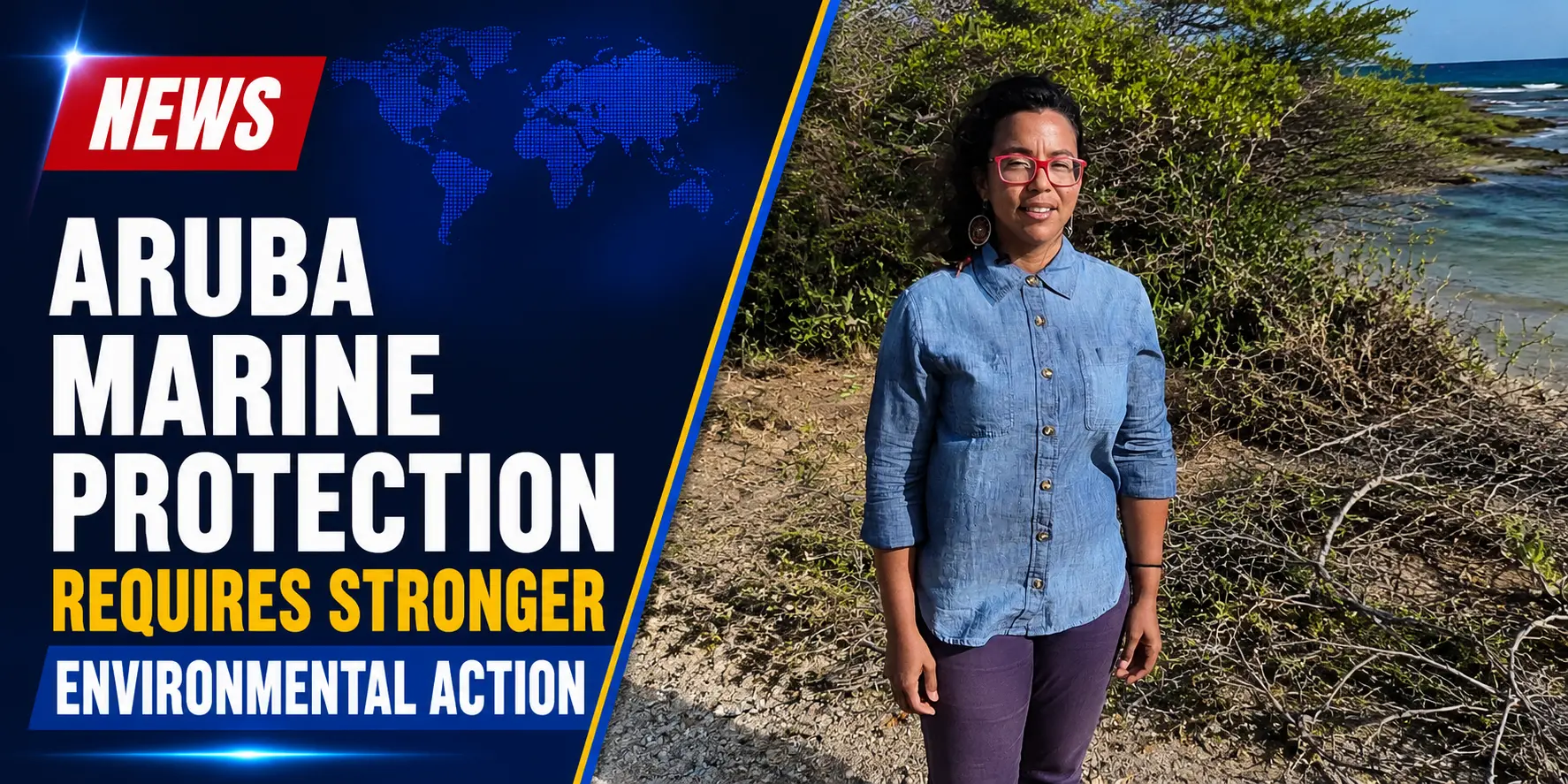
Aruba Marine Protection must be strengthened through modern environmental legislation, better enforcement, and improved marine management if the island hopes to preserve its ecosystems for future generations, according to ecologist and environmental activist Oriana Wouters.
During a recent interview, Wouters expressed concern about the condition of Aruba’s reefs and marine environment. She emphasized that both government and the community already have access to tools that could improve the management and protection of marine resources.
According to Wouters, Aruba Marine Protection would benefit from the development of structured marine planning similar to existing land-use planning systems. She suggested that a dedicated framework for managing marine areas could help balance environmental conservation with economic activities.

One of the initiatives already proposed for Aruba is the establishment of a marine park surrounding the island. However, Wouters argued that creating protected areas alone is not enough without effective monitoring and enforcement.
She noted that activities such as watersports operations, boat anchoring, and improper use of marine areas can continue to damage coral reefs if supervision remains limited. Mangel Halto was cited as an example where environmental quality has declined over the years.
A key recommendation for Aruba Marine Protection is the implementation of Marine Spatial Planning, a system that organizes and regulates activities taking place within marine environments. Such planning can help reduce conflicts between conservation efforts and commercial activities.
Wouters also highlighted the impact of land-based pollution on marine ecosystems. Rainwater runoff from roads, paved surfaces, and urban areas can transport contaminants directly into coastal waters, affecting coral reefs and marine habitats.
Additional concerns include nutrient pollution and the discharge of brine, the highly concentrated saltwater byproduct produced during the desalination process.
According to Wouters, the absence of fully implemented environmental legislation limits Aruba’s ability to enforce stronger environmental protections. She pointed to the Environmental Management Law introduced in 2012 and the Water Law introduced in 2017, noting that both remain incomplete in practice.
Without these legal tools, Aruba Marine Protection efforts face challenges when attempting to require hotels, businesses, and government entities to reduce their environmental impact.
Environmental studies and field observations have already revealed troubling trends. Wouters reported declines in fish populations, reduced biodiversity, and continued deterioration of coral reef systems.
She warned that Aruba may soon have to acknowledge the loss of portions of its reef ecosystems if stronger action is not taken.
While organizations such as ScubbleBubbles Foundation and Aruba Conservation Foundation continue working on coral restoration projects, Wouters believes broader participation is necessary. She stressed that long-term success depends on both community engagement and government commitment.
The future of Aruba Marine Protection, she concluded, will depend on whether society embraces the necessary changes today. Without decisive action, future environmental assessments may reveal even greater losses across Aruba’s marine ecosystems.