


Aruba land clearing rules require property owners and developers to consider environmental and spatial-planning requirements before using tractors, Bobcats or other equipment to clear land.
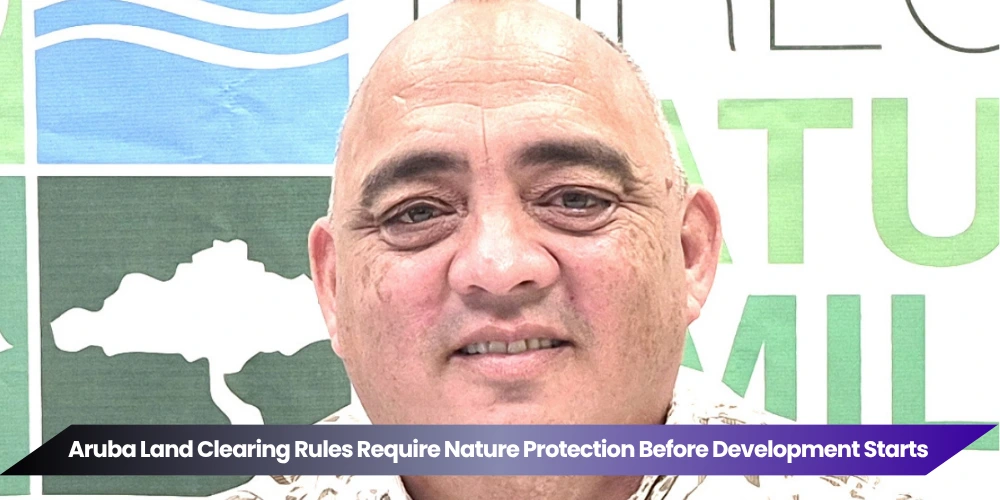
Gisbert Boekhoudt of the Directorate of Nature and Environment, known as DNM, said land clearing is regulated by law and should no longer begin before the proposed development and environmental conditions of a property are properly assessed.
He advised residents to first determine which rules apply before clearing vegetation or altering a site.

According to Boekhoudt, unauthorized clearing often occurs when property owners carry out the work independently rather than using professionals familiar with the applicable regulations.
He acknowledged that enforcement remains challenging because several departments are involved and there are not always enough inspectors available in the field.
DNM Calls for Stronger Cooperation
Boekhoudt believes a joint task force could improve supervision and enforcement.
Under such a system, departments with formal enforcement powers could work alongside agencies such as DNM, which may provide environmental expertise even when it does not directly enforce every spatial-planning law.
DNM also understands concerns raised by environmental organizations and NGOs about natural areas being cleared without sufficient planning.
To address this, the department developed its “Build with Nature” approach.
Nature Must Be Included in Development Plans
Boekhoudt said developers should identify existing natural features directly on their site plans before construction begins.
This includes determining whether a property contains drainage channels, rock formations, protected vegetation or areas with significant ecological value.
DNM reviews development requests referred through DIP and can assess the ecological characteristics of a site.
The goal is to ensure that natural features form part of the development design rather than being removed first and considered afterward.
Boekhoudt said the former practice of clearing a property before deciding what to build is no longer considered the proper procedure.
Property Owners Can Check Environmental Information
People who receive land through DIP are encouraged to consult DNM’s digital information resources before beginning work.
DNM maintains information about environmental regulations and protected plant species that may be present on individual properties.
When DIP requests environmental advice, DNM can visit the site and prepare a report describing its ecological value.
That information is then incorporated into the advice provided during the planning process.
Protected Plants Require Special Attention
Boekhoudt also addressed what property owners should do when protected plants are discovered on a site.
Some species may be suitable for relocation, while others have seasonal life cycles and may not survive simple transplantation.
In certain cases, preserving seeds or adjusting the design of the development may be more appropriate.
The objective is to maintain ecological balance while allowing development to proceed responsibly.
The Aruba land clearing rules therefore require developers and landowners to plan around nature, verify applicable laws and obtain the necessary information before clearing vegetation or changing a property.