


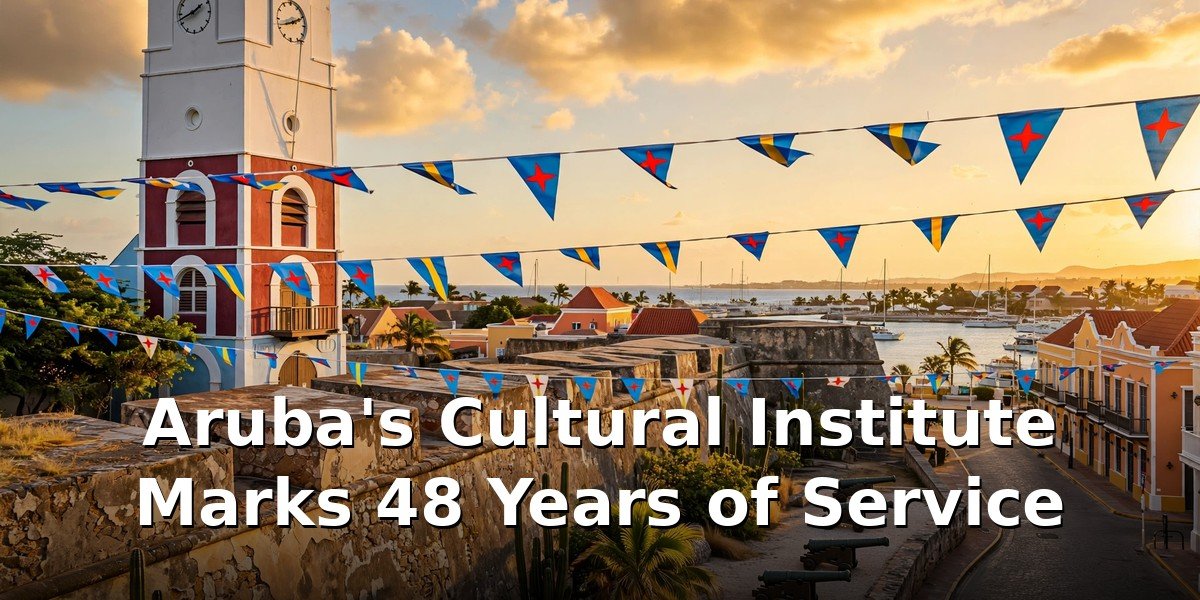
Aruba’s cultural establishment is marking a milestone: 48 years of continuous service to the island’s arts, heritage and identity. What began on September 30, 1978, as the Instituto di Cultura Aruba (ICA) has grown into today’s Departamento di Cultura Aruba (DCA), the government body charged with caring for and safeguarding Aruba’s cultural heritage.
The institute was inaugurated 48 years ago by Nelson O. Oduber, then Deputy for Culture, together with its first head, Hubert Lio Booi, with the musical group Trio Huasteca honored at the ceremony. Its founding came at a defining moment in Aruba’s history — the road toward Status Aparte. The island had celebrated its first Dia di Himno y Bandera on March 18, 1976, held the consultative referendum of March 25, 1977, and adopted its etymological Papiamento orthography in the Island Council, before the cultural institute was inaugurated to promote and defend Aruban identity, cultural work and folklore.
From the start, its mission was clear: the protection, promotion and education of art and culture as the foundation of national identity. That duty is anchored in Article V.23 of the Constitution (Staatsregeling), which obliges the Aruban government to create structures and platforms where the people can develop and make use of social, educational and cultural facilities.

Over nearly five decades, many leaders shaped the institution. Hubert Lio Booi led from 1978 to 1980, followed by interim head August “Juchi” Croes (1980–1982) and Leo Tromp (1982–1995), with Evelino Fingal serving as interim head during absences. After a reorganization management period (1998–2001), Frank Croes took the helm (2001–2007). In 2008 the institute transitioned into the government Department of Culture (DCA), led first by director Ruby Eckmeyer (2007–2009) and, since 2012, by Drs. Siegfried Dumfries.
Its track record includes projects that put Aruba on the cultural map: the Feria Popular, school cultural exchanges, the Watapana Festival — later the BonBini Festival — a theatre and drama section, and the National Seal of Craftsmanship (Seyo Nacional di Artesania), which gives official recognition to authentic Aruban artisanal products. Research programs such as Expedicion Rescate documented oral history and nature, while the Aruban music artists biography project and Buki Baluarte Cultural, developed with the Ministry of Culture, preserved the stories behind the island’s music. Partnerships with UNESCO, UNOCA, Fundacion Lanta Papiamento, consulates and cultural foundations extended its reach, alongside beloved traditions such as the cultural elections, Festival di Canto y Cancion, Parada di Lanterna and Parada Folklorico.
Looking ahead, the department is working toward more inclusion, more digitalization and more international collaboration — and toward growing the creative industry into a next economic pillar for Aruba, the so-called “Orange Economy.”
The anniversary reflection, authored by cultural veteran specialist Stanley Dabian, closes with a simple wish: congratulations to 48 years of Aruban cultural service — art and culture as Aruba’s roots and its future.
Source: AWE24