

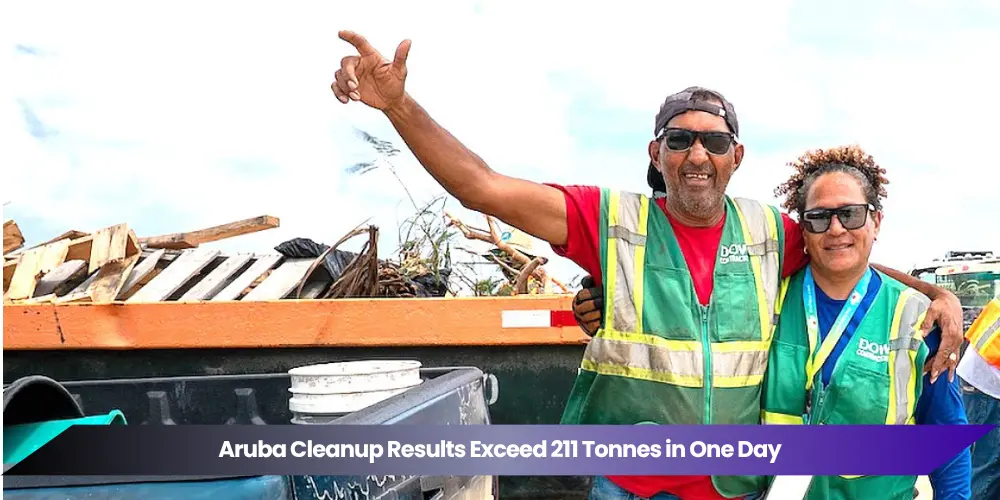
ORANJESTAD, Aruba — Aruba Cleanup Results exceeded expectations after residents, businesses, sports teams, organisations and volunteers collected more than 211 tonnes of waste during the National Day to Care for Aruba.
By 5 p.m. on Saturday, July 25, organisers had recorded 131 filled waste containers with a combined weight of 211.62 tonnes.
The preliminary total did not include waste collected through the Department of Public Works, AWSS and Daltra. The final figure is therefore expected to rise after materials from those locations are added.

Cleanup More Than Doubles National Target
The national campaign originally aimed to collect 100 tonnes of waste through collection points and community cleanup projects across the island.
The preliminary Aruba Cleanup Results more than doubled that target, demonstrating the scale of public participation and the amount of unwanted material requiring disposal.
The campaign operated through 26 collection locations where residents could deliver separated waste collected from homes, gardens, neighbourhoods, roadsides, sports facilities and public spaces.
Several containers filled more quickly than organisers anticipated, creating additional logistical pressure for collection teams, truck drivers and waste-processing partners.
Despite the challenges, participating agencies continued replacing, transporting and emptying containers throughout the day.
Families and Organisations Join Campaign
Residents began participating early in the morning, with families, businesses, sports teams, foundations and volunteer groups working throughout Aruba.
Some participants focused on cleaning their homes and gardens, while others worked in neighbourhoods, recreational areas and locations affected by accumulated waste.
The strong public response reflected the central message of the campaign: protecting and maintaining Aruba requires cooperation among government agencies, companies and residents.
Prime Minister Mike Eman thanked the community for responding to the national call and contributing to a cleaner island.
He said the amount of waste delivered confirmed that the campaign addressed a genuine community need.
Containers Fill Earlier Than Expected
The rapid filling of collection containers created one of the operation’s main challenges.
At several sites, teams had to coordinate the removal of full containers and arrange replacements so residents could continue delivering waste.
The campaign relied on cooperation among the Crisis Management Office, DOW, Serlimar, EcoTech, Aruba Ports Authority, utility companies, private contractors and volunteers.
Drivers, heavy-equipment operators and site coordinators worked to manage traffic, unload vehicles and transport collected waste for processing.
The organisers are expected to review these challenges when planning future editions.
Aruba Ports Authority Receives Heavy Traffic
Aruba Ports Authority made Harbour Arena available as one of the main waste-collection sites.
APA also supported the campaign by sponsoring containers and assisting with the location’s organisation and logistics.
APA Director Marc Figaroa said vehicles were already waiting when the gates opened at 7 a.m.
Teams worked continuously to coordinate vehicle entry, waste unloading and the transportation of filled containers to EcoTech.
Figaroa described the operation as successful and said the strong response demonstrated a clear public demand for similar initiatives.
Public Spaces Receive Special Attention
In addition to accepting household and neighbourhood waste, the campaign included projects targeting neglected public areas.
The Government of Aruba worked with DOW and other partners to clean and begin restoring selected recreational and sporting locations.
These projects were intended to make public spaces accessible and useful again for nearby communities.
More than a dozen companies reportedly contributed personnel, equipment, vehicles or other resources.
Sports teams, contractors, government agencies and volunteer groups also worked at different sites around the island.
Minister Praises Community Action
Minister Wendrick Cicilia congratulated residents for leaving their homes and taking direct action to improve Aruba.
He said meaningful change requires leadership, participation and positive examples from government, businesses and individual citizens.
The campaign brought the public and private sectors together around a practical project with visible benefits for the island.
Organisers said the public response demonstrated that residents are willing to participate when suitable collection locations and logistical support are available.
Future Cleanup Events Expected
The Government of Aruba plans to conduct a broad evaluation of the national campaign.
The review will examine operational difficulties, container capacity, transportation, traffic management, waste separation and coordination among participating organisations.
Officials want to identify improvements that can make future cleanup days more efficient.
Eman said the campaign’s success demonstrated the need for additional editions rather than only one more event.
The government’s original campaign was designed not only to remove waste but also to strengthen shared responsibility and encourage residents to keep cleaned areas in good condition.
Government Thanks Campaign Partners
The Government of Aruba thanked Aruba Ports Authority, Serlimar, DOW, AWSS, SETAR, Post Aruba, EcoTech, CMO, Bureau City Inspector, DNM, the Ministry of General Affairs team and participating media organisations.
Special appreciation was expressed to residents whose participation made the campaign possible.
The preliminary Aruba Cleanup Results show that the community collected at least 211.62 tonnes of waste in one day, with the official total expected to increase once figures from the remaining collection sites are included.
Government officials said they remain committed to working with communities and the private sector to create a cleaner, healthier and more sustainable Aruba.
The message following the successful event is clear: the national cleanup may have ended, but responsibility for caring for the island must continue.