

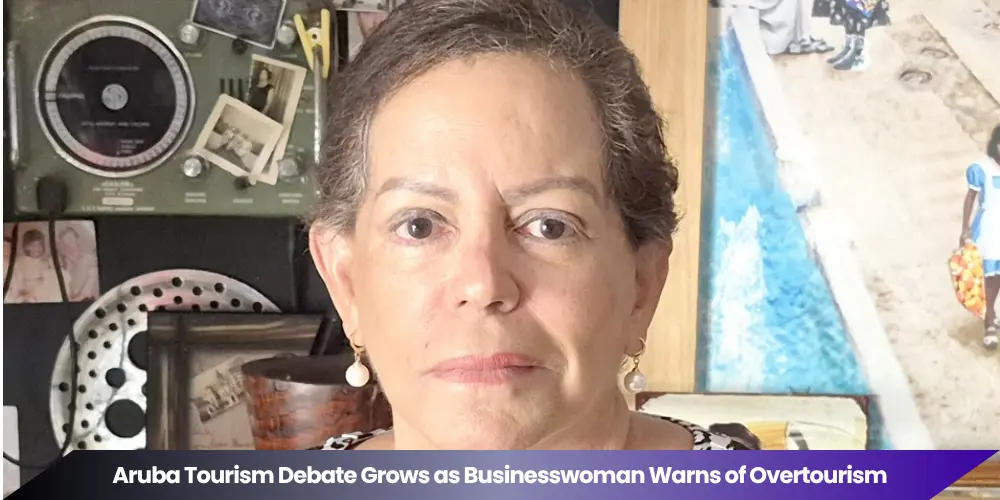
ORANJESTAD, Aruba — The Aruba Tourism Debate has intensified after businesswoman Marjorie Vermeer-Luidens warned that uncontrolled tourism growth could place increasing pressure on local families, infrastructure and the island’s quality of life.
During an interview with DIARIO, Vermeer-Luidens described Aruba as being at a crucial point in the development of its tourism industry.
She argued that tourism can create employment and economic opportunities but may also damage the island when growth is not supported by long-term planning, effective regulation and adequate public infrastructure.

Her comments represent her personal assessment of Aruba’s tourism model and should not be interpreted as an official government or tourism-industry position.
Businesswoman Uses Strong Tourism Comparison
Vermeer-Luidens compared uncontrolled tourism to a virus entering a country and gradually taking control of it.
She said tourism brings significant amounts of money, causing governments and businesses to prioritise economic benefits while potentially overlooking environmental, social and community concerns.
According to her, similar concerns are emerging in destinations worldwide as residents respond to overtourism, overcrowding and the increasing cost of supporting large visitor populations.
She also compared rapid global tourism growth with a tsunami, warning that destinations may struggle to control the consequences once visitor demand expands beyond available capacity.
Tourism Can Build or Damage Aruba
Vermeer-Luidens said tourism has the ability to strengthen Aruba’s economy but can also weaken the island when it grows without sufficient controls.
She argued that Aruba must determine how much tourism it can responsibly accommodate while maintaining a good quality of life for residents.
The businesswoman said public discussions often focus on what tourists think about damaged roads, traffic congestion and other local conditions.
However, she believes policymakers should first consider how residents experience those same problems every day.
According to Vermeer-Luidens, decisions concerning roads, housing, public spaces and utilities should prioritise the needs of the people who live and work on the island while also supporting a positive visitor experience.
Long-Term Tourism Vision Requested
A major concern raised during the interview involved the continuity of government policy.
Vermeer-Luidens said Aruba’s governments operate within four-year political terms and that tourism plans can change significantly whenever a new administration takes office.
She argued that useful projects and long-term strategies may be delayed, changed or abandoned even when they could continue benefiting the island.
Aruba therefore needs a tourism vision that extends beyond political terms, according to the businesswoman.
Such a strategy could establish long-term objectives involving visitor numbers, infrastructure, environmental protection, workforce conditions and community wellbeing.
She said consistent planning is essential because tourism affects almost every part of Aruba’s economy and society.
Pressure on Tourism Employees Highlighted
The Aruba Tourism Debate also involves the working conditions of residents employed in hotels, restaurants, transportation, retail and other visitor-related industries.
Vermeer-Luidens described tourism as an industry that operates continuously, including during weekends, Christmas and national holidays.
Employees may be required to work overtime, accept additional shifts and remain available during periods when many other residents are spending time with their families.
She expressed particular concern about parents who work multiple jobs or frequent overtime shifts to meet household expenses.
According to Vermeer-Luidens, some mothers and fathers have limited time available for their children because of demanding work schedules.
She warned that children who regularly remain at home without enough parental support or supervision may experience emotional and social difficulties.
Families May Carry Hidden Tourism Costs
Vermeer-Luidens said tourism’s economic benefits should not be evaluated without also examining its effects on family life.
Employment can provide income and financial security, but excessive working hours may reduce the time parents spend raising and supporting their children.
She argued that these pressures represent a hidden cost of an economy heavily dependent on continuous visitor services.
The businesswoman called for greater attention to work-life balance, fair employment practices and the wellbeing of tourism workers.
She believes Aruba should measure tourism success not only through arrival numbers, hotel occupancy and visitor spending, but also through the quality of life experienced by local employees and their families.
Island Capacity Requires Discussion
Vermeer-Luidens said there are increasing indications that Aruba may be approaching or exceeding its capacity in several areas.
Additional tourism can increase pressure on roads, housing, waste management, water, electricity, beaches and other public resources.
She argued that visitor growth should be matched by investments in infrastructure and services.
Without those investments, residents may experience worsening congestion, higher living costs and reduced access to important public areas.
The businesswoman did not call for tourism to end. Instead, she questioned whether Aruba is managing the industry in a way that remains sustainable for both residents and visitors.
Regulation Considered Essential
Vermeer-Luidens said tourism must be managed through clear rules and coordinated planning.
She compared the industry with caring for several children at the same time, explaining that each requires attention, structure and responsibility.
In her view, tourism growth should be supported by regulations addressing development, visitor accommodation, environmental protection, labour conditions and infrastructure capacity.
She warned that pursuing short-term revenue without managing these wider effects could create problems that become increasingly difficult and expensive to solve.
Community Must Benefit From Tourism
The businesswoman said Aruba should ensure that tourism development creates meaningful benefits for the wider population.
Those benefits could include stable employment, improved public infrastructure, protected natural areas and opportunities for locally owned businesses.
She argued that tourism should serve Aruba rather than forcing the island to reorganise every part of community life around visitor demand.
A sustainable tourism model would consider the needs of residents, workers, businesses and future generations alongside those of travellers.
Warning Intended to Encourage Action
Vermeer-Luidens used strong language to communicate what she views as an urgent situation.
Her comparison of tourism with COVID reflects her opinion that uncontrolled growth can spread rapidly and transform a destination in damaging ways.
The statement does not mean tourism itself is a disease or that every form of tourism harms Aruba.
Instead, her comments form part of a broader discussion about overtourism, island capacity and whether current development is environmentally and socially sustainable.
The Aruba Tourism Debate ultimately centres on how the island can continue benefiting from its most important industry without sacrificing family life, community identity, infrastructure or residents’ wellbeing.
Vermeer-Luidens said Aruba must choose between uncontrolled growth and a more united, carefully managed approach that protects the island while preserving tourism’s economic value.