
ORANJESTAD – The Aruba AWSS reform Minister Dowers initiative is undergoing major structural changes after serious issues were identified within the organization.
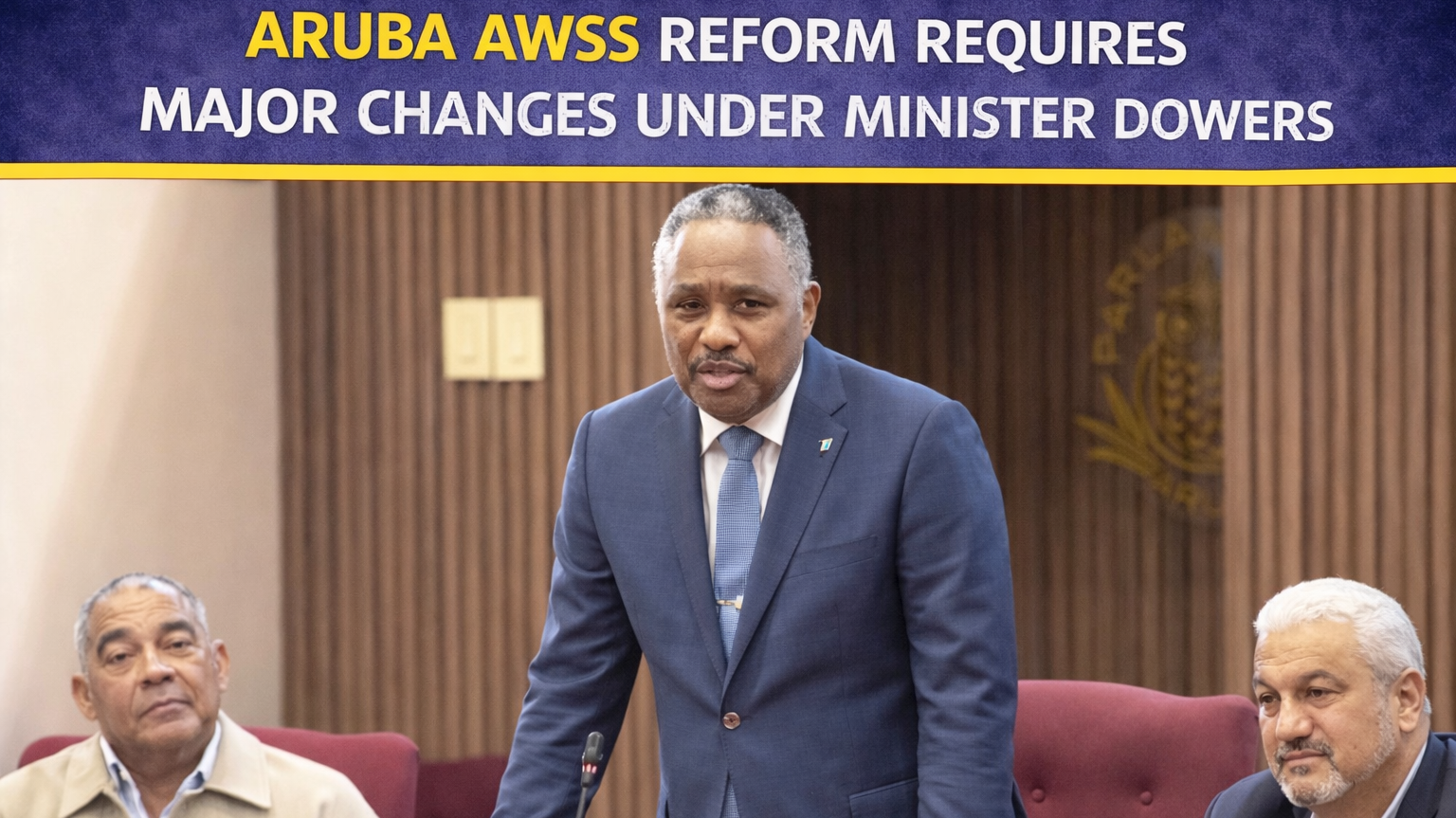
On Monday morning, Minister Arthur Dowers, together with AWSS Director Joseph Everon and CFO Randolph Ruiz, presented Parliament with a detailed update on the situation and progress since taking over management of AWSS.
Upon assuming responsibility, Minister Dowers initiated multiple studies to assess the organization’s condition. These evaluations covered operations, IT systems, human resources, and compliance with corporate governance standards.

The findings revealed significant concerns, including poor management, lack of strategic direction, dependence on a single revenue source, and weak financial oversight. There were also no proper internal controls, whistleblower systems, or ethical compliance structures, increasing risks for the organization.
The Aruba AWSS reform Minister Dowers plan focuses on improving transparency, strengthening governance, and clearly defining roles within the organization. AWSS generates millions annually through ED Card payments from travelers, but these funds were previously mismanaged.
Operationally, the situation in 2024 was critical. Key facilities were functioning below capacity, with Bubali at 35%, Parkietenbos at 0%, Zeewijk at 65%, and the incinerator at 25%. Recent improvements show progress, with Bubali now operating at 65%, Parkietenbos at 90%, and Zeewijk stable at 65%. The incinerator remains at 25% but is addressing a backlog of over a year of medical waste.
Globally, medical waste is expected to be processed within 48 hours, highlighting the scale of the challenge faced by AWSS. To improve capacity, two additional incinerators are expected to be operational soon.
The incinerator plays a critical role beyond medical waste, handling sludge from wastewater treatment, animal remains, confiscated drugs, and sensitive documents from institutions such as the Public Prosecutor and the courts.
Significant investments have also been made in staff training, facility upgrades at Parkietenbos, and transitioning incinerators to use LPG gas instead of diesel.
Minister Dowers expressed satisfaction with the progress made, emphasizing that these reforms are essential to restoring a critical public service that directly impacts public health, the environment, and quality of life in Aruba.