

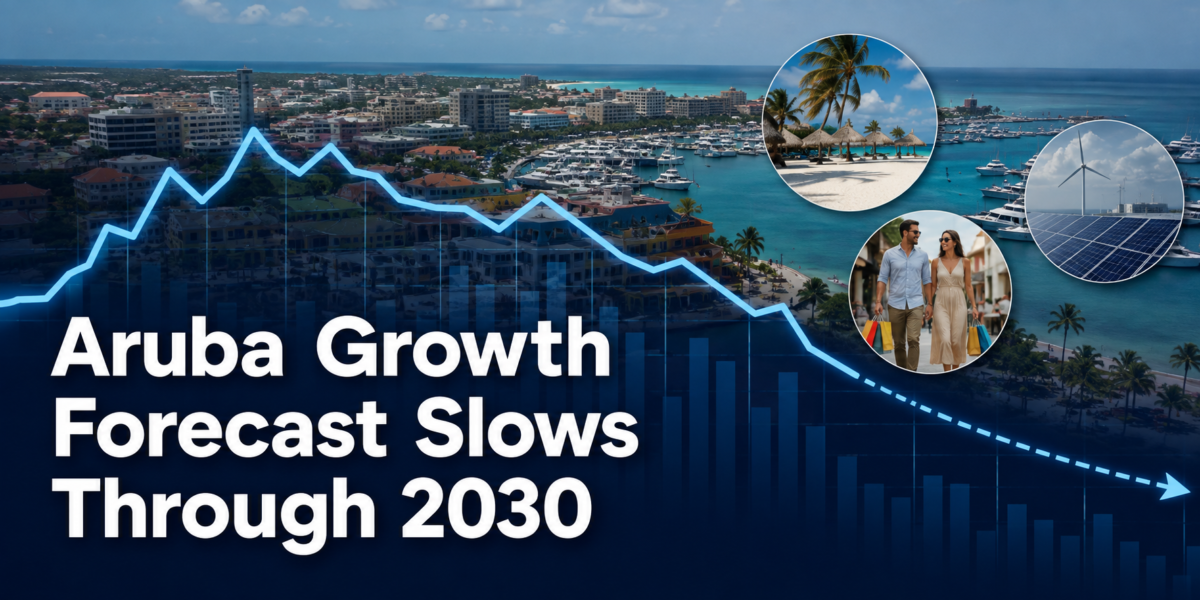
Aruba’s economy is expected to continue growing this year, but at a progressively slower pace through 2030, according to the Central Bank of Aruba’s latest real-sector outlook.
The Aruba economic growth forecast projects real gross domestic product growth of 3.7 percent in 2026 and 2.3 percent in 2027. The forecast then moderates to 2.1 percent in 2028, 1.7 percent in 2029 and 1.0 percent in 2030.
Growth remains positive after strong 2025
The Central Bank estimates that the economy expanded by 6.3 percent in 2025. For 2026, household spending, fiscal stimulus and employment are expected to continue supporting activity. Tourism is also projected to contribute to growth.

At the same time, Aruba’s tight labor market means additional workers may need to be recruited from abroad. The outlook identifies the availability of labor as one factor that could influence how much of the projected growth can be achieved.
Inflation is forecast to rise from 0.1 percent in 2025 to 2.4 percent in 2026 before easing to 1.4 percent in 2027. The projections reflect the bank’s baseline assumptions and may change as international and domestic conditions develop.
Energy prices are a key risk
The Central Bank also modeled an adverse scenario involving elevated oil prices. Under that scenario, economic growth in 2027 could slow to 0.4 percent while inflation could reach 4.9 percent.
Other risks cited in the outlook include changes in tourism demand, global and geopolitical conditions, energy costs, labor constraints, the implementation of investment plans and fiscal policy decisions.
What happens next
The outlook provides a baseline for government, employers and households as they plan for the coming years. Actual results will depend on how Aruba manages capacity constraints and external shocks while carrying out public and private investment.
Source: Information based on the Central Bank of Aruba’s September 2026 Economic Outlook and its English press release.