

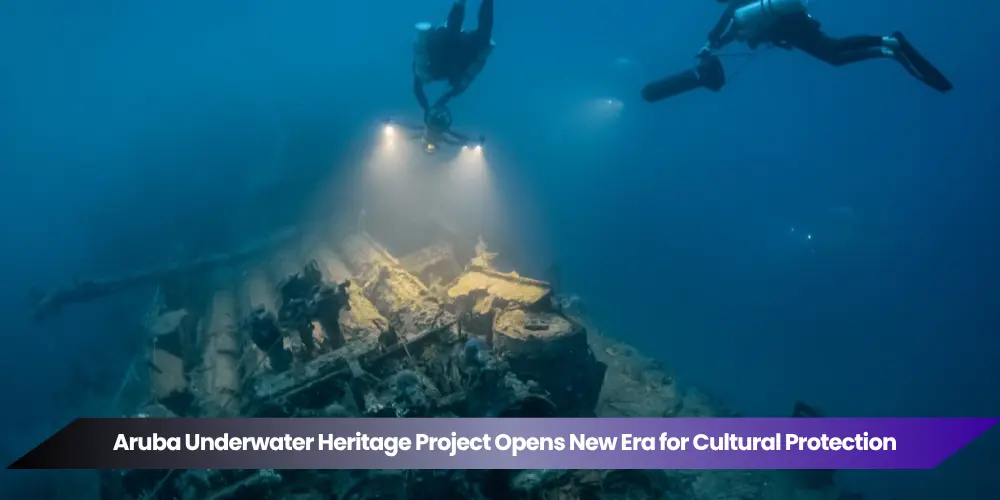
ORANJESTAD, Aruba — Aruba underwater heritage is entering a new phase of research and protection through an international partnership combining local expertise with advanced maritime technology.
Shipwrecks and other cultural remains beneath Aruba’s waters preserve important stories about the island’s maritime history, international trade, migration and wartime events. This month, several organizations are joining forces to identify, document and protect these underwater cultural resources.
The collaboration involves the National Archaeological Museum Aruba (MANA), Imagination for Development and the Nature of Values Aruba (IDNOVA), Aruba Conservation Foundation (ACF) and international maritime research organization Inkfish LLC.

Research Expedition Around Aruba
Harold Kelly of MANA and Oriana Wouters of IDNOVA entered quarantine in Curaçao on August 20 before boarding Inkfish LLC’s research vessel, RV Hydra.
Inkfish supports ocean science through advanced research vessels, innovative mapping technologies and multidisciplinary scientific expeditions.
The research expedition is scheduled to take place from August 25 through September 15, 2026, with surveys planned around Aruba’s coastline.
The mission represents an important new stage in efforts to understand and protect Aruba underwater heritage.
Building on International Training
The project follows specialized training conducted in Aruba in November 2025 by the Cultural Heritage Agency of the Netherlands.
Professionals from the Dutch Caribbean received training based on internationally recognized UNESCO methods for documenting and protecting underwater cultural heritage.
Aruba was represented by MANA archaeologists Harold Kelly and Raymundo Dijkhoff, Shane Thielman of ACF and Oriana Wouters of IDNOVA.
MANA, ACF and IDNOVA later applied that training by documenting underwater cultural heritage in San Nicolas Bay, one of Aruba’s most historically significant maritime areas.
The organizations also conducted a new assessment of the SS Pedernales.
Local divers and community heritage specialists, guided by Anthony Hagedoorn and Lui Samanez, participated at several research locations.
Their involvement helped combine local knowledge with scientific investigation while supporting responsible community archaeology and the transfer of knowledge between generations.
Advanced Technology to Map Historic Sites
The next phase begins with the Inkfish expedition.
Working alongside MANA, the international research team will help locate, map and document Aruba underwater heritage using advanced technology.
The equipment will include high-resolution seabed mapping, 3D imaging and deep-water research systems designed to study areas that may be difficult to examine using conventional methods.
The expedition will also provide hands-on training for local researchers.
This is expected to strengthen Aruba’s ability to manage and protect underwater cultural sites long after the international expedition has ended.
Kelly and Wouters will work directly with the international research team, helping ensure that technical knowledge and practical experience remain available in Aruba for future heritage research and management.
Research Data Will Remain Available to Aruba
A Memorandum of Understanding signed by Minister of Culture Mike Eman ensures that scientific data gathered during the expedition will remain accessible to Aruba.
The information could support future research, educational programs and sustainable management of the island’s underwater cultural resources.
Beyond potential discoveries, organizers say the project represents an investment in Aruba’s future.
The partnership is expected to strengthen national research capacity, inspire future heritage professionals and help preserve Aruba underwater heritage for coming generations.
Throughout the expedition, MANA, IDNOVA and Inkfish LLC plan to share regular updates so the public can follow the research and discoveries taking place beneath Aruba’s surrounding waters.