

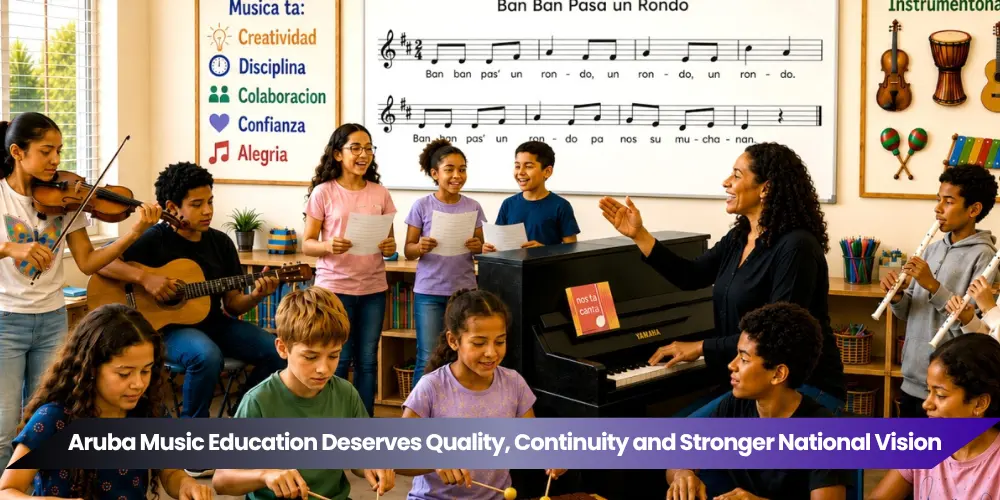
ORANJESTAD, Aruba — Aruba music education should offer every child quality, continuity and a clear long-term vision, according to teacher and musician Johnny Croes, who is calling for a broader discussion about the future of music instruction on the island.
Croes, a cum laude graduate of Berklee College of Music who worked for 22 years at Scol di Musica Rufo Wever, presented his views in an analysis titled “Music Is Part of a Good Education.”
At the heart of his argument is a simple principle: every child in Aruba should have an opportunity to receive high-quality music education.

Croes said music offers benefits that extend far beyond learning notes, rhythm and melody. It can help children develop discipline, creativity, concentration, memory, confidence, perseverance, listening skills and the ability to work with others.
Aruba Already Has a Strong Foundation
According to Croes, Aruba does not need to build its music education system from the beginning.
The island has a long musical and educational history, with generations of children exposed to music through schools and cultural programs.
He pointed to Nos ta Canta as an example of how music has connected education with Papiamento, local culture and Aruban identity.
Aruba also has teachers, musicians, institutions and organizations that have contributed to developing musical talent for many years.
However, Croes believes the discussion must now focus on where Aruba music education should be in 10, 20 or even 30 years.
Aruba already has a national framework for artistic education. The 2017 core objectives for primary education include arts education as one of the areas of student development.
However, the July 2024 Arts and Cultural Education Plan recognizes that parts of this framework need to be updated. The document also identifies inconsistencies in implementation between schools and calls for a new structured learning pathway.
Croes said this shows that improving music education is not simply a personal opinion but an issue already recognized within educational planning.
Access and Quality Must Work Together
Croes stressed that Aruba should not treat access and quality as competing goals.
He believes every child should have access to music while also receiving meaningful, well-structured instruction.
Teacher preparation is an important part of achieving that goal.
The Instituto Pedagogico Arubano includes arts education in its training for primary school teachers, covering music, visual arts, drama and dance.
Croes, however, distinguishes between the role of a general classroom teacher and that of a specialized music teacher.
A classroom teacher must work across many subjects, while a specialist can develop deeper knowledge of rhythm, melody, musical notation, instruments, repertoire, technique, performance and music teaching methods.
Croes argues that schools should not have to choose between the two.
Classroom teachers can integrate music into everyday learning, while specialist teachers can provide a more structured and progressive Aruba music education curriculum.
Cooperation Between Schools and Cultural Sector
Croes also believes stronger cooperation is essential.
Aruba is a small island with limited resources but substantial artistic talent and experience. He argues that this makes coordination between schools, government, educational institutions and the arts and cultural sector especially important.
The 2024 Arts and Cultural Education Plan also identifies insufficient coordination between schools and cultural providers as an area that needs improvement.
It recommends developing more sustainable partnerships between educational institutions and cultural organizations.
Croes also highlighted the role of educational research. He referred to a practical research project presented at IPA in 2026 examining the influence of music among younger primary school students.
Music, Papiamento and Aruban Identity
For Croes, Aruba music education also has a strong cultural dimension.
The Department of Education has recognized the importance of Papiamento within arts and cultural education and the connection between language, art and culture.
Croes said that when children sing in Papiamento, they are doing more than learning a song. They are also learning about language, culture and history.
Music can therefore serve as a bridge connecting education with Aruba’s cultural identity.
Building a Long-Term Music Education Strategy
Croes acknowledged that government does not have to manage every aspect of music education directly.
However, he believes government has an important role in establishing educational frameworks, setting quality standards, supporting teacher training, providing resources and ensuring educational objectives are implemented.
The 2024 plan proposes several steps, including reviewing existing educational objectives, developing a structured arts education curriculum, strengthening teacher training and professional development, considering specialist or certified arts teachers, improving resources and facilities, and expanding cooperation between schools and cultural organizations.
Croes views these proposals as a useful starting point.
He emphasized that Aruba already has history, talent, teachers and experience. The challenge now is to bring those resources together under a stronger and more coordinated vision.
A Shared Goal for Aruba’s Children
Croes said his analysis is not intended to present one solution for every challenge facing music education.
Instead, he hopes to encourage a constructive discussion about how Aruba can provide children with the quality of music education they deserve.
While opinions may differ about how music instruction should be organized, Croes believes there is one principle that can unite the community: every child should have access to quality Aruba music education.
Achieving that goal, he said, will require clear objectives, properly prepared teachers, specialist instructors where necessary, appropriate facilities and materials, continuity, evaluation, research and collaboration.
Croes concluded that as Aruba expands access to music education, quality should remain at the centre of that effort because music is not simply an additional activity for children. It is part of a well-rounded education.
Johnny Croes graduated cum laude from Berklee College of Music and spent 22 years as a teacher and deputy director at Scol di Musica Rufo Wever, where he contributed to curriculum development. He has also written five piano books featuring works by Aruban composers, helped establish and organize the Aruba Symphony Festival, initiated Leerorkest Aruba and currently serves as founder and director of Allegro Piano Studio.