

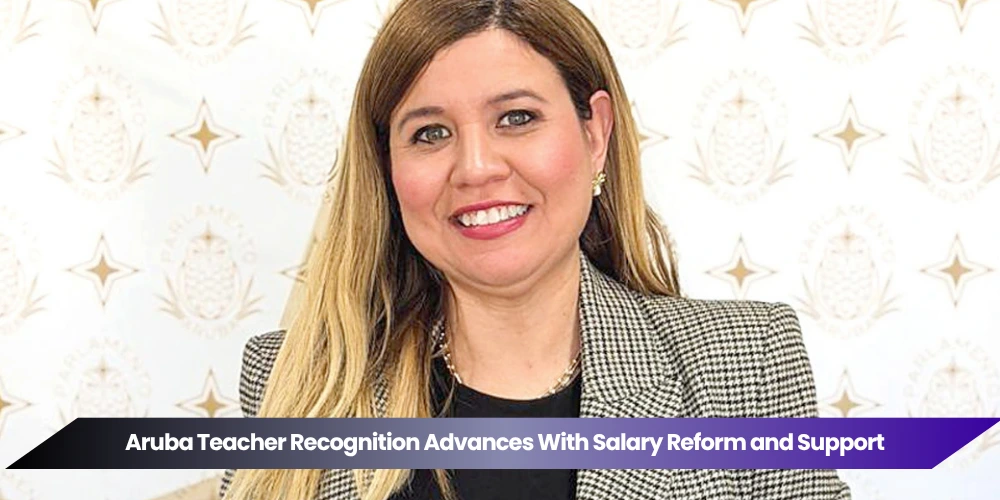
ORANJESTAD, Aruba — Aruba Teacher Recognition should be expressed through concrete improvements as well as words of appreciation, according to AVP parliamentary faction leader Jennifer Arends-Reyes as schools begin the 2026–2027 academic year.
Arends-Reyes wished teachers, students, parents, school directors and other education employees a successful return to the classroom, while placing particular emphasis on the contribution teachers make to Aruba’s future.
She said educators carry a responsibility that extends well beyond classroom hours, including lesson preparation, grading assignments, guiding students and paying attention to their wellbeing.

“Without teachers there is no education, and without education there is no progress,” Arends-Reyes said.
Salary Reform Marks Significant Change
The new academic year begins after the first phase of Aruba’s teacher salary restructuring was approved to take effect from January 1, 2026.
Under the agreement reached by the government and education unions, primary-school teachers on salary scale D13 are to be equalised with secondary-school teachers on scale D34.
Allowances for school directors are also being harmonised at 25%, with the allowance included for pension purposes.
The agreement additionally provides an accelerated procedure for teachers expected to retire within three years so they can benefit from the salary adjustment before leaving the profession.
Arends-Reyes described the reform as evidence that recognition for educators should translate into more equitable compensation.
Reform Followed Talks With Education Unions
The Government of Aruba and unions SIMAR, SEPPA and TOPA signed the Phase 1 letter of intent and commitment in December 2025 after approximately seven months of studies, calculations and consultations.
The process also involved the Directorate of Education, DUOS, the Department of Human Resources and the Department of Finance.
Government described the change as a major step after more than three decades without such a restructuring of teacher compensation.
Arends-Reyes credited dialogue between the AVP-Futuro government and the unions for producing the first phase.
More Work Remains After Phase One
Despite the salary changes, Arends-Reyes said the education reform process cannot stop with compensation.
She identified teacher workload, class sizes, support personnel, professional development, educational materials and the physical condition of school buildings as areas requiring continued attention.
The government has already maintained a policy for the 2026–2027 school year establishing a general maximum of 24 students per class in kindergarten, primary and secondary education.
The Education Ministry says smaller classes are intended to give teachers more opportunities for individual attention while reducing workload and supporting staff wellbeing.
Schools are generally expected to maintain classes between 16 and 24 students, although exceptional circumstances can be discussed with the ministry.
Phase Two Expected to Address Additional Issues
Government plans for Phase 2 of the teacher salary restructuring include simplifying the existing salary system and examining compensation linked with continuing professional development.
The next phase also includes work involving classroom assistants, teacher-support structures and educational models designed for changing classroom needs.
Approximately 98 classroom assistants were specifically identified in the government’s Phase 2 plans, according to the official reform announcement.
Because those studies remain underway, Phase 2 should be presented as planned continuing reform rather than as a completed measure.
Families Receive Additional School Support
Arends-Reyes also highlighted social assistance aimed at helping lower-income families meet back-to-school expenses.
The government recently announced increases in several forms of assistance, including support for school fees and materials.
Officials said the measures are intended to reduce the burden associated with uniforms, supplies, transportation and other education-related expenses for vulnerable families.
Arends-Reyes said financial circumstances should not prevent children from beginning the school year with the materials and support they need.
Teachers Need More Than Appreciation
For Arends-Reyes, improving education requires teachers to feel that government and Parliament listen to their concerns and respond through policy.
She said educators need appropriate working conditions if they are expected to provide high-quality education.
That includes not only salaries but also manageable workloads, sufficient classroom assistance, modern teaching materials, safe school buildings and opportunities to continue developing professionally.
Her comments represent her political assessment of the government’s education programme and the work that remains to be completed.
New School Year Begins With Continuing Reform
As the 2026–2027 school year begins, Aruba’s education sector enters another period in which implementation will determine whether policy changes produce noticeable improvements for teachers and students.
Phase 1 of the compensation restructuring represents a concrete element of Aruba Teacher Recognition, while the next stages will determine how issues involving workload, support staff, professional development and school conditions are addressed.
Arends-Reyes concluded by thanking educators for choosing a profession that directly influences the lives of Aruba’s children and the island’s long-term development.
She also encouraged students to approach the new academic year with enthusiasm, respect their teachers and remain confident in their own abilities.
Her message to the education community was that teacher recognition must continue beyond ceremonial appreciation and be reflected in sustained action throughout the school system.