

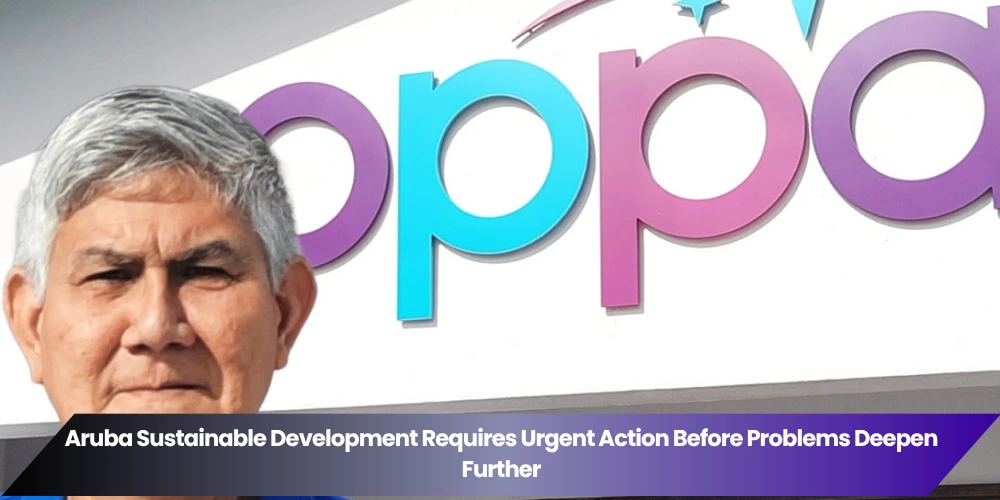
Aruba sustainable development requires a fundamental change in direction before existing economic, environmental and social pressures become more difficult to manage, according to OPPA President Ivo Valdez.
Valdez, president of the Organisacion di Penshonadonan Publico di Aruba, said Aruba has reached a decisive point and that residents are expecting concrete action rather than additional discussions.
He said families across the island are feeling increasing pressure through supermarket prices, pharmacy costs, electricity and water bills, and everyday household expenses.

According to Valdez, the central question facing Aruba is whether the country will continue managing one crisis after another or make a long-term change in direction.
He argued that Aruba’s heavy dependence on tourism, combined with weaknesses in spatial planning, has contributed to several challenges that are now visible in daily life.
These include pressure from high tourism volumes, shortages of affordable housing, ageing infrastructure, environmental degradation and social inequality.
Valdez warned that continuing on the same path could eventually affect both quality of life and economic stability.
National Social Dialogue
OPPA believes the National Social Dialogue should become a practical mechanism through which residents, organizations and decision-makers develop concrete responses to Aruba’s challenges.
Valdez stressed that sustainable development should not be viewed as a luxury but as a necessity for Aruba’s future.
He said hotel and tourism development has placed increasing pressure on traffic, waste management, public infrastructure and the environment.
At the same time, housing has become increasingly difficult to afford for many residents, while Aruba’s labour market remains highly dependent on temporary foreign workers.
OPPA also expressed concern about natural areas being threatened by construction, illegal dumping and insufficient environmental protection.
Five-Year Moratorium on New Hotels
Among OPPA’s recommendations is a moratorium of at least five years on the construction of new hotels.
The organization argues that no additional permits for major tourism developments should be issued until comprehensive studies determine whether Aruba’s infrastructure and ecological capacity can support further growth.
Valdez said future tourism development should be based on evidence and the island’s actual carrying capacity.
National Spatial Planning
OPPA is also calling for a legally enforceable national spatial-development plan.
Such a plan should clearly identify areas intended for nature conservation, housing, agriculture, tourism and industry.
The organization also wants land policy administered through DIP to become more transparent and focused on the broader public interest.
Affordable Housing
Affordable housing should become a national priority, according to OPPA.
Government land should be used to support social housing and homes for middle-income residents.
The organization also proposed measures to limit land speculation involving non-residents, encourage cooperative housing models and provide more opportunities for local developers.
Economic Diversification
Valdez argued that Aruba needs to reduce its dependence on tourism by investing in additional sectors.
OPPA identified renewable energy, including solar and wind power, as an important opportunity.
The organization also supports greater investment in agriculture and food security, information technology, digital services, education and knowledge-based industries.
Infrastructure modernization should form part of this strategy, including improvements to wastewater treatment, stronger waste-management systems, recycling and circular-economy initiatives.
OPPA also called for modern mobility solutions, including better public transportation and safer cycling infrastructure.
Nature and Heritage Protection
Environmental protection forms another major part of OPPA’s recommendations.
The organization wants legally protected zones established for vulnerable natural areas.
It also called for stronger enforcement against illegal construction and pollution.
Investment in environmental management, education and ecotourism could help Aruba protect its natural assets while creating sustainable economic opportunities.
Greater Public Participation
OPPA believes citizens, young people, neighbourhood organizations and civil-society groups should play a greater role in national decision-making.
Transparency, public participation and accountability are essential to building broad support for major policy changes, according to the organization.
Valdez said sustainable development does not necessarily mean reducing economic growth.
Instead, it should mean better-planned, fairer and more future-oriented growth.
He argued that Aruba has the potential to become an example for the Caribbean if the country acts with vision, courage and responsibility.
OPPA said political decision-making should look beyond the next election and prioritize a long-term balance between people, nature and the economy.
Valdez warned that the National Social Dialogue should not become another exercise in speeches and promises without implementation.
According to OPPA, Aruba sustainable development now requires decisions that place residents first, protect the island’s natural resources and create a more secure future for coming generations.