
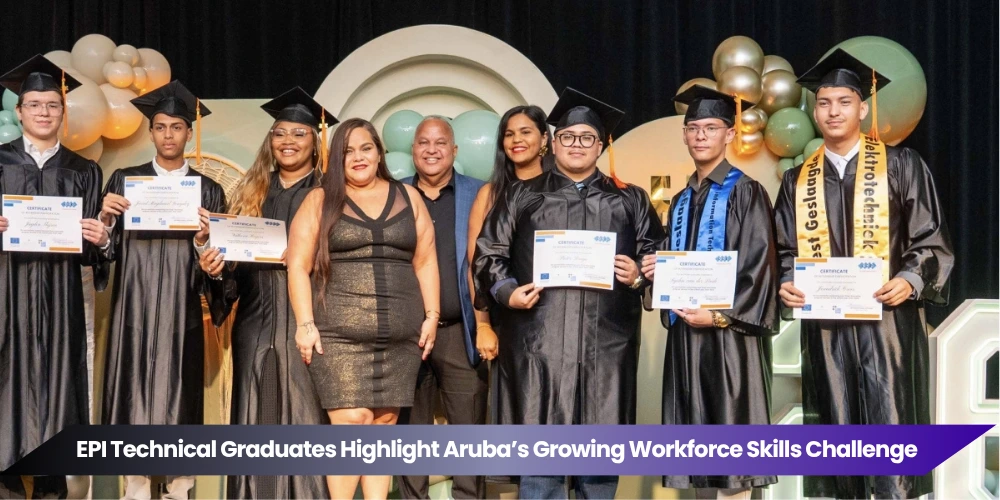
ORANJESTAD, Aruba — EPI Technical Graduates celebrated the successful completion of their studies as Minister Gervais René Herdé called for greater investment in technical education and stronger connections between schools and Aruba’s labour market.
Herdé attended the official graduation ceremony for Colegio EPI’s Science and Technology Unit, where a new group of trained professionals completed an important stage of their education.
He congratulated the graduates for their perseverance, dedication and commitment throughout their programmes.

Graduates Expected to Help Build Aruba’s Future
During his address, Herdé described the graduates as future engineers and technicians who will help shape and lead Aruba’s development.
He said their technical knowledge will be important for maintaining and improving the island’s infrastructure, economy and communities.
Technical professionals can contribute across fields including electrical engineering, information technology, construction, telecommunications, maintenance and industrial services.
Herdé encouraged the graduates to view their diplomas as the beginning of a new professional chapter rather than the end of their learning.
Technical Programmes Face Recruitment Challenge
The minister also highlighted what he described as a continuing difficulty in attracting enough students to technical study programmes.
He said demand for qualified professionals is growing, making it important for educational institutions to present technical careers as modern, valuable and attractive options for young people.
Herdé encouraged Colegio EPI to continue exploring innovative ways to generate interest in science, technology and technical professions.
This could include practical demonstrations, school-industry partnerships, career information and greater exposure to the types of employment available after graduation.
His remarks represented an assessment of the challenges facing technical education. The announcement did not include enrolment figures comparing technical programmes over multiple academic years.
Internships Connect Education With Employment
Herdé placed particular emphasis on cooperation between educational institutions and employers.
He said internships provide students with valuable practical experience and help prepare them for the expectations of a professional workplace.
Classroom education gives students theoretical and technical knowledge, while workplace placements allow them to apply that knowledge in real situations.
Internships can also help students develop communication, teamwork, punctuality, problem-solving and professional responsibility.
Closer cooperation with employers may make the transition from school to work easier while ensuring that technical programmes remain responsive to Aruba’s changing labour-market needs.
International Placements Recognised
Students who completed international practical placements in Ireland, Belgium and Curaçao received certificates during the graduation ceremony.
These placements allowed participants to experience different workplaces, technologies and professional cultures.
International experience can broaden a student’s knowledge and help graduates adapt to an increasingly competitive labour market.
Participants can also bring ideas and methods learned abroad back to Aruba as they begin their careers or continue their education.
Modern Professionals Need More Than Technical Knowledge
Herdé said modern education should not focus exclusively on transferring technical information.
Graduates also need to think critically, analyse situations, develop creative ideas and solve complex problems.
These abilities become particularly important when technology, equipment and workplace requirements continue changing.
A technician may understand how a system normally operates but must also be able to identify the cause of unexpected problems and select an appropriate solution.
The minister said education must therefore develop both practical expertise and the broader thinking skills expected from future professionals.
Top Students Receive Recognition
The ceremony included recognition for students who delivered outstanding academic performances.
A separate Government of Aruba recognition of the island’s leading 2026 graduates identified Jeandrick Croes as EPI Science and Technology’s top Electrical Engineering graduate and Jaquan Geerman as its leading ICT graduate.
Awards for strong performance can encourage students to maintain high standards while acknowledging the time, discipline and effort required to complete technical programmes successfully.
The graduation event also recognised the contributions of families, instructors, mentors and EPI employees who supported the students throughout their education.
EPI Recorded 282 Graduates Across All Units
Colegio EPI reported that 282 students graduated across its different programmes during the 2025–2026 academic year.
The institution said this represented an overall completion rate of approximately 70% among students who reached the end of their study programmes.
Those graduates came from units covering economics, health and services, science and technology, and hospitality and tourism.
The Science and Technology graduates form part of that larger group of new professionals preparing to enter employment, continue specialised training or pursue higher education.
EPI Encouraged to Remain Technical-Education Leader
Herdé called on EPI to continue positioning its Science and Technology Unit as a leading institution for technical education in Aruba.
He said the unit should remain focused on innovation, educational quality and programmes responding to the needs of the country and its employers.
Maintaining that position will require regular communication with industries employing technical graduates.
Employers can help educational institutions identify emerging technologies, skills shortages and areas where programmes may require updates.
Schools can then adjust training while ensuring that education remains broad enough to support long-term career development.
Technical Talent Supports National Development
Aruba relies on qualified professionals to operate and maintain essential infrastructure and services.
Locally trained technicians can support the island’s electricity, telecommunications, construction, digital systems, transportation and other technical sectors.
Developing more local expertise may also give young residents clearer career pathways and improve the availability of qualified workers for employers.
However, building that workforce requires sustained interest from students, suitable training facilities, experienced instructors and sufficient internship opportunities.
Graduates Begin New Professional Chapter
At the conclusion of the ceremony, Herdé read the official graduation declaration, symbolically confirming that the students had completed their programmes and were ready to begin the next stage of their lives.
The Government of Aruba congratulated the graduates, their families, educators, mentors and Colegio EPI personnel.
The graduation of the latest EPI Technical Graduates celebrates individual academic success while highlighting the continuing need to attract young people into technical careers.
Herdé said investment in technical education, innovation and local talent remains essential for creating a stronger, more competitive Aruba prepared for future economic and technological challenges.